Home
Class 12
PHYSICS
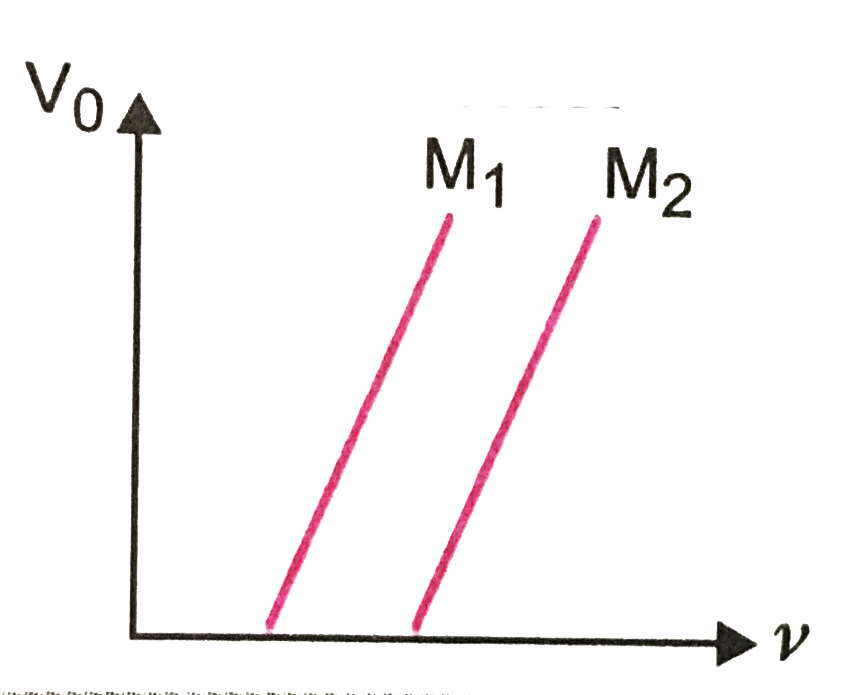
fig. shows variation of stopping potenti...

fig. shows variation of stopping potential `(V_0)` with frequency (v) for two photosenstive matrials `M_1 and M_2`.

(i) why is the slope same for both lines?
(ii) For which material will the emitted electrons have greater kinetic energy for the incident radiations of the same frequency? Justify your answer.

Text Solution

Verified by Experts

(i) From photoelectric equation, we have
`eV_0-hv-phi_0 or V_0=(hv)/e-(phi_0)/e`
It is an equation of straight line with slope h/e (=constant). It means the slope metals `V_0-v` graph
(=h/e) is same for both metals `M_1 and M_2`.
(ii) Also, `K_(max)=hv-hv_0`. For the given frequency of incident light, the smaller is the value of `v_0`, the larger is the value of `K_(max)` and vice versa. Since material `M_1` has lower value of threshold frequency `v_0`, so metal `M_1` will emit photoelectrons of greater K.E.
Promotional Banner

Topper's Solved these Questions

  • DUAL NATURE OF RADIATION AND MATTER

    PRADEEP|Exercise NCERT Exerciese question|1 Videos
  • DUAL NATURE OF RADIATION AND MATTER

    PRADEEP|Exercise Short answer|1 Videos
  • CURRENT ELECTRICITY

    PRADEEP|Exercise Problems for Practice (B)|2 Videos
  • ELECTROMAGNETIC INDUCTION & ALTERNATING CURRENT

    PRADEEP|Exercise Multiple Choice Questions|1 Videos

Similar Questions

Explore conceptually related problems

Fig. shows the variation of stopping potential V_0 with the frequency v of the incident radiation for two photosenstive metal P and Q: (i) Explain which metal has smaller threshold wavelength (ii) Explain, giving reason, which metal emits photoelectrons having smaller kinetic energy, for the same wavelength of incident radiation. (iii) If the distance between the light source and metal P is doubled, how will the stopping potential change.

The following graph shows the variation of stopping potential V_0 with the frequency v of the incident radiation for two photosensitive metals X and Y. (i) Which metal has larger threshold wavelength ? Give reason. (ii) Explain giving reason , which metal gives out electrons , having larger kinetic energy , for same wavelength of the incident radiation. (iii) If the distance between the light source and metal X is halved , how will the kinetic energy of electrons emitted from it change ? Given reason.

The graph shows variation of stopping potential V_(0) versus frequency of incident radiation v for two photosensitive metals A and B . Which of two metals has higher threshold frequency and why?

Figure show the variation of the stopping potential (V_(0)) with the frequency (v) of the incident radiations for two different photosensitive matererial M_(1) and M_(2) What are the values of work functions for M_(1) and M_(2) respectively

The figure shows the variation of stopping potential V_(Q) with the frequency v of the incident radiations for two photosensitive metals P and Which metal has smaller threshold wavelength ? Justify your answer.

Ultraviolet light is incident on two photosenstive materials having work functions phi_1 and phi_2 (phi_1 gt phi_2) . In which case will the K.E. of the emitted electrons be greater ? Why ?

Sketch the graphs, showing the variation of stopping potential V_s with frequency v of the incident radiations for two photosensitive materials A and B having threshold frequencies v_0gtv'_0 respectively. (i) which of the two metals A or B has higher work function? (ii) What information do you get from the slope of the graphs? (iii) What does the value of the intercept of graph A on the potential axis represent?

Two masses M_1 & M_2 have same kinetic energy. If V_2 = 2V_1 , then find ratio of their momentum

PRADEEP-DUAL NATURE OF RADIATION AND MATTER-Exercise
  1. fig. shows variation of stopping potential (V0) with frequency (v) for...

    Text Solution

    |

  2. The photoelectric effect can be explained on the basis of

    Text Solution

    |

  3. Which of the following has minimum stopping potential?

    Text Solution

    |

  4. When radiation is incident on a photoelectron emitter, the potential i...

    Text Solution

    |

  5. Two photons, each of energy 2.5 eV are simultaneously incident on the ...

    Text Solution

    |

  6. The maximum velocity of an electron emitted by light of wavelength lam...

    Text Solution

    |

  7. The photoelectric work function for a metal surface is 4.125 eV. The c...

    Text Solution

    |

  8. The slope of frequency of incident light and stopping potential for a ...

    Text Solution

    |

  9. Threshold wavelength for a metal having work function w(0) is lambda. ...

    Text Solution

    |

  10. The work function for metals A , B and C are respectively 1.92 eV , 2....

    Text Solution

    |

  11. The wavelength of the matter wave is independent of

    Text Solution

    |

  12. If E(1), E(2), E(3), E(4) are the respective kinetic energies of elect...

    Text Solution

    |

  13. What is de-Broglie wavelength assciated with electron moving under a ...

    Text Solution

    |

  14. The minimum energy required by an electron to..........form the metal ...

    Text Solution

    |

  15. The maximum kinetic energy of emitted photoelectrons depends on the......

    Text Solution

    |

  16. The ratio of number of photoelectrons ejected to the number of the pho...

    Text Solution

    |

  17. For given photosenstive material, the photoelectric current is...........

    Text Solution

    |

  18. An increase in the frequency of the incident light.............the vel...

    Text Solution

    |

  19. The minimum energy required to ejected an electron from the surface of...

    Text Solution

    |

  20. In photoelectric effect the energy of the free electron does not depen...

    Text Solution

    |

  21. Photon is not a..........but it is a.......... .

    Text Solution

    |
