Home
Class 12
PHYSICS
A mercury lamp is a convenient souce for...

A mercury lamp is a convenient souce for studying frequency dependence of photoelectric emission, since it gives a number of spectral lines ranging from the UV to the end of the red vissible spectrum. In our experiment with rubidium photocell, the following lines from a mercury source were used: `lambda_(1)=3650A^(@), lambda_(2)=4047A^(@), lambda_(3)=4358A^(@), lambda_(4)=5461A^(@), lambda_(5)=6907A^(@)` The stopping voltages, respectively were measured to be:
`V_(01)=1.28V, V_(02)=0.95V, V_(03)=0.74V, V_(04)=0.16V, V_(05)=0V`.
(a) Determine the value of Planck's constant h.
(b) Estimate the threshold frequency and work function for the material.

Text Solution

Verified by Experts
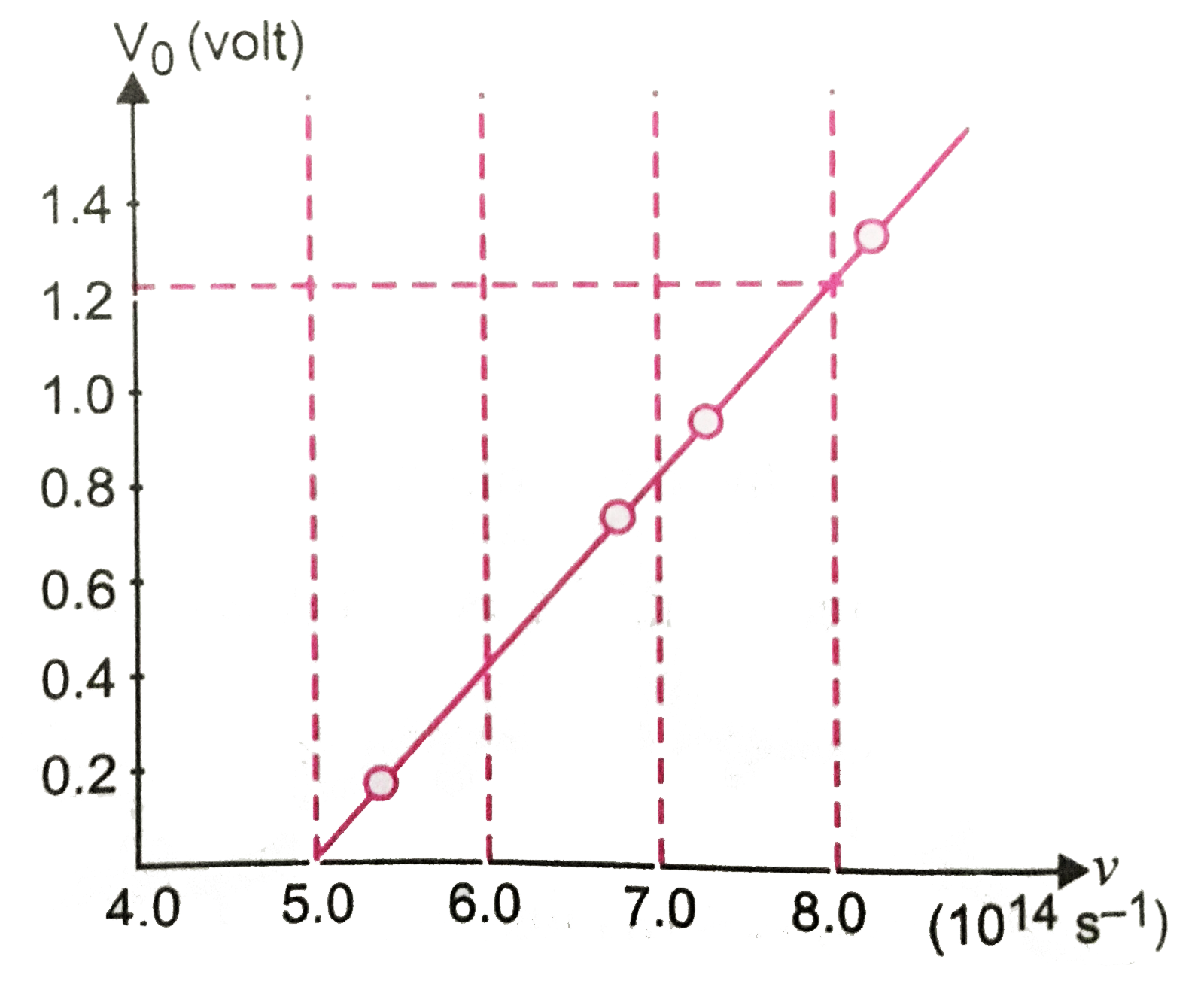
(a) `v_(1)=c/(lambda_(1))=(3xx10^(8))/(3650xx10^(-10))=8.219xx10^(14)Hz, v_(2)=c/(lambda_(2))=(3xx10^(8))/(4040xx10^(-10))=7.412xx10^(14)Hz`,
`v_(3)=c/(lambda_(3))=(3xx10^(8))/(4358xx10^(-10))=6.884xx10^(14)Hz, v_(4)=c/(lambda_(4))=(3xx10^(8))/(5461xx10^(-10))=5.493xx10^(14)Hz`,
`v_(5)=c/(lambda_(5))=(3xx10^(8))/(6907xx10^(-10))=4.343xx10^(14)Hz` we know that, `eV_(0)=hv-phi_(0) or V_(0)=(hv)/e-(phi_(0))/e`
Hence a graph between frequency v and stopping potential `V_(0)`, must be a straght line. On plotting a graph between given frequencies v and corresponding values of stopping potential `V_(0)`, we get a straight line with first four points. This straight line is cutting v-axis at `5.0xx10^(14)Hz`. The fifth point comes in the range of `vltv_(0)`, which shows there is no photoelectric emission and hence no stopping is required to stope be current. From graph fig. The slope of this straight line,
`h/e=(V_(01)-V_(04))/(v_(1)-v_(4))=((1.28-0.16))/((8.219-5.493)xx10^(14))`
or `h=(1.12xx1.6xx10^(-19))/(2.726xx10^(14)) =6.574xx10^(-34)Js`
(b) Work function of metal, `phi_(0)=hv_(0)=6.574xx10^(-34)xx5xx10^(14)=32.870xx10^(-20)J=2.05eV`
Promotional Banner

Topper's Solved these Questions

  • DUAL NATURE OF RADIATION AND MATTER

    PRADEEP|Exercise NCERT Exerciese question|1 Videos
  • DUAL NATURE OF RADIATION AND MATTER

    PRADEEP|Exercise Short answer|1 Videos
  • CURRENT ELECTRICITY

    PRADEEP|Exercise Problems for Practice (B)|2 Videos
  • ELECTROMAGNETIC INDUCTION & ALTERNATING CURRENT

    PRADEEP|Exercise Multiple Choice Questions|1 Videos

Similar Questions

Explore conceptually related problems

A photon of frequency v causes photo electric emission from a surface with threshold frequency v_(0) . The de-Broglies wavelength (lambda) of the photo electron emitted is given by:

The stopping potential are V_(1) and V_(2) . Calculate the (V_(1)-V_(2)) , if the lambda_(1) and lambda_(2) are wavelength of incident lights, respectively.

Derive the equations v = n lambda , where n and lambda are frequency and wavelength .

If V_(1) and V_(2) are veloctities of light in two different media, then the ratio of wavelength of light in the same media (lambda_(1))/(lambda_(2))=

If lambda_v, lambda_x and lambda_m represents the wavelength of visible light X-ray and microwave respectively then :

PRADEEP-DUAL NATURE OF RADIATION AND MATTER-Exercise
  1. A mercury lamp is a convenient souce for studying frequency dependence...

    Text Solution

    |

  2. The photoelectric effect can be explained on the basis of

    Text Solution

    |

  3. Which of the following has minimum stopping potential?

    Text Solution

    |

  4. When radiation is incident on a photoelectron emitter, the potential i...

    Text Solution

    |

  5. Two photons, each of energy 2.5 eV are simultaneously incident on the ...

    Text Solution

    |

  6. The maximum velocity of an electron emitted by light of wavelength lam...

    Text Solution

    |

  7. The photoelectric work function for a metal surface is 4.125 eV. The c...

    Text Solution

    |

  8. The slope of frequency of incident light and stopping potential for a ...

    Text Solution

    |

  9. Threshold wavelength for a metal having work function w(0) is lambda. ...

    Text Solution

    |

  10. The work function for metals A , B and C are respectively 1.92 eV , 2....

    Text Solution

    |

  11. The wavelength of the matter wave is independent of

    Text Solution

    |

  12. If E(1), E(2), E(3), E(4) are the respective kinetic energies of elect...

    Text Solution

    |

  13. What is de-Broglie wavelength assciated with electron moving under a ...

    Text Solution

    |

  14. The minimum energy required by an electron to..........form the metal ...

    Text Solution

    |

  15. The maximum kinetic energy of emitted photoelectrons depends on the......

    Text Solution

    |

  16. The ratio of number of photoelectrons ejected to the number of the pho...

    Text Solution

    |

  17. For given photosenstive material, the photoelectric current is...........

    Text Solution

    |

  18. An increase in the frequency of the incident light.............the vel...

    Text Solution

    |

  19. The minimum energy required to ejected an electron from the surface of...

    Text Solution

    |

  20. In photoelectric effect the energy of the free electron does not depen...

    Text Solution

    |

  21. Photon is not a..........but it is a.......... .

    Text Solution

    |

