Home
Class 12
PHYSICS
Consider an electron in front of metalli...

Consider an electron in front of metallic surface at a distance d (treated as an infinite plane surface). Assume the force of attraction by the plate is given as `1/4 (q^(2))/(4pi in_(0)d^(2))`.
Calculate work in taking the charge to an infinite distance from the plate. Taking d=0.1nm, find the work done in electron volts. [Such a force law is not valid for d lt 0.1nm].

Text Solution

Verified by Experts
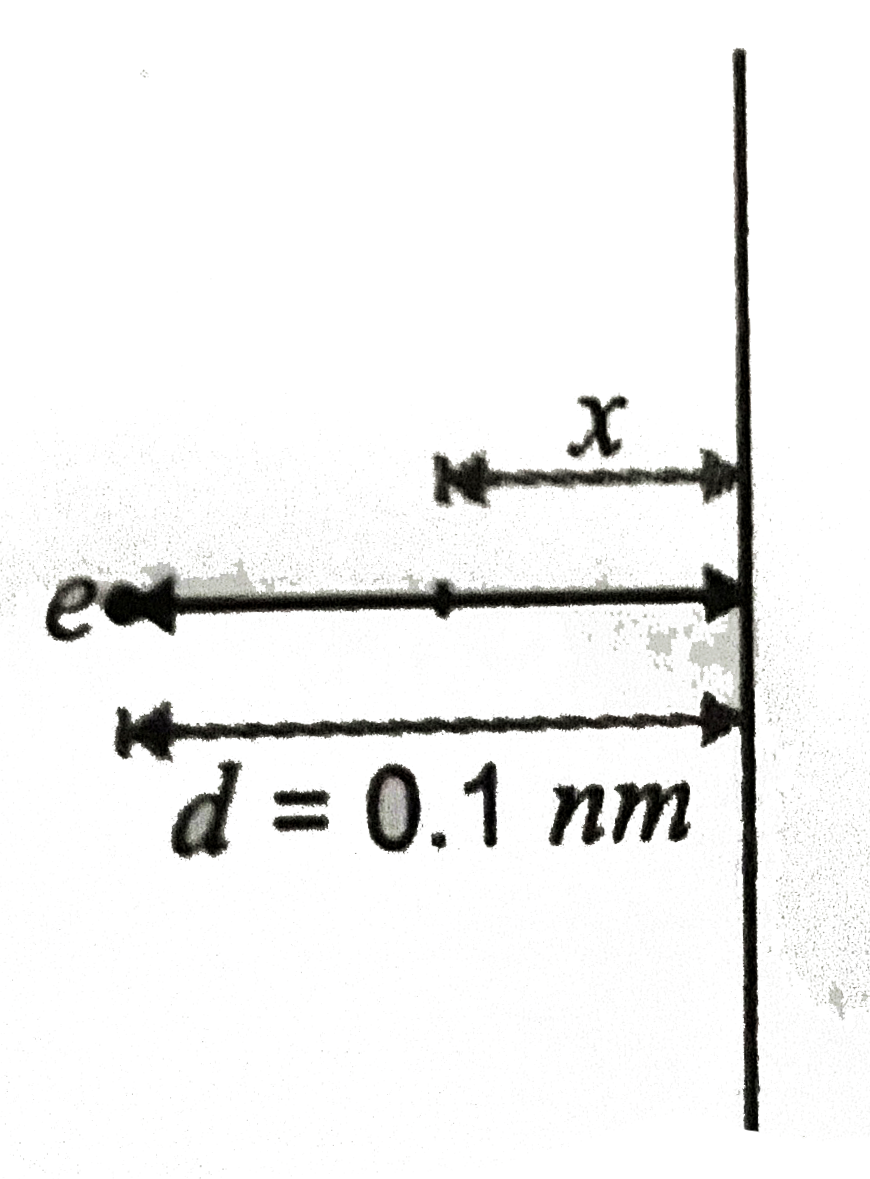
`d=0.1nm =10^(-10)m , F=(q^(2))/(4xx4pi in_(0)d^(2))`
Let the electron be at distance x from metallic surface. Then force of attraction on it is
`F_(x)=(q^(2))/(4xx4pi in_(0)x^(2))`
Work done by an external agency for a displacement dx against the force of attraction `F_(x)` is,
`dW=F_(x)dx`
Total workdone by external agency in taking the electron from distance d to infinity is
`W=int_(d)^(oo)F_(x)dx=int_(d)^(oo) (q^(2) dx)/(4xx4pi in_(0)x^(2))=(q^(2))/(4xx4pi in_(0))[1/d]`
`=((1.6xx10^(-19))^(2)xx9xx10^(9))/(4xx10^(-10))J=((1.6xx10^(-19))^(2)xx(9xx10^(9)))/((4xx10^(-10))xx(1.6xx10^(-19)))eV=3.6eV`
Promotional Banner

Topper's Solved these Questions

  • DUAL NATURE OF RADIATION AND MATTER

    PRADEEP|Exercise NCERT Exerciese question|1 Videos
  • DUAL NATURE OF RADIATION AND MATTER

    PRADEEP|Exercise Short answer|1 Videos
  • CURRENT ELECTRICITY

    PRADEEP|Exercise Problems for Practice (B)|2 Videos
  • ELECTROMAGNETIC INDUCTION & ALTERNATING CURRENT

    PRADEEP|Exercise Multiple Choice Questions|1 Videos

Similar Questions

Explore conceptually related problems

A charge Q is fixed at a distance d in front of an infinite metal plate. The lines of force are represented by

A charge + Q is fixed at a distance d in front of an infinite metal plate. Draw the lines of force indicating the directions clearly.

The p.d between two plates separated by a distance of 1 mm is 100V .The force on an electron placed in between the plates is

Consider a fixed charge Q and another charge q is placed at a distance x_(0) from Q on a smooth plane surface. Find the velocity of charge q as a function of x. [[(Qq)/(2pi in_(0)m){(1)/(x_(0))-(1)/(x)}]^(1/2)]

The plates of a parallel plate capacitance 1.0 F are separated by a distance d =1 cm. Find the plate area .

A capacitor is given a charge q . The distance between the plates of the capacitor is d . One of the plates is fixed and the other plate is moved away from the other till the distance between them becomes 2d . Find the work done by the external force.

Two identical metal plates each having surface area A, having charges q_1 and q_2 , are placed facing each other at a separation d. Find the charge appearing on surface (1),(2),(3), and (4). Assume the size of the plate is much larger than the separation between the plates.

Five identical plates each of area A are joined as shown in the figure. The distance between the plates is d. The plates are connected to a p.d. of V volts . The charges on plates 1 and 4 will be

Show that the force of attraction between two short magnets of moment m and m' with their centres d distance apart and their axes in the same direction along the same lines is (mu_(0))/(4pi) (6mm')/(d^(4))

PRADEEP-DUAL NATURE OF RADIATION AND MATTER-Exercise
  1. Consider an electron in front of metallic surface at a distance d (tr...

    Text Solution

    |

  2. The photoelectric effect can be explained on the basis of

    Text Solution

    |

  3. Which of the following has minimum stopping potential?

    Text Solution

    |

  4. When radiation is incident on a photoelectron emitter, the potential i...

    Text Solution

    |

  5. Two photons, each of energy 2.5 eV are simultaneously incident on the ...

    Text Solution

    |

  6. The maximum velocity of an electron emitted by light of wavelength lam...

    Text Solution

    |

  7. The photoelectric work function for a metal surface is 4.125 eV. The c...

    Text Solution

    |

  8. The slope of frequency of incident light and stopping potential for a ...

    Text Solution

    |

  9. Threshold wavelength for a metal having work function w(0) is lambda. ...

    Text Solution

    |

  10. The work function for metals A , B and C are respectively 1.92 eV , 2....

    Text Solution

    |

  11. The wavelength of the matter wave is independent of

    Text Solution

    |

  12. If E(1), E(2), E(3), E(4) are the respective kinetic energies of elect...

    Text Solution

    |

  13. What is de-Broglie wavelength assciated with electron moving under a ...

    Text Solution

    |

  14. The minimum energy required by an electron to..........form the metal ...

    Text Solution

    |

  15. The maximum kinetic energy of emitted photoelectrons depends on the......

    Text Solution

    |

  16. The ratio of number of photoelectrons ejected to the number of the pho...

    Text Solution

    |

  17. For given photosenstive material, the photoelectric current is...........

    Text Solution

    |

  18. An increase in the frequency of the incident light.............the vel...

    Text Solution

    |

  19. The minimum energy required to ejected an electron from the surface of...

    Text Solution

    |

  20. In photoelectric effect the energy of the free electron does not depen...

    Text Solution

    |

  21. Photon is not a..........but it is a.......... .

    Text Solution

    |

