Home
Class 12
PHYSICS
Find the acceleration of the body of mas...

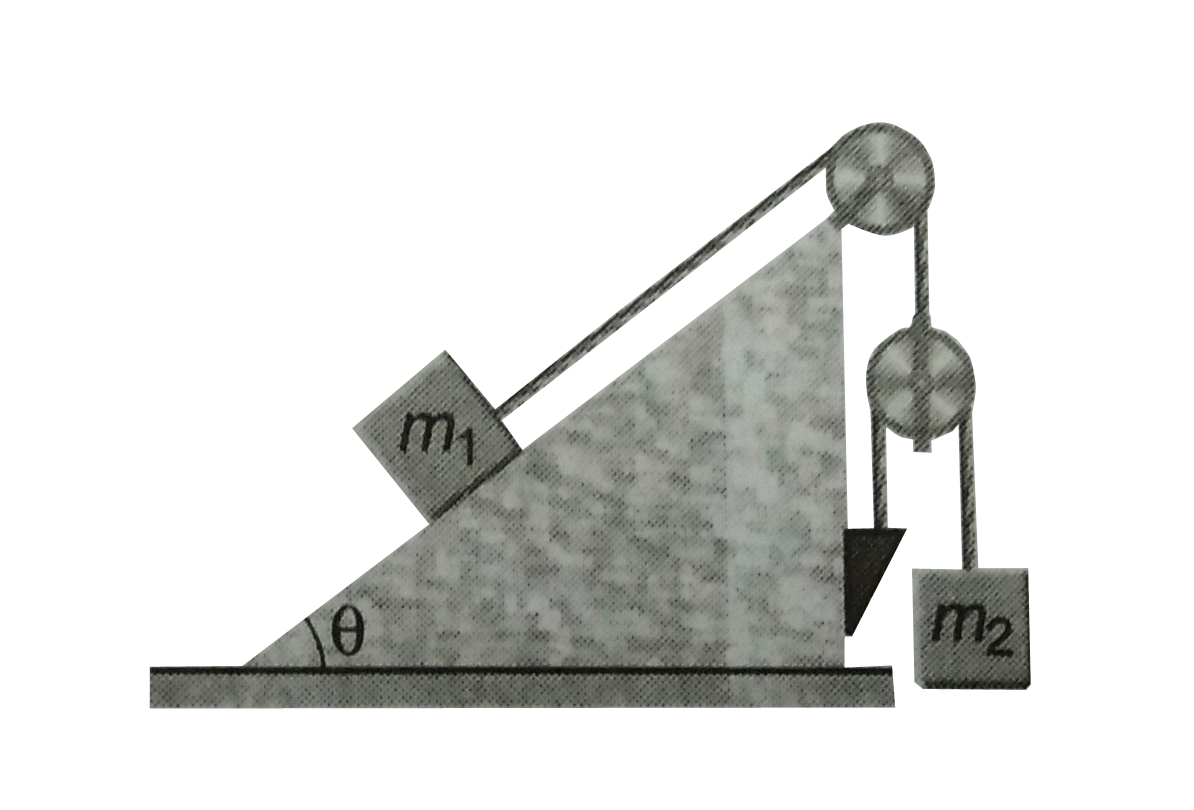
Find the acceleration of the body of mass `m_(2)` in the arrangement shown in figure. If the mass`m_(2)` is `eta` time great as the mass `m_(1)` and the angle that the inclined plane forms with the horizontal is equal to `theta`. The masses of the pulley and threads, as well as the friction, are assumed to be negligible.

Text Solution

Verified by Experts

Let us write Newton's second law for both, bar 1 and body 2 in terms of projection having taken the positive direction of `x_1` and `x_2` as shown in the figure and assuming that body 2 starts sliding, say, upward along the incline
`T_1-m_1gsin alpha=m_1w_1` (1)
`m_2g-T_2=m_2w` (2)
For the pulley, moving in vertical direction from the equation `F_x=mw_x`
`2T_2-T_1=(m_P)w_1=0`
(as mass of the pulley `m_P=0`)
or `T_1=2T_2` (3)
As the length of the threads are constant, the kinematical relationship of accelerations becomes
`w=2w_1` (4)
Simultaneous solutions of all these equations yields:
`w=(2g(2m_2/m_1-sin alpha))/((4m_2/m_1+1))=(2g(2eta-sin alpha))/((4eta+1))`
As `etagt1`, w is directed vertically downward, and hence in vector from
`vecw=(2vec(g)(2eta-sin alpha))/(4eta+1)`
Promotional Banner

Topper's Solved these Questions

  • PHYSICAL FUNDAMENTALS OF MECHANICS

    IE IRODOV, LA SENA & SS KROTOV|Exercise Laws Of Conservation Of Energy, Momentum And Angular Momentum|82 Videos
  • PHYSICAL FUNDAMENTALS OF MECHANICS

    IE IRODOV, LA SENA & SS KROTOV|Exercise Universal Gravitation|34 Videos
  • PHYSICAL FUNDAMENTALS OF MECHANICS

    IE IRODOV, LA SENA & SS KROTOV|Exercise Relativistic Mechanics|49 Videos
  • OSCILLATIONS AND WAVES

    IE IRODOV, LA SENA & SS KROTOV|Exercise Electromagnetic Waves, Radiation|36 Videos
  • THERMODYNAMICS AND MOLECULAR PHYSICS

    IE IRODOV, LA SENA & SS KROTOV|Exercise Transport Phenomena|38 Videos

Similar Questions

Explore conceptually related problems

Find the acceleration of the body of mass m_(2) in the arrangement shown in figure. If the mass m_(2) is eta time great as the mass m_(1) and the angle that the inclined plane forms with the horizontal is equal to theta . The masses of the pulley and threads, as well as the friction, are accumed to be negligible.

Find the acceleration of the prism of mass M and that of the bar of mass m shown in figure.

Find the acceleration of the block of mass m in the arrangement shown in the following figures. The masses of the pulleys and the threads, as well as the friction are assumed to be negligible.

The following parameters of the arrangement of figure are available: the angle alpha which the inclined plane forms with the horizontal, and the coefficient of friction k between the body m_1 and the inclined plane. The masses of the pulley and the threads, as well as the friction in the pulley, are negligible. Assuming both bodies to be motionless at the initial moment, find the mass ratio m_2//m_1 at which the body m_2 (a) starts coming down, (b) starts going up, (c) is at rest.

Find the accelerations of rod A and wedge B in the arrangement shown in figure if the ratio of the mass of the wedge to that of the rod equals eta , and the friction between all contact surfaces is negligible.

In the arrangement shown in figure the masses m of the bar and M of the wedge, as well as the wedge angle alpha , are known. The masses of the pulley and the thread are negligible. The friction is absent. Find the acceleration of the wedge M.

In the arrangement shown in the figure, the blocks have masses 3m,m and 2m , the friction is absent, the masses of the pulleys and the threads are negligible. Find the acceleration of mass 3m .

In terms of masses m_(1),m_(2) and g, find the acceleration of both the blocks shown in Fig. Neglect all friction and masses of the pulley.

In the arrangement shown in fig the bodies have masses m_(0), m_(1) and m_(2) the friction is absent the masses of pulleys and the threads are negligible find the acceleration of the body m_(1)

IE IRODOV, LA SENA & SS KROTOV-PHYSICAL FUNDAMENTALS OF MECHANICS-The Fundamental Equation Of Dynamics
  1. A horizontal plane with the coefficient of friction k supports two bod...

    Text Solution

    |

  2. A pulley fixed to the ceiling of an elevator car carries a thread whos...

    Text Solution

    |

  3. Find the acceleration of the body of mass m(2) in the arrangement show...

    Text Solution

    |

  4. In the arrangement shown in figure the bodies have masses m0, m1, m2, ...

    Text Solution

    |

  5. In the arrangement shown in fig., mass of the rod M exceeds the mass m...

    Text Solution

    |

  6. In the arrangement shown in figure the mass of the ball is eta times a...

    Text Solution

    |

  7. In the arrangement shown in figure the mass of body 1 is eta=4.0 times...

    Text Solution

    |

  8. Find the accelerations of rod A and wedge B in the arrangement shown i...

    Text Solution

    |

  9. In the arrangement shown in figure the masses of the wedge M and the b...

    Text Solution

    |

  10. What is the minimum acceleration with which bar A (figure) should be s...

    Text Solution

    |

  11. Prism 1 with bar 2 of mass m placed on it gets a horizontal accelerati...

    Text Solution

    |

  12. Prism 1 of mass m1 and width angle alpha (see figure) rests on a horiz...

    Text Solution

    |

  13. In the arrangement shown in figure the masses m of the bar and M of th...

    Text Solution

    |

  14. A particle of mass m moves along a circle of radius R. Find the modulu...

    Text Solution

    |

  15. An aircraft loops the loop of radius R=500m with a constant velocity v...

    Text Solution

    |

  16. A small sphere of mass m suspended by a thread is first taken aside so...

    Text Solution

    |

  17. A ball suspended by a thread swings in a vertical plane so that its ac...

    Text Solution

    |

  18. A small body A starts sliding off the top of a smooth sphere of radius...

    Text Solution

    |

  19. A device (figure) consists of a smooth L-shaped rod located in a horiz...

    Text Solution

    |

  20. A cyclist rides along the circumference of a circular horizontal plane...

    Text Solution

    |

