Home
Class 12
PHYSICS
In the arrangement shown in figure the m...

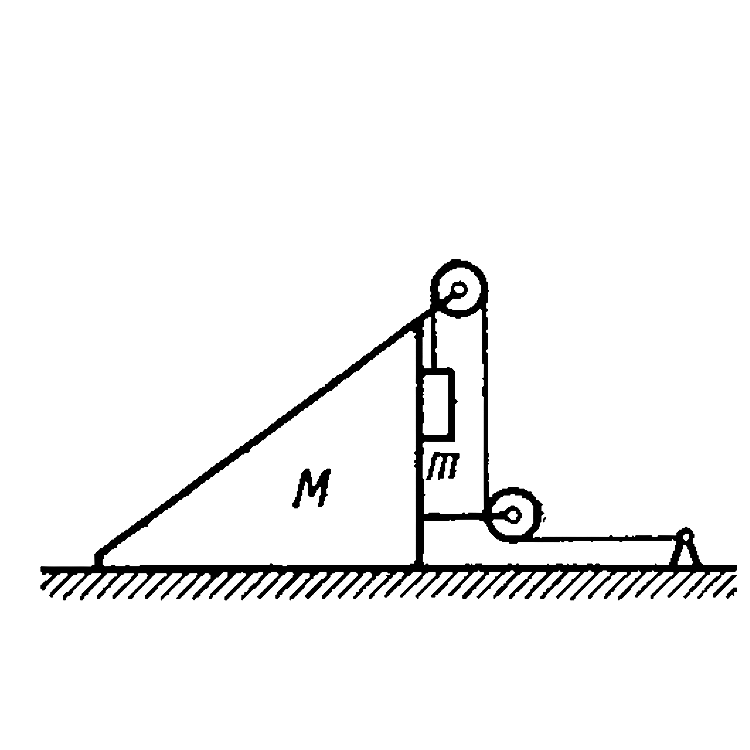
In the arrangement shown in figure the masses of the wedge M and the body m are known. The appreciable friction exists only between the wedge and the body m, the friction coefficient being equal to k. The masses of the pulley and the thread are negligible. Find the acceleration of the body m relative to the horizontal surface on which the wedge slides.

Text Solution

Verified by Experts

Let us draw free body diagram of each body and fix the coordinate system, as shown in the figure. After analysing the motion of M and m on the basis of force diagram, let us draw the kinematical diagram for accelerations (figure).
As the length of threads are constant so,
`ds_(mM)=ds_M` and as `vecv_(mM)` and `vecv_M` do not change their directions that why
`|vecw_(mM)|=|vecw_M|=w` (say) and
`vecw_(mM)uarr uarr vecv_M` and `vecw_Muarr uarr vecv_M`
As `vecw_M=vecw_(mM)+vecw_M`
so, from the traingle law of vector addition
`w_m=sqrt2w` (1)
From the Eq. `F_x=mw_x`, for the wedge and block:
`T-N=Mw`, (2)
and `N=mw` (3)
Now, from the Eq. `F_y=mw_y`, for the block
`mg-T-kN=mw` (4)
Simultaneous solution of Eqs. (2), (3) and (4) yields:
`w=(mg)/((km+2m+M))=(g)/((k+2+M//m))`
Hence using Eq. (1)
`w_m=(gsqrt2)/((2+k+M//m))`
Promotional Banner

Topper's Solved these Questions

  • PHYSICAL FUNDAMENTALS OF MECHANICS

    IE IRODOV, LA SENA & SS KROTOV|Exercise Laws Of Conservation Of Energy, Momentum And Angular Momentum|82 Videos
  • PHYSICAL FUNDAMENTALS OF MECHANICS

    IE IRODOV, LA SENA & SS KROTOV|Exercise Universal Gravitation|34 Videos
  • PHYSICAL FUNDAMENTALS OF MECHANICS

    IE IRODOV, LA SENA & SS KROTOV|Exercise Relativistic Mechanics|49 Videos
  • OSCILLATIONS AND WAVES

    IE IRODOV, LA SENA & SS KROTOV|Exercise Electromagnetic Waves, Radiation|36 Videos
  • THERMODYNAMICS AND MOLECULAR PHYSICS

    IE IRODOV, LA SENA & SS KROTOV|Exercise Transport Phenomena|38 Videos

Similar Questions

Explore conceptually related problems

In the arrangement shown in figure-2.68 the masses of the wedge M and the body m are known. There is no friction at any of the surfaces. The mass of the pulleys and thread is negligible. Find the acceleration of the body m relative to the horizontal surface on which the wedge slides. [(sqrt(2)mg)/(M+2m)]

In the arrangement shown in the figure, the blocks have masses 3m,m and 2m , the friction is absent, the masses of the pulleys and the threads are negligible. Find the acceleration of mass 3m .

In the arrangement shown in fig the bodies have masses m_(0), m_(1) and m_(2) the friction is absent the masses of pulleys and the threads are negligible find the acceleration of the body m_(1)

In the arrangement shown in figure the bodies have masses m_0 , m_1 , m_2 , the friction is absent, the masses of the pulleys and the threads are negligible. Find the acceleration of the body m_1 . Look into possible cases.

In the arrangement shown in figure the masses m of the bar and M of the wedge, as well as the wedge angle alpha , are known. The masses of the pulley and the thread are negligible. The friction is absent. Find the acceleration of the wedge M.

All surfaces are smooth. The acceleration of mass m relative to the wedge is

In the arrangement shown in fig. the block of mass m=2kg lies on the wedge of mass M=8kg . The initial acceleration of the wedge, if the surfaces are smooth, is

All the surfaces are smooth as shown in figure. The acceleration of mass m relative to wedge is :

A pulley fixed to the ceiling carries a thread with bodies of masses m_1 and m_2 attached to its ends. The masses of the pulley and the thread are negligible, friction is absent. Find the acceleration w_C of the centre of inertia of this system.

All surfaces are smooth The acceleration of mass m relative to the wedge is .

IE IRODOV, LA SENA & SS KROTOV-PHYSICAL FUNDAMENTALS OF MECHANICS-The Fundamental Equation Of Dynamics
  1. In the arrangement shown in figure the mass of body 1 is eta=4.0 times...

    Text Solution

    |

  2. Find the accelerations of rod A and wedge B in the arrangement shown i...

    Text Solution

    |

  3. In the arrangement shown in figure the masses of the wedge M and the b...

    Text Solution

    |

  4. What is the minimum acceleration with which bar A (figure) should be s...

    Text Solution

    |

  5. Prism 1 with bar 2 of mass m placed on it gets a horizontal accelerati...

    Text Solution

    |

  6. Prism 1 of mass m1 and width angle alpha (see figure) rests on a horiz...

    Text Solution

    |

  7. In the arrangement shown in figure the masses m of the bar and M of th...

    Text Solution

    |

  8. A particle of mass m moves along a circle of radius R. Find the modulu...

    Text Solution

    |

  9. An aircraft loops the loop of radius R=500m with a constant velocity v...

    Text Solution

    |

  10. A small sphere of mass m suspended by a thread is first taken aside so...

    Text Solution

    |

  11. A ball suspended by a thread swings in a vertical plane so that its ac...

    Text Solution

    |

  12. A small body A starts sliding off the top of a smooth sphere of radius...

    Text Solution

    |

  13. A device (figure) consists of a smooth L-shaped rod located in a horiz...

    Text Solution

    |

  14. A cyclist rides along the circumference of a circular horizontal plane...

    Text Solution

    |

  15. A car moves with a constant tangential acceleration wtau=0.62m//s^2 al...

    Text Solution

    |

  16. A car moves uniformly along a horizontal since curvey = a sin (x//alph...

    Text Solution

    |

  17. A chain of mass m forming a circle of radius R is slipped on a s...

    Text Solution

    |

  18. A fixed pulley carries a weightless thread with masses m(1) and m(2) a...

    Text Solution

    |

  19. A particle of mass m moves along the internal smooth surface of a vert...

    Text Solution

    |

  20. Find the magnitude and direction of the force acting on the particle o...

    Text Solution

    |

