Home
Class 12
PHYSICS
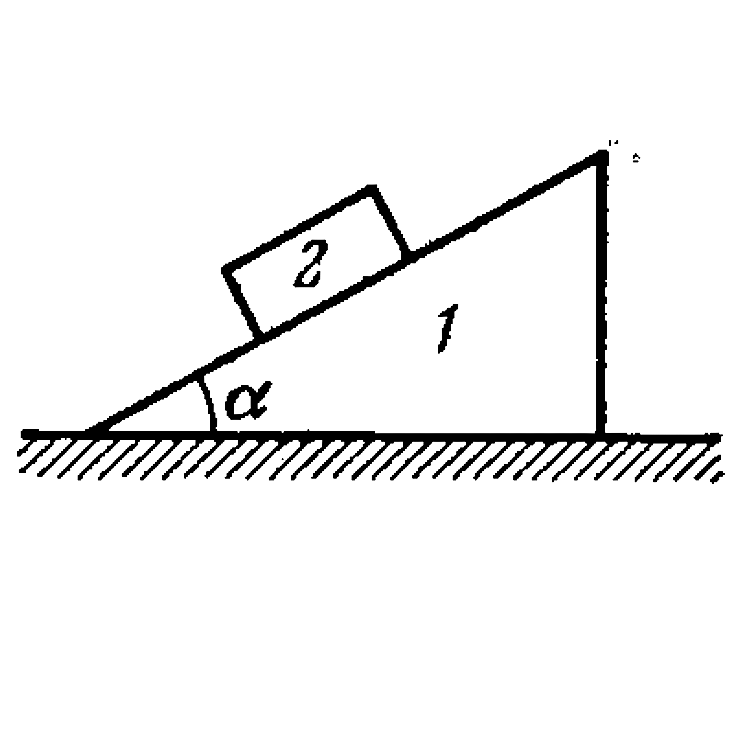
Prism 1 with bar 2 of mass m placed on i...

Prism 1 with bar 2 of mass m placed on it gets a horizontal acceleration w directed to the left (figure). At what maximum value of this acceleration will the bar still stationary relative to the prism, if the coefficient of friction between them `k lt cot alpha` ?

Text Solution

Verified by Experts

On the basis of the initial argument of the solution of above, the tendency of bar 2 with respect to 1 will be to move up along the plane.
Let us fix `(x-y)` coordinate system in the frame of ground as shown in figure.
From second law of motion in projection form along y and x-axis:
`mg cos alpha-N=m w sin alpha`
or, `N=m(g cos alpha-w sin alpha)` (1)
`mg sin alpha+f r=mw cos alpha`
or, `f r=m(w cos alpha-g sin alpha)` (2)
but `f r le kN`, so from (1) and (2)
`(w cos alpha-g sin alpha)lek(g cos alpha+w sin alpha)`
or, `w(cos alpha-k sin alpha)le g(k cos alpha+sin alpha)`
or, `w le "g"((cos alpha+sin alpha))/(cos alpha-k sin alpha)`,
So, the sought maximum acceleration of the wedge:
`w_(max)=((k cos alpha+ sin alpha)g)/(cos alpha- k sin alpha)=((k cot alpha+1)g)/(cot alpha-k)` where `cot alpha gt k`
Promotional Banner

Topper's Solved these Questions

  • PHYSICAL FUNDAMENTALS OF MECHANICS

    IE IRODOV, LA SENA & SS KROTOV|Exercise Laws Of Conservation Of Energy, Momentum And Angular Momentum|82 Videos
  • PHYSICAL FUNDAMENTALS OF MECHANICS

    IE IRODOV, LA SENA & SS KROTOV|Exercise Universal Gravitation|34 Videos
  • PHYSICAL FUNDAMENTALS OF MECHANICS

    IE IRODOV, LA SENA & SS KROTOV|Exercise Relativistic Mechanics|49 Videos
  • OSCILLATIONS AND WAVES

    IE IRODOV, LA SENA & SS KROTOV|Exercise Electromagnetic Waves, Radiation|36 Videos
  • THERMODYNAMICS AND MOLECULAR PHYSICS

    IE IRODOV, LA SENA & SS KROTOV|Exercise Transport Phenomena|38 Videos

Similar Questions

Explore conceptually related problems

A plank of mass m_1 with a bar of mass m_2 placed on it lies on a smooth horizontal plane. A horizontal force growing with time t as F^'=at (a is constant) is applied to the bar. Find how the accelerations of the plank w_1 and of the bar w_2 depend on t, if the coefficient of friction between the plank and the bar is equal to k. Draw the approximate plots of these dependences.

A block of mass m is placed on the rough incline of a wedge of mass M and inclination alpha to the horizontal. Calculate the maximum and minimum acceleration that can be imparted to the wedge so that the block may remain stationary relative to the wedge. The coefficient iof friction between the block and the wedge is mu .

Detrmine the maximum acceleration of the train in which a box lying on the floor will remain stationary given that the coefficient of static friction between the box and the train s floor is 0.15 given g = 10 m//s^(2) .

A block of mass M = 4 kg is kept on a smooth horizontal plane. A bar of mass m = 1 kg is kept on it. They are connected to a spring as shown & the spring is compressed. Then what is the maximum compression in the spring for which the bar will not slip on the block when released if coefficient of friction between them is 0.2 & spring constant = 1000 N/m : (Take g=10m//s^(2) )

Two block , with masses m_(1) and m_(2) are staked as shown in fig and placed on a frictionless horizontal surface . There is a friction between the two block .An external force of magnitude F is applied to the top block at an angle alpha below the horizontal . The coefficient of friction between m_(1) and m_(2) are mu_(s) b. If the two blocks move together, find their acceleration b . Calculate the maximum value of force so that blocks will move together

What is the minimum acceleration with which bar A (figure) should be shifted horizontally to keep bodies 1 and 2 stationary relative to the bar? The masses of the bodies are equal, and the coefficient of friction between the bar and the bodies is equal to k. The masses of the pulley and the threads are negligible, the friction in the pulley is absent.

A block of mass m is placed on a wedge of mass M. Coefficient between then is mu lt cot theta . The wedge is given an acceleration to its left. Find the maximum acceleration at which block apears stationary relative to wedge.

Two touching bars 1 and 2 are placed on an inclined plane forming an angle alpha with the horizontal (figure). The masses of the bars are equal to m_1 and m_2 , and the coefficients of friction between the inclined plane and these bars are equal to k_1 and k_2 respectively, with k_1gtk_2 . Find: (a) the force of interaction of the bars in the process of motion, (b) the minimum value of the angle alpha at which at bars start sliding down.

Mass m_(2) placed on a plank of mass m_(1) lying on a smooth horizontal plane. A horizontal force F = alpha_(0) t ( alpha_(0) is a constant ) is applied to a bar. If acceleratiion of the plank and bar are a_(1) and a_(2) respectively and the coefficient of friction between m_(1) and m_(2) is mu . Then find acceleration a with time t.

IE IRODOV, LA SENA & SS KROTOV-PHYSICAL FUNDAMENTALS OF MECHANICS-The Fundamental Equation Of Dynamics
  1. In the arrangement shown in figure the masses of the wedge M and the b...

    Text Solution

    |

  2. What is the minimum acceleration with which bar A (figure) should be s...

    Text Solution

    |

  3. Prism 1 with bar 2 of mass m placed on it gets a horizontal accelerati...

    Text Solution

    |

  4. Prism 1 of mass m1 and width angle alpha (see figure) rests on a horiz...

    Text Solution

    |

  5. In the arrangement shown in figure the masses m of the bar and M of th...

    Text Solution

    |

  6. A particle of mass m moves along a circle of radius R. Find the modulu...

    Text Solution

    |

  7. An aircraft loops the loop of radius R=500m with a constant velocity v...

    Text Solution

    |

  8. A small sphere of mass m suspended by a thread is first taken aside so...

    Text Solution

    |

  9. A ball suspended by a thread swings in a vertical plane so that its ac...

    Text Solution

    |

  10. A small body A starts sliding off the top of a smooth sphere of radius...

    Text Solution

    |

  11. A device (figure) consists of a smooth L-shaped rod located in a horiz...

    Text Solution

    |

  12. A cyclist rides along the circumference of a circular horizontal plane...

    Text Solution

    |

  13. A car moves with a constant tangential acceleration wtau=0.62m//s^2 al...

    Text Solution

    |

  14. A car moves uniformly along a horizontal since curvey = a sin (x//alph...

    Text Solution

    |

  15. A chain of mass m forming a circle of radius R is slipped on a s...

    Text Solution

    |

  16. A fixed pulley carries a weightless thread with masses m(1) and m(2) a...

    Text Solution

    |

  17. A particle of mass m moves along the internal smooth surface of a vert...

    Text Solution

    |

  18. Find the magnitude and direction of the force acting on the particle o...

    Text Solution

    |

  19. A body of mass m is thrown at an angle to the horizontal with the init...

    Text Solution

    |

  20. At the moment t=0 a stationary particle of mass m experiences a time-d...

    Text Solution

    |

