Home
Class 12
PHYSICS
In the system shown in figure the masses...

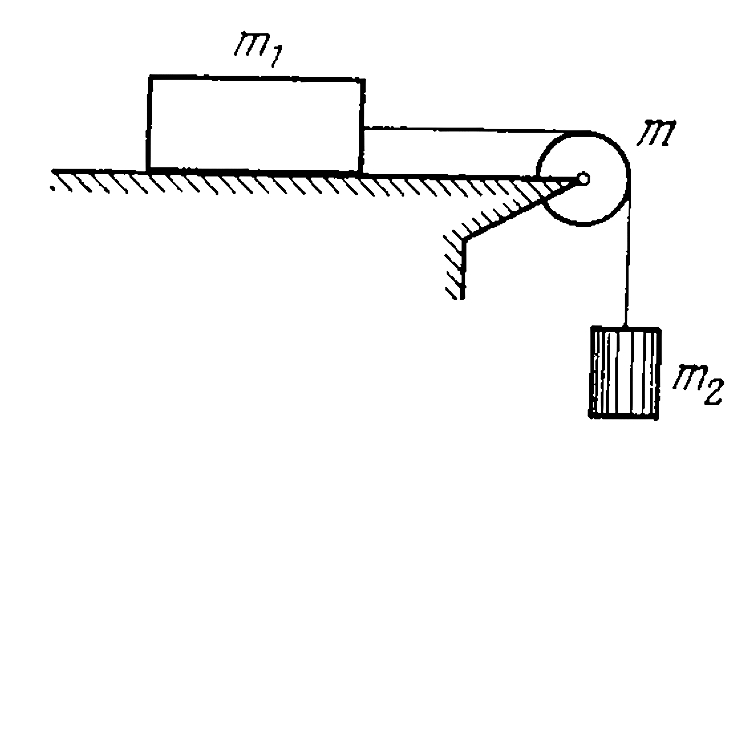
In the system shown in figure the masses of the bodies are known to be `m_1` and `m_2`, the coefficient of friction between the body `m_1` and the horizontal plane is equal to `k`, and a pulley of mass m is assumed to be a uniform disc. The thread does not slip over the pulley. At the moment `t=0` the body `m_2` starts descending. Assuming the mass of the thread and the friction in the axle of the pulley to be negligible, find the work performed by the friction forces acting on the body `m_1` over the first t seconds after the beginning of motion.

Text Solution

Verified by Experts

As the system (`m+m_1+m_2`) is under constant forces, the acceleration of body `m_1` an `m_2` is constant. In addition to it the velocities and acceleration of bodies `m_1` and `m_2` at equal in magnitude (say v and w) because the length of the thread is constant.
From the equation of increament of mechanical energy i.e. `DeltaT+DeltaU=A_(f r)`, at time t whe block `m_1` is distance h below from initial position corresponding to `t=0`,
`1/2(m_1+m_2)v^2+1/2((mR^2)/(2))v^2/R^2-m_2gh=-km_1gh` (1)
(as angular velocity `omega=v//R` for no slipping of thread).
But `v^2=2wh`
So using it in (1), we get
`w=(2(m_2-km_1)g)/(m+2(m_1+m_2))` (2)
Thus the work done by the friction force on `m_1`
`A_(f r)=-km_1gh=-km_1g(1/2wt^2)`
`=-(km_1(m_1-km_1)g^2t^2)/(m+2(m_1+m_2))` (using 2)
Promotional Banner

Topper's Solved these Questions

  • PHYSICAL FUNDAMENTALS OF MECHANICS

    IE IRODOV, LA SENA & SS KROTOV|Exercise Elastic Deformation Of Asolid Body|25 Videos
  • PHYSICAL FUNDAMENTALS OF MECHANICS

    IE IRODOV, LA SENA & SS KROTOV|Exercise Hydrodynamics|25 Videos
  • PHYSICAL FUNDAMENTALS OF MECHANICS

    IE IRODOV, LA SENA & SS KROTOV|Exercise Universal Gravitation|34 Videos
  • OSCILLATIONS AND WAVES

    IE IRODOV, LA SENA & SS KROTOV|Exercise Electromagnetic Waves, Radiation|36 Videos
  • THERMODYNAMICS AND MOLECULAR PHYSICS

    IE IRODOV, LA SENA & SS KROTOV|Exercise Transport Phenomena|38 Videos

Similar Questions

Explore conceptually related problems

In the arrangement shown in fig the bodies have masses m_(0), m_(1) and m_(2) the friction is absent the masses of pulleys and the threads are negligible find the acceleration of the body m_(1)

In the arrangement shown in figure the masses of the wedge M and the body m are known. The appreciable friction exists only between the wedge and the body m, the friction coefficient being equal to k. The masses of the pulley and the thread are negligible. Find the acceleration of the body m relative to the horizontal surface on which the wedge slides.

In the arrangement shown in the figure, the blocks have masses 3m,m and 2m , the friction is absent, the masses of the pulleys and the threads are negligible. Find the acceleration of mass 3m .

A pulley fixed to the ceiling of an elevator car carries a thread whose ends are attached to the loads of masses 3m and m . The car starts gong up with acceleration g//s . Assuming the masses of the pulley and the thread, as well as friction, to be negligible, find the force exerted by the pulley on the ceiling of car.

Two bodies of masses m_1 and m_2(

In the arrangement shown in figure the bodies have masses m_0 , m_1 , m_2 , the friction is absent, the masses of the pulleys and the threads are negligible. Find the acceleration of the body m_1 . Look into possible cases.

The inclined plane of figure forms an angle alpha=30^@ with the horizontal. The mass ratio m_2//m_1=eta=2//3 . The coefficients of friction between the body m_1 and the inclined plane is equal to k=0.10 . The masses of the pulley and the threads are negligible. Find the magnitude and the direction of acceleration of the body m_2 when the formely stationary system of masses starts moving.

In the arrangement shown in figure-2.124 pulley A and B are massless and the thread is inextensible. Mass of pulley C is equal to m. If friction in all the pulleys negligible, then :

In the arrangement shown in figure the mass of the uniform solid cylindrical pulley of radius R is equal to m and the masses of two bodies are equal to m_(1) and m_(2) . The thread slipping and the friction in the axle of the pulley are supposed to be absent. Find the angular acceleration of the cylinder and the ratio of tensions (T_(1))/(T_(2)) of the vertical sections of the thread in the process of motion.

IE IRODOV, LA SENA & SS KROTOV-PHYSICAL FUNDAMENTALS OF MECHANICS-Dynamics Of A Solid Body
  1. A thin horizontal uniform rod AB of mass m and length l can rotate fre...

    Text Solution

    |

  2. In the arrangement shown in figure the mass of the uniform solid cylin...

    Text Solution

    |

  3. In the system shown in figure the masses of the bodies are known to be...

    Text Solution

    |

  4. A uniform cylinder of radius R is spinned about it axis to the angular...

    Text Solution

    |

  5. A uniform disc of radius R is spinned to the angular velocity omega an...

    Text Solution

    |

  6. A flywheel with the initial angular velocity omega0 decelerates due to...

    Text Solution

    |

  7. A uniform cylinder of radius r and mass m can rotate freely about a fi...

    Text Solution

    |

  8. A uniform sphere of mass m and radius R rolls without slipping down an...

    Text Solution

    |

  9. A uniform cylinder of mass m and radius R starts descending at a momen...

    Text Solution

    |

  10. Thin threads are tightly wound on the ends of a uniform solid cylinder...

    Text Solution

    |

  11. A spool with a thread wound on it is placed on an inclined smooth plan...

    Text Solution

    |

  12. A uniform solid cylinder of mass m rests on two horizontal planks. A t...

    Text Solution

    |

  13. A spool with thread wound on it, of mass m, rests on a rough horizonta...

    Text Solution

    |

  14. The arrangement shown in figure consists of two identical, uniform, so...

    Text Solution

    |

  15. In the arrangement shown in figure a weight A possesses mass m, a pull...

    Text Solution

    |

  16. A uniform solid cylinder A of mass m1 can freely rotate about a horizo...

    Text Solution

    |

  17. A plank of mass m1 with a uniform sphere of mass m2 placed on it rests...

    Text Solution

    |

  18. A uniform solid cylinder of mass m and radius R is set in rotation abo...

    Text Solution

    |

  19. A uniform ball of radius r rolls without slipping down from the top of...

    Text Solution

    |

  20. A uniform solid cylinder of radius R=15cm rolls over a horizontal plan...

    Text Solution

    |
