Home
Class 12
PHYSICS
What work should be done in order to squ...

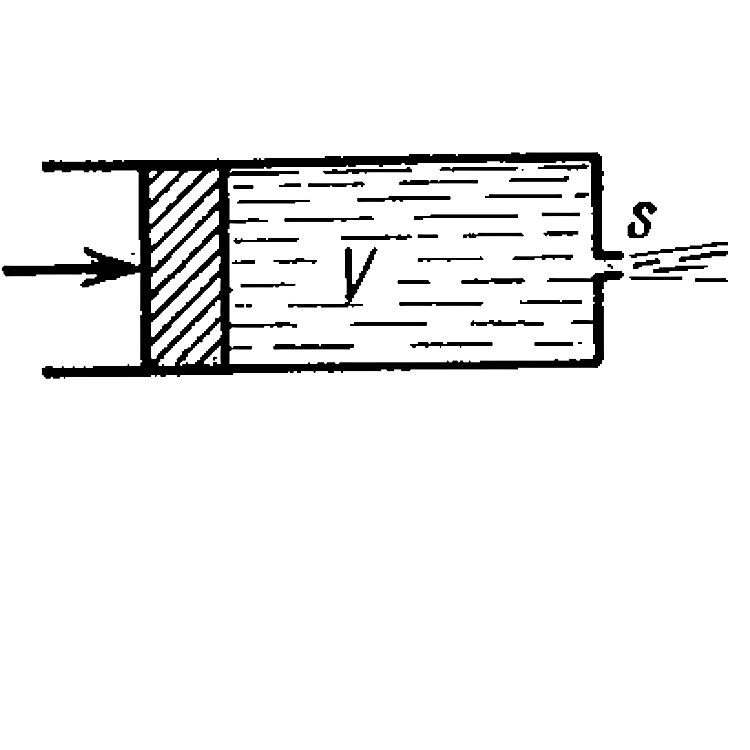
What work should be done in order to squeeze all water from a horizontally located cylinder (figure) during the time t by means of a constant force acting on the piston? The volume of water in the cylinder is equal to V, the cross-sectional area of the orifice to s, with s being considerably less than the piston area. The friction and viscosity are negligibly small.

Text Solution

Verified by Experts

Let the force acting on the piston be F and the length of the cylinder be l.
Then, work done `=Fl` (1)
Applying Bernoulli's theorem for points A and B, `p=1/2rhov^2` where `rho` is the density and v is the velocity at point B. Now, force on the piston,
`F=pA=1/2rhov^2A` (2)
where A is the cross section area of piston. Also, discharge through the orifice during time interval `t=Svt` and this is equal to the volume of the cylinder, i.e.,
`V=Svt` or `v=(V)/(St)` (3)
From Eq. (1), (2) and (3) work done
`=1/2rhov^2Al=1/2rhoA(V^2)/((St)^2)l=1/2rhoV^3//S^3t^2` (as `Al=V`)
Promotional Banner

Topper's Solved these Questions

  • PHYSICAL FUNDAMENTALS OF MECHANICS

    IE IRODOV, LA SENA & SS KROTOV|Exercise Relativistic Mechanics|49 Videos
  • PHYSICAL FUNDAMENTALS OF MECHANICS

    IE IRODOV, LA SENA & SS KROTOV|Exercise Elastic Deformation Of Asolid Body|25 Videos
  • OSCILLATIONS AND WAVES

    IE IRODOV, LA SENA & SS KROTOV|Exercise Electromagnetic Waves, Radiation|36 Videos
  • THERMODYNAMICS AND MOLECULAR PHYSICS

    IE IRODOV, LA SENA & SS KROTOV|Exercise Transport Phenomena|38 Videos

Similar Questions

Explore conceptually related problems

What work should be done in order to sqeeze all water from a horizontally located cylinder (figure) during the time t by means of a constant force acting on the poston? The volume of water in the cylinder is equal to V, the cross-sectional area of the orifice is s, with s being considerablu less than the piston area. The friction and viscosity are negligibly small. Density of water is rho

A horizontal cylinder of length l contains water. On the left a constant force F is applied on the piston and on the right there is a small hole of area a. What is the velocity of the piston? Hence, calculate the work done in emptying the vessel in time t . brgt given area of cylinder is A

A flatcar of mass m_0 starts moving to the right due to a constant horizontal force F(figure). Sand spills on the flatcar from a stationary hopper. The velocity of loading is constant and equal to mukg//s . Find the time dependence of the velocity and the acceleration of the flatcar in the process of loading. The friction is negligibly small.

Water is filled to height h in a fixed vertical cylinder placed on horizontal surface. At time t = 0 a small hole a drilled at a height h//4 from bottom of cylinder as shown. The cross section area of hole is a and the cross-section area of cylinder is A such that A gtgt a . The duration of time for which water flows out of hole is.

Passage XIV) A uniform cylindrical block of mass 2M and cross-sectional area A remains partially submerged in a non viscous liquid of density rho , density of the material of the cylinder is 3rho . The cylinder is connected to lower end of the tank by means of a light spring of spring constant K. The other end of the cylinder is connected to anotehr block of mass M by means of a light inextensible sting as shown in the figure. The pulleys shown are massless and frictionless and assume that the cross-section of the cylinder is very small in comparison to that of the tank. Under equilibrium conditions, half of the cylinder is submerged. [given that cylinder always remains partially immersed) If the cylinder is pushed down from equilibrium by a distance which is half the distance as calculated in the above question, determine time period of subsequent motion.

Passage XIV) A uniform cylindrical block of mass 2M and cross-sectional area A remains partially submerged in a non viscous liquid of density rho , density of the material of the cylinder is 3rho . The cylinder is connected to lower end of the tank by means of a light spring of spring constant K. The other end of the cylinder is connected to anotehr block of mass M by means of a light inextensible sting as shown in the figure. The pulleys shown are massless and frictionless and assume that the cross-section of the cylinder is very small in comparison to that of the tank. Under equilibrium conditions, half of the cylinder is submerged. [given that cylinder always remains partially immersed) By what maximum distance cylinder will be pushed downward into the liquid from equilibrium position so that when it is set free then tension in the string will not vanish [Assume at equilibrium position system was at rest]

A horizontal cylindrical vessel with a small orifice of area s is first filled with a liquid of density rho and then forced out through it by applying a constant force on the piston closing the cylinder. The time taken is t. The time taken is t. Calculate the work done.

Water is filled to height h in a fixed vertical cylinder placed on horizontal surface. At time t = 0 a small hole a drilled at a height h//4 from bottom of cylinder as shown. The cross section area of hole is a and the cross-section area of cylinder is A such that A gtgt a . Let the value of horizontal distance of point where the4 water fall on horizontal surface from bottom of cylinder be x as shown. Then from time t = 0 till water comes out of hole, pick the correct statement:

One mole of a certain ideal gas is contained under a weight-less piston of a vertical cylinder at a temperature T . The space over the piston opens into the atmosphere. What work has to be performed on order to increase isothermally the gas volume under the piston n times by slowly raising the piston ? The friction of the piston against the cylinder walls is negligibly small.

Water of mass m = 20 g is enclosed in a thermally insulated cylinder at the temperature of 0 ^@C under a weightless piston whose area is S = 410 cm^2 . The outside pressure is equal to standard atmospheric pressure. To what height will the piston rise when the water absorbs Q = 20.0 k J of heat ?

IE IRODOV, LA SENA & SS KROTOV-PHYSICAL FUNDAMENTALS OF MECHANICS-Hydrodynamics
  1. A bent tube is lowered into a water stream as shown in figure. The vel...

    Text Solution

    |

  2. The horizontal bottom of wide vessel with an ideal fluid has a round o...

    Text Solution

    |

  3. What work should be done in order to squeeze all water from a horizont...

    Text Solution

    |

  4. A cylindrical vessel of height h and base area S is filled with water....

    Text Solution

    |

  5. A horizontally oriented tube AB of length l rotates with a constant an...

    Text Solution

    |

  6. Demostrate that is the case of a steady flow of an ideal fluid turns i...

    Text Solution

    |

  7. On the opposite sides of a wide vertical vessel filled with water two ...

    Text Solution

    |

  8. The side wall of a wide vertical vessel of height h=75 cm has a narrow...

    Text Solution

    |

  9. Water flows out of a big tank along a tube bent at right angles, the i...

    Text Solution

    |

  10. A side wall of a wide open tank is provided with a narrowing tube (fig...

    Text Solution

    |

  11. A cylindrical vessel with water is rotated about its vertical axis wit...

    Text Solution

    |

  12. A thin horizontal disc of radius R=10cm is located with in a cylindric...

    Text Solution

    |

  13. A long cylinder of radius R1 is displaced along its axis with a consta...

    Text Solution

    |

  14. A fluid with viscosity eta fills the space between two long co-axial c...

    Text Solution

    |

  15. A tube of length l and radius R carries a steady flow of fluid whose d...

    Text Solution

    |

  16. In the arrangement shown in figure a viscous liquid whose density is r...

    Text Solution

    |

  17. The cross-sectional radius of a pipeline decreases graudally as r=r0e^...

    Text Solution

    |

  18. When a sphere of radius r1=1.2mm moves in glycerin, the laminar flow i...

    Text Solution

    |

  19. A lead sphere is steadily is steadily sinking in glycerine whose visco...

    Text Solution

    |

  20. A steel ball of diameter d=3.0mm starts sinking with zero initial velo...

    Text Solution

    |

