Home
Class 12
PHYSICS
Making use of the spectral response curv...

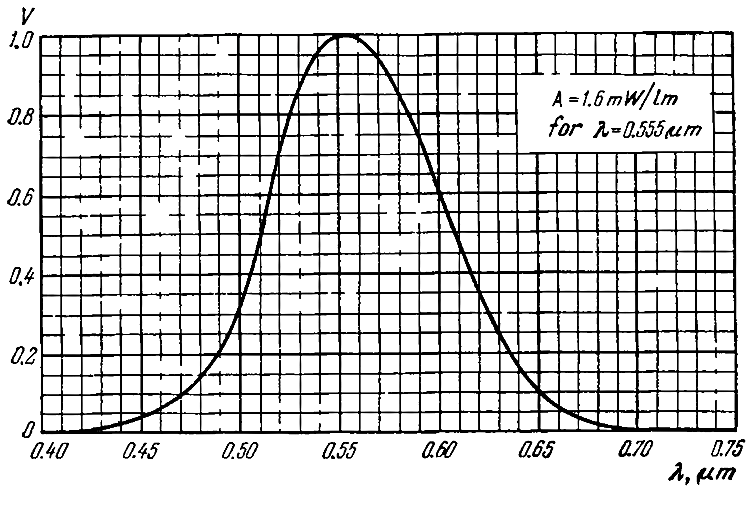
Making use of the spectral response curve for an eye (see Fig.), find :
(a) the energy flux corresponding to the luminous flux of `1.0 1m` at the wavelength `0.51` and `0.64mu m`,
(b) the luminous flux corresponding to the wavelength interval from `0.58` to `0.63 mu m` if the respective energy flux, equal to `Phi = 4.5 mW`, is unifromly distributed over all wavelengths of the interval. The function `V (lambda)` is assumed to be linear in the given spectral interval.

Text Solution

Verified by Experts

The relative spectral response `V(lambda)` shown in Fig. o fthe book is so defined that `A//V (lambda)` is the enegry flux of light of wave length `lambda` needed to produce a unit luminous flux at that wavelength. (`A` is the converison factor defined in the book)
At `lambda = 0.51 mu m`, we read from the figure
`V (lambda) = 0.50` so
energy flux corresponding to a luminous flux of `1` lumen `= (1.6)/(0.50) = 3.2 mW`
At `lambda = 0.64 mu m`, we read
`V (lambda) = 0.17`
and energy flux corresponding to a luminous flux of `1` lumen `= (1.6)/(.17) = 9.4 mW`
(b) Here `d Phi_(e) (lambda) = (Phi_(e))/(lambda_(2) - lambda_(1)) d lambda, lambda_(1) le lambda le lambda_(2)`
since energy is distributied unifromly. then
`Phi = int_(lambda_(1))^(lambda_(2)) V(lambda) d Phi_(2) (lambda)//A = (Phi_(e))/(A (lambda_(2) - lambda_(1)))int_(lambda_(1))^(lambda_(2)) V(lambda) d lambda`
since `V(lambda)` is assumed to very linearly in the interval `lambda_(1) le lambda le lambda_(2)`, we have
`(1)/(lambda_(1) - lambda_(2))int_(lambda_(1))^(lambda_(2)) V (lambda)d lambda = (1)/(2) (V (lambda_(1)) + V(lambda_(2)))`
Thus, `Phi = (Phi_(e))/(2A) (V (lambda_(1)) + V (lambda_(2)))`
Using `V (0.58 mu m) = 0.85`
`V (0.63 mu m) = 0.25`
Thus `Phi = (Phi_(e))/(2xx1.6) xx 1.1 = 1.55` lumen.
Promotional Banner

Topper's Solved these Questions

  • OPTICS

    IE IRODOV, LA SENA & SS KROTOV|Exercise Interference Of Light|33 Videos
  • OPTICS

    IE IRODOV, LA SENA & SS KROTOV|Exercise Diffraction Of Light|60 Videos
  • MECHANICS

    IE IRODOV, LA SENA & SS KROTOV|Exercise Mechanics Problems|92 Videos
  • OSCILLATIONS AND WAVES

    IE IRODOV, LA SENA & SS KROTOV|Exercise Electromagnetic Waves, Radiation|36 Videos

Similar Questions

Explore conceptually related problems

Dimensions of luminous flux are

What will be the energy of a photon which corresponds to the wavelength of 0.50 Å?

Calculate the energy of one of the photons of a beam of light having wavelength 25.0 mu m.

What is the luminous flux of a source emitting radio waves ?

The luminous flux of a monochromatic source of 1 W is 450 lumen watt^-1 . Find the relative luminosity at the wavelength emitted.

Find the luminous flux of 10 W source of 600 nm. The relative luminosity at 600 nm is 0.6.

At 1600K maximum radiation is emitted at a wavelength of 2mu_(M) . Then what will be corresponding wavelength at 2000K ?

What is the dimension of Luminous flux :

Find energy of each of the photons which a. correspond to light of frequency 3xx10^(15) Hz . b. have wavelength of 0.50 Å .
