Home
Class 12
PHYSICS
A parallel beam of light falls from vacu...

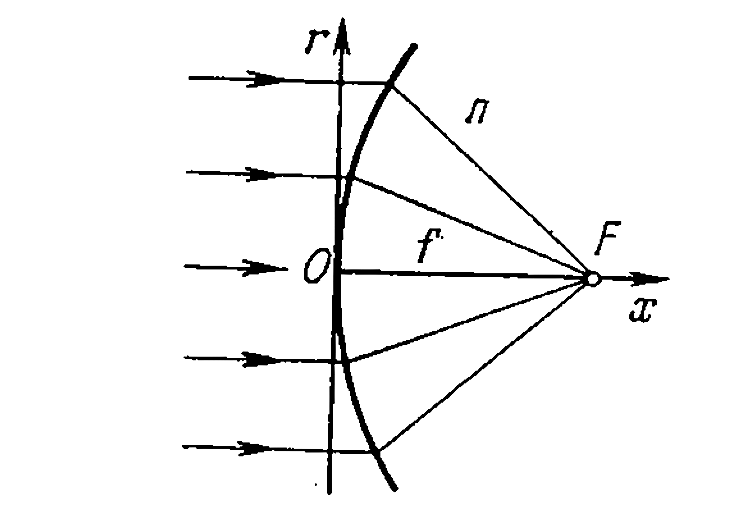
A parallel beam of light falls from vacuum on a surface enclosing a medium with refractive3 index `n` (Fig.) Find the shape of that surface, `x(r )` if the beam is brought into focus at the point `F` at a distance `f` from the crest `O`. What is the maximum radius of a beam that can still be focussed ?

Text Solution

Verified by Experts

All rays focusing at a point must have traversed the same optical path. Thus

`x + n sqrt(r^(2) + (f - x)^(2)) = nf` or `(nf - x)^(2) = n^(2) r^(2) + n^(2) (f - x)^(2)`
or, `n^(2)r^(2) = (nf - x)^(2) -[n(f - x)]^(2) = (nf - x + nf -nx) (nf - x - nf + nx)`
`= x(n - 1) (2n f - (n + 1)x)`
`= 2n (n -1) fx - (n + 1) (n - 1)x^(2)`
Thus, `(n + 1) (n - 1)x^(2) - 2n (n - 1) fx + n^(2) r^(2) = 0`
so, `x = (n(n - 1)f+-sqrt(n^(2)(n -1)^(2) f^(2) - n^(2) (n + 1) (n - 1)))/((n + 1) (n - 1))`
`= (nf)/(n + 1) 1+= sqrt(1 -(n + 1)/(n - 1)(r^(2))/(f^(2)))`
Ray must move forward so `x lt f`, for `+` sing `x gt f` fro small `r`, so -sign
(Also `x rarr 0` as `r rarr 0`)
`(x gt f` means ray turning back in the direction of incidence. (see Fig.)
Hence `x = (nf)/(n + 1) [1-sqrt(1 -(n + 1)/(n - 1)(r^(2))/(f^(2)))]`
For the maximum value of `r`,
`sqrt(1 -(n + 1)/(n - 1)(r^(2))/(f^(2))) = 0` (A)
beacuse the expression under the radical sign must be non-negative, which gives the maximum value of `r`.
Hence from Eqn .(A), `r_(max) = f sqrt((n - 1)//(n + 1))`
Promotional Banner

Topper's Solved these Questions

  • OPTICS

    IE IRODOV, LA SENA & SS KROTOV|Exercise Interference Of Light|33 Videos
  • OPTICS

    IE IRODOV, LA SENA & SS KROTOV|Exercise Diffraction Of Light|60 Videos
  • MECHANICS

    IE IRODOV, LA SENA & SS KROTOV|Exercise Mechanics Problems|92 Videos
  • OSCILLATIONS AND WAVES

    IE IRODOV, LA SENA & SS KROTOV|Exercise Electromagnetic Waves, Radiation|36 Videos

Similar Questions

Explore conceptually related problems

A narrow parallel beam of light falls on a glass sphere of radius R and refractive index mu at normal incidence. The distance of the image from the outer edge is given by-

A beam of monochromatic light is refacted from vacuum into a medium of refracticve index 1.5 The wavelength of refracted light will be

A parallel beam of light is incident on the surface of a transparent hemisphere of radius R and refractive index 2.0 as shown in figure. The position of the image formed by refraction at the first surface is :

A parallel beam of light is incident on a lens of focal length 10 cm. A parallel slab of refractive index 1.5 and thickness 3 cm is placed on the other side of the lens. Find the distance of the final image from the lens. .

A narrow parallel beam of light is incident on a transparent sphere of refractives index n if the beam finally gets focussed at a point situated at a distance= 2xx("radius of sphere") form the center of the sphere then find n ?

A parallel beam of light is incident normally on the flat surface of a hemisphere of radius 6 cm and refractive index 1.5 , placed in air as shown in figure (i). Assume paraxial ray approxiamtion. .

