Home
Class 12
PHYSICS
Two sources S(1) and S(2) of intensity ...

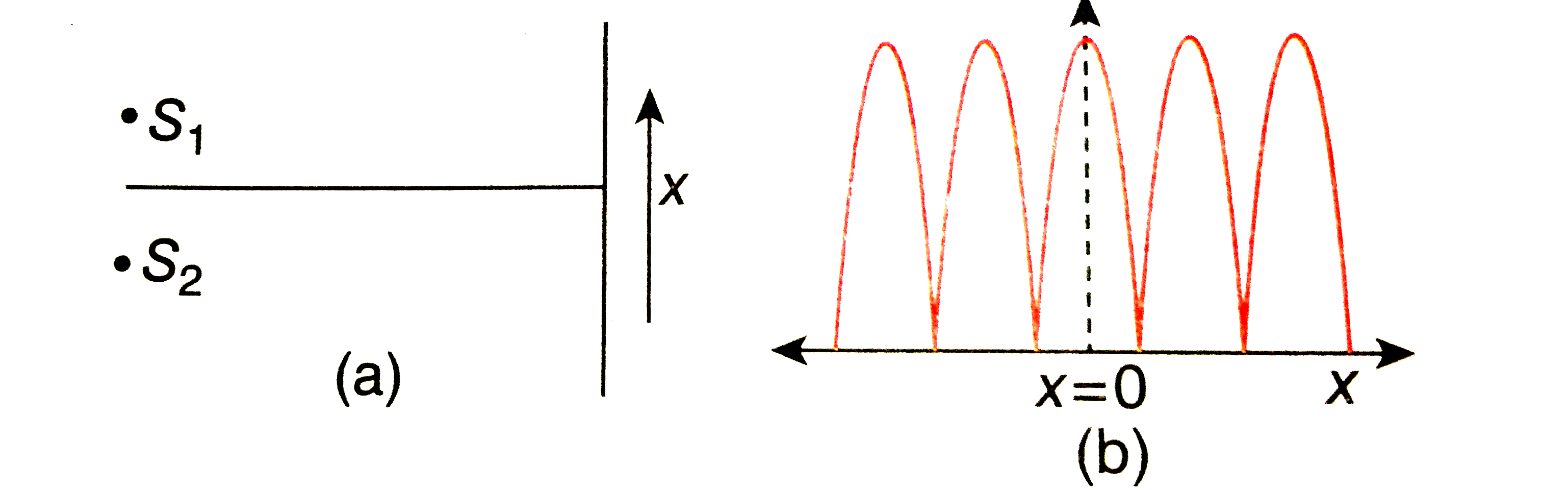
Two sources `S_(1)` and `S_(2)` of intensity `I_(1)`and `I_(2)` are pIaced font of a screen [fig .6.24(a)]. The pattern of intensity distrtbution seen in the centraI portion is given in fig.6.24(b). Which of the foIIowing statements are true?

A

`S_(1)` and `S_(2)` have same intensities

B

`S_(1)` and `S_(2)` have a constant phase difference

C

`S_(1)` and `S_(2)` have same phase

D

`S_(1)` and `S_(2)` have same wavelength

Text Solution

Verified by Experts

The correct Answer is:

A, B
Promotional Banner

Topper's Solved these Questions

  • LIGHT WAVE AND INTERFERENCE OF LIGHT

    CHHAYA PUBLICATION|Exercise EXERCISE (Multiple Choice Questions )|5 Videos
  • LIGHT WAVE AND INTERFERENCE OF LIGHT

    CHHAYA PUBLICATION|Exercise EXERCISE (Multiple Choice Questions ) In terference of light|8 Videos
  • LIGHT WAVE AND INTERFERENCE OF LIGHT

    CHHAYA PUBLICATION|Exercise NCERT TEXTBOOK QUESTIONS WITH ANSWER HINT|13 Videos
  • KIRCHHOFF'S LAWS AND ELECTRICAL MEASUREMENT

    CHHAYA PUBLICATION|Exercise CBSE SCANNER|16 Videos
  • Magnetic Properties of Materials

    CHHAYA PUBLICATION|Exercise CBSE SCANNER|11 Videos

Similar Questions

Explore conceptually related problems

Two waves of intensities I_(1) and I_(2) crosses a place in same direction and same time. The summation of maximum and minimum intensities is

Two coherent sources of Iight having intensities, I and 4I interfere a fainge pattern on a screen. Find the resuItant intensities at the points where the phere the phase- differ- ence between the two waves are (pi)/(2) and pi .

Two periodic waves of intensities I_1 and I_2 are travelling through a region in a same direction at the same time. What is the summation of maximum and minimum intensities?

The electrostatic potential on the surface of a charged conducting sphere is 100 V. Two statement are made in this regard - S_(1) : At any point inside the sphere, electric intensity is zero. S_(2) : At any point inside the sphere, the electrostatic potential is 100V. Which of the following is a correct statement?

Two light beams of intersities I and 4I, respectively form interference fringes on a screen. For the two beams phase difference at point a is (pi)/(2) and at point B is pi . Find the difference in resultant intensities at A and B.

A battery A (15V,1Omega) and a battery B(10V,1Omega) are joined to a resistance of 3Omega as shown in Fig.Match the statements given in Column-I with the entries given in Column-II

Each question has four choices, a,b,c and d,out of which only one is correct. Each question contains STATEMENT 1 and STATEMENT 2. if both the statements are true and statement 2 is the correct explanation of statement 1. If both the statements are true but statement 2 is not the correct explanation of statement 1. If statement is True and statement2 is false. If statement1 is false and statement2 is true. Statement 1: If x in [1,sqrt(3)], then the range of f(x)=tan^(-1)x is [pi/4,pi/3] Statement 2 : If x in [a , b], then the range of f(x)i s[f(a),f(b)]dot

Each question has four choices, a,b,c and d,out of which only one is correct. Each question contains STATEMENT 1 and STATEMENT 2. if both the statements are true and statement 2 is the correct explanation of statement 1. If both the statements are true but statement 2 is not the correct explanation of statement 1. If statement is True and statement2 is false. If statement1 is false and statement2 is true. Statement 1: f: N->R ,f(x)=sinx is a one-one function. Statement 2: The period of sinx i s 2pia n d2pi is an irrational number.

When waves from two coherent source of amplitudes a and b superimpose , the amplitude R of the resultant wave is given by R = sqrt(a^(2)+b^(2)+2ab cos phi). where phi is the constant phase angle between the two waves. The resultant intensity I is directly proportional to the square of the amplitude of the resultant wave i.e I prop R^(2) i.e, I prop (a^(2) +b^(2) +2ab cos phi ) For constructive interference , phi = 2n pi " ""and"" " I _("max") = (a+b)^(2) For destructive interference , phi = (2n-1) pi "and" I_("min") = (a-b)^(2) If I_(1) I_(2) are intensities from two slits of width w_(1) "and" w_(2) then I_(1)/I_(2)=w_(1)/w_(2)=a^(2)/b^(2) Light waves from two coherent sources of intensity ratio 81 : 1 produce interference. With the help of the passage choose the most appropriate alternative for each of the following questions If two slits in Young's experiment have width ratio 1:4 the ratio of maximum and minimum intensity in the interference pattern would be

When waves from two coherent source of amplitudes a and b superimpose , the amplitude R of the resultant wave is given by R = sqrt(a^(2)+b^(2)+2ab cos phi). where phi is the constant phase angle between the two waves. The resultant intensity I is directly proportional to the square of the amplitude of the resultant wave i.e I prop R^(2) i.e, I prop (a^(2) +b^(2) +2ab cos phi ) For constructive interference , phi = 2n pi " ""and"" " I _("max") = (a+b)^(2) For destructive interference , phi = (2n-1) pi "and" I_("min") = (a-b)^(2) If I_(1) I_(2) are intensities from two slits of width w_(1) "and" w_(2) then I_(1)/I_(2)=w_(1)/w_(2)=a^(2)/b^(2) Light waves from two coherent sources of intensity ratio 81 : 1 produce interference. With the help of the passage choose the most appropriate alternative for each of the following questions The ratio of maxima and minima in the interference pattern is
