Home
Class 12
PHYSICS
In 8000 y, a radioactive substance reduc...

In 8000 y, a radioactive substance reduces a `1/32`th part of its initial amount. Determine its half-life.

Text Solution

Verified by Experts
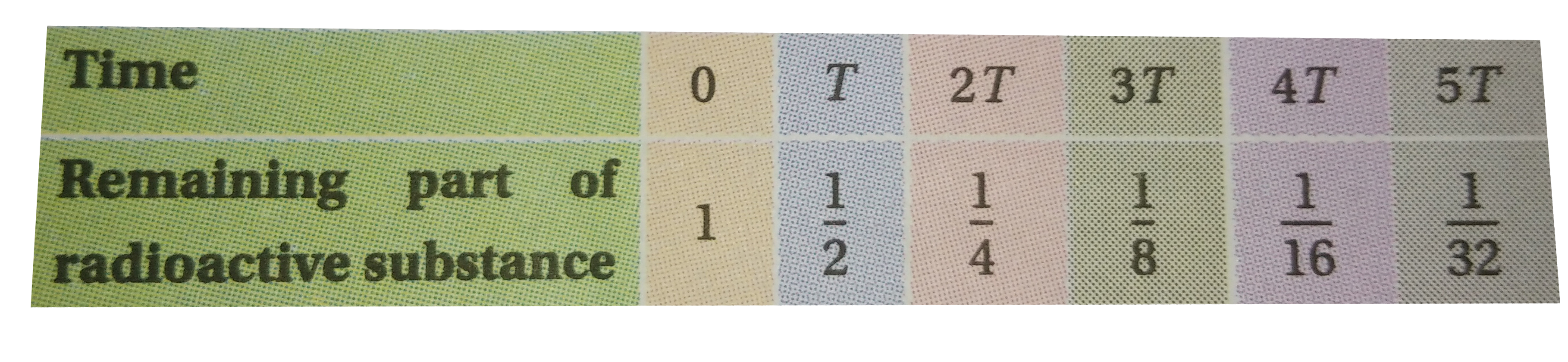
Let initial amount of radioactive substance be 1 and half-life is T.

`therefore` According to question,
5T=8000 or , `T=8000/5`=1600 y
Promotional Banner

Topper's Solved these Questions

  • ATOMIC NUCLEUS

    CHHAYA PUBLICATION|Exercise SECTION RELATED QUESTIONS|54 Videos
  • ATOMIC NUCLEUS

    CHHAYA PUBLICATION|Exercise HOTS QUESTION|14 Videos
  • ATOM

    CHHAYA PUBLICATION|Exercise CBSE SCANNER|18 Videos
  • CAPACITANCE AND CAPACITOR

    CHHAYA PUBLICATION|Exercise CBSE SCANNER|15 Videos

Similar Questions

Explore conceptually related problems

In-8000 years a radioactive element is reduced to 1/32 of its initial amount. What is its half life?

A radioactive material reduces to 1/8 th of its initial amount in 18000 y. Find its half-life period.

If a radioactive substance disintegrates by 20% in 5d, then what part of the initial mass of the substance will remain intact after 15 d?

The initial number of radioactive atoms in a radioactive sample is N_0 . If after time t the number of becomes N, then N=N_0e^(-lambdat) , where lambda is known as the decay constant of the element. The time in which the number of radioactive atoms becomes half of its initial number is called the half-life (T) of the element. The time in which the number of atoms falls to 1/e times of its initial number is the mean life (tau) of the element. The product lambdaN is the activity (A) of the radioactive sample when the number of atoms is N. The SI unit of activity is bequerel (Bq)' where 1 Bq= 1 decay. s^(-1) . After how many days the activity of Iodine-131 will be 1/16 th of its initial value. [The half-life of Iodine-131 is 8 d.] (A) 24 d (B) 32 d (C) 40 d (D) 48 d

The initial number of radioactive atoms in a radioactive sample is N_0 . If after time t the number of becomes N, then N=N_0e^(-lambdat) , where lambda is known as the decay constant of the element. The time in which the number of radioactive atoms becomes half of its initial number is called the half-life (T) of the element. The time in which the number of atoms falls to 1/e times of its initial number is the mean life (tau) of the element. The product lambdaN is the activity (A) of the radioactive sample when the number of atoms is N. The SI unit of activity is bequerel (Bq)' where 1 Bq = 1 decay. s^(-1) , and Avogadro's number, N=6.023xx10^23 What is the ratio of activity of same amount of sodium-24 to that of iodine-131? [half life of sodium-24 is 15h.] (A) 1/70 (B) 1/7 (C) 7 (D) 70

The initial number of radioactive atoms in a radioactive sample is N_0 . If after time t the number of becomes N, then N=N_0e^(-lambdat) , where lambda is known as the decay constant of the element. The time in which the number of radioactive atoms becomes half of its initial number is called the half-life (T) of the element. The time in which the number of atoms falls to 1/e times of its initial number is the mean life (tau) of the element. The product lambdaN is the activity (A) of the radioactive sample when the number of atoms is N. The SI unit of activity is bequerel (Bq)' where 1 Bq = 1 decay. s^(-1) . The half-life of Iodine-131 is 8 d. Its mean life (in SI) is - (A) 4.79xx10^5 s. (B) 6.912xx10^5 s. (C) 9.974 xx 10^5 s. (D) 22.96xx10^5 s.

The initial number of radioactive atoms in a radioactive sample is N_0 . If after time t the number of becomes N, then N=N_0e^(-lambdat) , where lambda is known as the decay constant of the element. The time in which the number of radioactive atoms becomes half of its initial number is called the half-life (T) of the element. The time in which the number of atoms falls to 1/e times of its initial number is the mean life (tau) of the element. The product lambdaN is the activity (A) of the radioactive sample when the number of atoms is N. The SI unit of activity is bequerel (Bq)' where 1 Bq = 1 decay. s^(-1) , The half-life of Iodine-131 is 8d. Its decay constant (in SI) is - (A) 10^(-6) (B) 1.45xx10^(-6) (C) 2xx10^(-6) (D) 2.9xx10^(-6)

A first order reaction takes 60 minutes for 75% completion. Determine its half- life.

The initial number of radioactive atoms in a radioactive sample is N_0 . If after time t the number of becomes N, then N=N_0e^(-lambdat) , where lambda is known as the decay constant of the element. The time in which the number of radioactive atoms becomes half of its initial number is called the half-life (T) of the element. The time in which the number of atoms falls to 1/e times of its initial number is the mean life (tau) of the element. The product lambdaN is the activity (A) of the radioactive sample when the number of atoms is N. The SI unit of activity is bequerel (Bq)' where 1 Bq = 1 decay. s^(-1) . The half-life of Iodine-131 is 8 d. What is the activity (in Bq) of 1 g of Iodine? (A) 2.3xx10^15 (B) 4.6xx10^15 (C) 6.9xx10^15 (D) 9.2xx10^15

0.0625g remains from 1g of a radioactive element after 20 years of radioactive decay. Determine the rate constant and half-life (t_(1//2)) of the reaction. How much of the element did remain after 10 years from the start?

