Home
Class 12
PHYSICS
In an interference experiment, the two s...

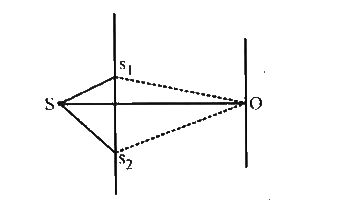
In an interference experiment, the two slits `S_(1) and S_(2)` are not equidistant from the source S. then the central fringe at 0 will be

A

always dark

B

always bright

C

either bright or dark depending upon the position of S

D

neither dark nor bright

Text Solution

Verified by Experts

The correct Answer is:

C

It depends upon the path diff. `(S S_(2)+S_(2)O)-(S S_(1)+S_(1)0)`.
Promotional Banner

Topper's Solved these Questions

  • INTERFERENCE AND DIFFRACTION

    MARVEL PUBLICATION|Exercise TEST YOUR GRASP|20 Videos
  • GRAVITATION

    MARVEL PUBLICATION|Exercise TEST YOUR GRASP -2|20 Videos
  • KINETIC THEORY OF GASES ,THERMODYNAMICS AND RADIATION

    MARVEL PUBLICATION|Exercise TEST YOUR GRASP - 9|30 Videos

Similar Questions

Explore conceptually related problems

In the set up shown in figure, the two slits S_1 and S_2 are not equidistant from the slit S. The central fringe at O is then

A monochromatic light source of wavelength lamda is placed at S. three slits S_(1),S_(2) and S_(3) are equidistant from the source S and the point P on the screen S_(1)P-S_(2)P=lamda//6 and S_(1)P-S_(3)P=2lamda//3 . if I be the intensity at P when only one slit is open the intensity at P when all the three slits are open is-

When light from two sources (say slits S_(1) and S_(2) ) interfere, they form alternate dark and bright fringes. Bright fringe is formed at all point where the path difference is an odd multiple of half wavelength. At the condition of equal amplitudes, A_(1) = A_(2) = a , the maximum intensity will be 4 a^(2) and the visibility improves, The resultant intensity can also be indicated with phase factor as I = 2 a^(2) cos^(2) (phi // 2) .Using this passage, answer the following questions. If the path difference between the slits S_(1) and S_(2) is (lambda)/(2) the central fringe will have an intensity of

In a interference arrangement similar to Young's double-slit experiment ,the slits S_(1) and S_(2) are illuminated with coheremt microwave source ,each of frequencies 10^(6) Hz.The source are syhronized to have zero phase difference.The slits are separated by a distance from S_(1) and S_(2) where theta is defined as shown if I_(0) is the maximum intensity then

In Young’s experiment small gap between the two slits is d, and distance of screen from the slits is D. Then the number of fringes per metre that will appear on screen by mono-chromatic source of wavelength of lamda , will be :

Fringe width equal to 1 mm is observed in the interference pattern of biprism experiment. Then the distance of nearest bright fringe from the central bright fringe will be :

In a young’s double slit experiment the distance between slits S1 and S2 is d and distance of slit plane from the screen is D (gtgt d) . The point source of light (S) is placed a distance (d) / (2 ) below the principal axis in the focal plane of the convex lens (L). The slits S1 and S2 are located symmetrically with respect to the principal axis of the lens. Focal length of the lens is f (gtgt d) . Find the distance of the central maxima of the fringe pattern from the centre (O) of the screen.

Consider the situation shown in figure-6.35. The two slits S_(1) and S_(2) placed symmetrically around the central line are illuminated by a monochromatic light of wavelength lambda . The separation between the slits is d. The light transmitted by the slits falls on a screen E_(1) placed at a distance D from the slits. The slit S_(3) is at the central line and the slit S_(4) is at a distance z from S_(3) . Another screen E_(2) is placed a further distance D away from E_(1) . Find the ratio of the maximum to minimum intensity observed on E_(2) if z is equal is : (a) (lambdaD)/(2d) " "(b) (lambdaD)/(d)" " (c )(lambdaD)/(4d)

MARVEL PUBLICATION-INTERFERENCE AND DIFFRACTION-TEST YOUR GRASP
  1. In an interference experiment, the two slits S(1) and S(2) are not equ...

    Text Solution

    |

  2. Two waves having the intensities in the ratio of 9 : 1 produce interfe...

    Text Solution

    |

  3. A point P is situated at 40.1 cm and 40.2 cm away from two coherent so...

    Text Solution

    |

  4. Two coherent monochromatic light beams of intensities I and 4I are sup...

    Text Solution

    |

  5. In Young's double slit experiment carried out with wavelength lamda=50...

    Text Solution

    |

  6. In Young's experiment, interference fringes are obtained on a screen p...

    Text Solution

    |

  7. In a young's double slit experiment, one of the slits is covered by a ...

    Text Solution

    |

  8. In Young's double slit experiment, the two slits are at a distance 'd'...

    Text Solution

    |

  9. In Youngs 's double slit experiment, the fringe width obtained by usin...

    Text Solution

    |

  10. In Young's double slit experiment, the maximum intensity is I(0). What...

    Text Solution

    |

  11. In a biprism experiment the band width is 0.4 mm when the eye piece is...

    Text Solution

    |

  12. In a biprism experiment, the distance between the consecutive bright b...

    Text Solution

    |

  13. Microwave ocillators S(1) and S(2) are used to show interference of el...

    Text Solution

    |

  14. Two sources of light P and Q have wavelengths 6000 Å and 5500 Å respec...

    Text Solution

    |

  15. Light of wavelength 5000 Å, illuminates the slit in a biprism experime...

    Text Solution

    |

  16. A diffraction patter is obtained by making lbue light incident on a na...

    Text Solution

    |

  17. Light of wavelength lambda is incident on a slit of width d and distan...

    Text Solution

    |

  18. A light wave is incident normally over a slit of width 24xx10^-5cm. Th...

    Text Solution

    |

  19. In a Fraunhoffer diffraction at single slit of width 'a' with incident...

    Text Solution

    |

  20. By using light of wavelength 5200 Å, two points separated by a distanc...

    Text Solution

    |

  21. What is the resolving power of a telescope whose objective lens has a ...

    Text Solution

    |
