Home
Class 12
PHYSICS
The human eye has an approximate angular...

The human eye has an approximate angular resolution of `phi = 5.8xx10^(-4)` rad and a typical photo printer prints a minimum of 300 dpi (dots per inch, `= 2.54 cm`). Aminimum distance 'z' should a printed page be held so that one doesnot see the indivdual dots is ______ .

A

17 cm

B

12.5 cm

C

14.5 cm

D

16.3 cm

Text Solution

Verified by Experts

The correct Answer is:
C

The printer prints 300 dots per inch.
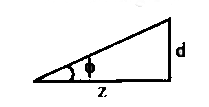
`therefore` The linear distance between two dots=d
`=(2.54)/(300)cm=0.84xx10^(-2)cm`
At a distance of z cm, this distance subtends an angle `phi`.
`because tanphi=phi=(d)/(z)`

`therefore z=(d)/(phi)=(0.84xx10^(-2))/(5.8xx10^(-4))=(84)/(5.8)=14.5cm`
Promotional Banner

Topper's Solved these Questions

  • INTERFERENCE AND DIFFRACTION

    MARVEL PUBLICATION|Exercise TEST YOUR GRASP|20 Videos
  • GRAVITATION

    MARVEL PUBLICATION|Exercise TEST YOUR GRASP -2|20 Videos
  • KINETIC THEORY OF GASES ,THERMODYNAMICS AND RADIATION

    MARVEL PUBLICATION|Exercise TEST YOUR GRASP - 9|30 Videos

Similar Questions

Explore conceptually related problems

Two metallic plate A and B , each of area 5 xx 10^(-4)m^(2) , are placed parallel to each at a separation of 1 cm plate B carries a positive charge of 33.7 xx 10^(-12) C A monocharonatic beam of light , with photoes of energy 5 eV each , starts falling on plate A at t = 0 so that 10^(16) photons fall on it per sqare mater for every 10^(6) incident photons fall on it per square meter per second Assume that one photoelectron is emitted for every 10^(6) incident photons . Also assume that all the emitted photoelectron are collected by plate B and the work function of plate A remain constant at the value 2 eV Determine (a) the number of photoelectrons emitted up to i = 10s, (b) the magnitude of the electron field between the plate A and B at i = 10 s, and (c ) the kinetic energy of the most energotic photoelectrons emitted at i = 10 s whenit reaches plate B Negilect the time taken by the photoelectrons to reach plate B Take epsilon_(0) = 8.85 xx 10^(-12)C^(2)N- m^(2))

A mercury arc lamp provides 0.10 W of UV radiation at a wavelength of lambda = 2537Å (all other wavelenghts having been absorbed by filters). The cathode of photoelectric device (a photo-tube) consists of potassium and has an effective area of 4cm^(2) . The anode is located at a distance of 1 m from radiation source. The work function for potassium is phi_(0) = 2.22eV . (a) According to classical theory, the radiation from the arc spreads out uniformly in space as spherical wave. What time of exposure to the radiation should be required for a potassium atoms(radius 2 Å) in the anode to accumulate sufficient energy to eject a photo-electron? (b) What is the energy of a single photon from the source? (C) What is the flux of photons(number per second) at the cathode? To what saturation current does this flux correspond if the photo-conversion efficiency is 5% (i.e. if each photon has a probability of 0.05 of ejecting an electron). (d) what is the cutt off potential V_(0) ?

MARVEL PUBLICATION-INTERFERENCE AND DIFFRACTION-TEST YOUR GRASP
  1. The human eye has an approximate angular resolution of phi = 5.8xx10^(...

    Text Solution

    |

  2. Two waves having the intensities in the ratio of 9 : 1 produce interfe...

    Text Solution

    |

  3. A point P is situated at 40.1 cm and 40.2 cm away from two coherent so...

    Text Solution

    |

  4. Two coherent monochromatic light beams of intensities I and 4I are sup...

    Text Solution

    |

  5. In Young's double slit experiment carried out with wavelength lamda=50...

    Text Solution

    |

  6. In Young's experiment, interference fringes are obtained on a screen p...

    Text Solution

    |

  7. In a young's double slit experiment, one of the slits is covered by a ...

    Text Solution

    |

  8. In Young's double slit experiment, the two slits are at a distance 'd'...

    Text Solution

    |

  9. In Youngs 's double slit experiment, the fringe width obtained by usin...

    Text Solution

    |

  10. In Young's double slit experiment, the maximum intensity is I(0). What...

    Text Solution

    |

  11. In a biprism experiment the band width is 0.4 mm when the eye piece is...

    Text Solution

    |

  12. In a biprism experiment, the distance between the consecutive bright b...

    Text Solution

    |

  13. Microwave ocillators S(1) and S(2) are used to show interference of el...

    Text Solution

    |

  14. Two sources of light P and Q have wavelengths 6000 Å and 5500 Å respec...

    Text Solution

    |

  15. Light of wavelength 5000 Å, illuminates the slit in a biprism experime...

    Text Solution

    |

  16. A diffraction patter is obtained by making lbue light incident on a na...

    Text Solution

    |

  17. Light of wavelength lambda is incident on a slit of width d and distan...

    Text Solution

    |

  18. A light wave is incident normally over a slit of width 24xx10^-5cm. Th...

    Text Solution

    |

  19. In a Fraunhoffer diffraction at single slit of width 'a' with incident...

    Text Solution

    |

  20. By using light of wavelength 5200 Å, two points separated by a distanc...

    Text Solution

    |

  21. What is the resolving power of a telescope whose objective lens has a ...

    Text Solution

    |

