Home
Class 11
PHYSICS
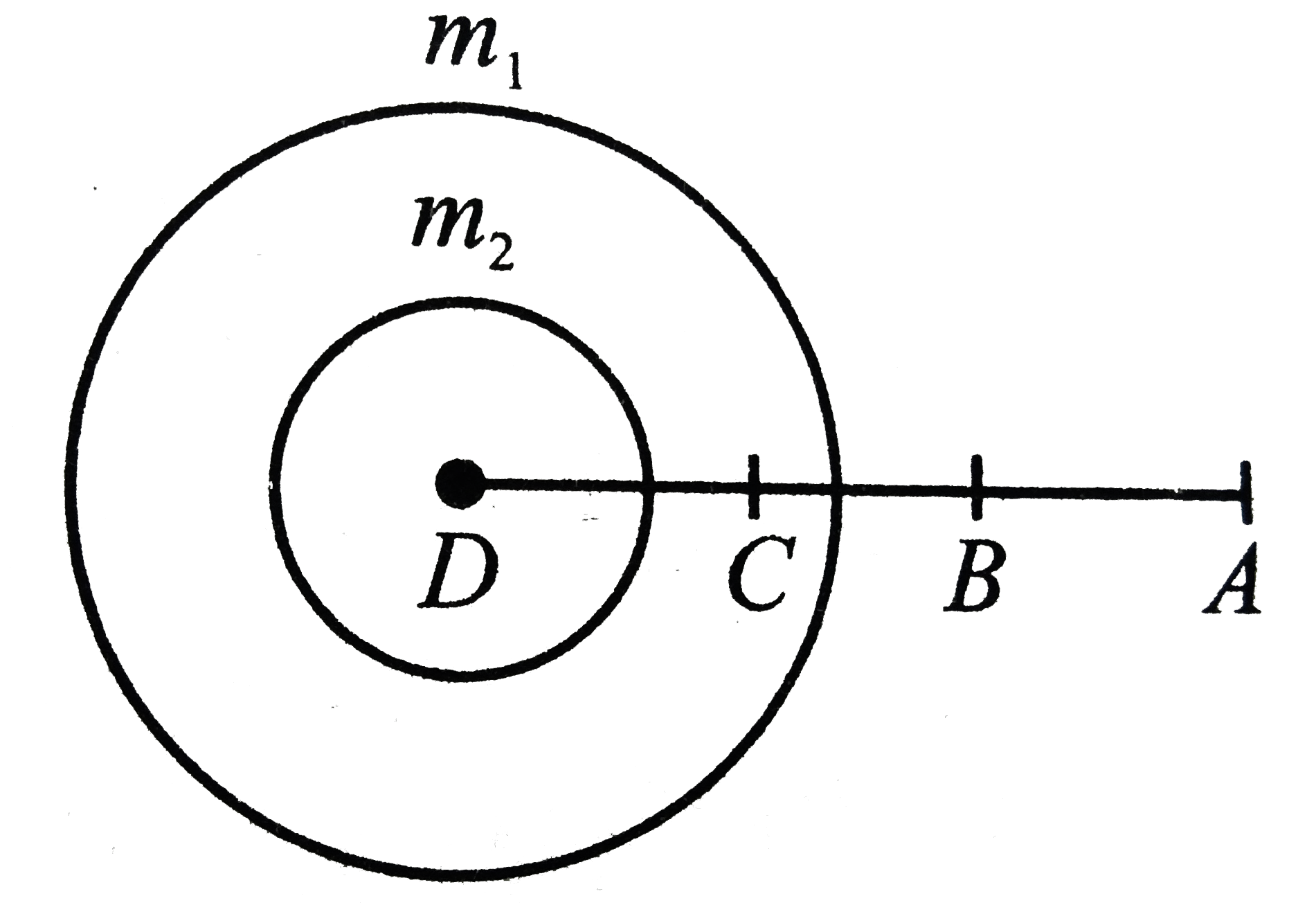
Figure shows two shells of masses m(1) a...

Figure shows two shells of masses `m_(1)` and `m_(2)`. The shells are concentric. At which point, a particle of mass `m` shall experience zero force?

A

`A`

B

`B`

C

`C`

D

`D`

Text Solution

Verified by Experts

The correct Answer is:

D

the gravitational field intensity at a point inside the spherical shell is zero.
Promotional Banner

Topper's Solved these Questions

  • GRAVITATION

    NARAYNA|Exercise LEVEL II (C.W.)|38 Videos
  • GRAVITATION

    NARAYNA|Exercise LEVEL III|44 Videos
  • GRAVITATION

    NARAYNA|Exercise C.U.Q|220 Videos
  • FRICTION

    NARAYNA|Exercise Passage type of questions I|6 Videos
  • KINETIC THEORY OF GASES

    NARAYNA|Exercise LEVEL-III(C.W)|52 Videos

Similar Questions

Explore conceptually related problems

Two concentric shells of mass m_(1) and m_(2) are situated as shown. Find the force on a particle of mass m when the particles is located at (a) r=r_(1),(b)r=r_(2),(c)r=r_(3) . The distance r is measured from the centre of the shell.

The figure shows a spherical shell of mass M . The point a is not at the centre but away from the centre of the shell. If a particle of mass m is placed at A , then

In the figure given below, two particles of masses m and 2m are fixed in place on an axis. Where on the axis can a third particle of mass 3m be placed (other than at infinity) so that the gravitational force on it from the first two particles is zero?

Two concentric shells of masses M_(1) and M_(2) are concentric as shown. Calculate the gravitational force on m due to M_(1) at points P,Q and R .

Two concentric shells of uniform density of mass M_(1) and M_(2) are situated. The forces experienced by a particle of mass m when palced at positions A,B and C respectively are given OA =p,OB = q and OC =r . .

F is the gravitational force between two point masses m_(1) and m_(2) , separated by a distance d. A point mass 2m_(1) is then brought near m_(1) . What is the total force on m_(2) ?

Two spherical shells have masses m and 2m as shows. Choose the correct options.

Two stationary particles of masses M_(1) and M_(2) are 'd' distance apart. A third particle lying on the line joining the particles, experiences no resultant gravitational force. What is the distance of this particle from M_(1) ?

Consider a system of two particles having masses m_(1) and m_(2) . If the particle of mass m_(1) is pushed towards the centre of mass of particles through a distance d , by what distance would the particle of mass m_(2) move so as to keep the mass centre of particles at the original position?

NARAYNA-GRAVITATION-LEVEL I(C.W.)
  1. A person brings a mass 2kg from A to B. The increase in kinetic energy...

    Text Solution

    |

  2. The work done liftting a particle of mass 'm' from the centre of the e...

    Text Solution

    |

  3. Figure shows two shells of masses m(1) and m(2). The shells are concen...

    Text Solution

    |

  4. Energy required to move a body of mass m from an orbit of radius 2R to...

    Text Solution

    |

  5. the ratio of escape velocities of two planets if g value on the two pl...

    Text Solution

    |

  6. The escape velocity from the surface of the earth of radius R and dens...

    Text Solution

    |

  7. A body is projected vertically up from surface of the earth with a vel...

    Text Solution

    |

  8. A spaceship is launched in to a circular orbit of radius R close to su...

    Text Solution

    |

  9. The escape velocity from the earth is 11 km//s. The escape velocity fr...

    Text Solution

    |

  10. An object of mass m is at rest on earth's surface. Escape speed of thi...

    Text Solution

    |

  11. A satellite revolves in a circular orbit with speed, V=1/(sqrt(3))V(e)...

    Text Solution

    |

  12. A space station is set up in space at a distance equal to the earth's ...

    Text Solution

    |

  13. The orbital speed for an earth satellite near the surface of the earth...

    Text Solution

    |

  14. Two satellite are revolving round the earth at different heights. The...

    Text Solution

    |

  15. A satellite of mass m revolves around the earth of radius R at a hight...

    Text Solution

    |

  16. Two satellites M and N go around the earth in circular orbits at heigh...

    Text Solution

    |

  17. A satellite of mass m revolves revolves round the earth of mass M in a...

    Text Solution

    |

  18. The moon revolves round the earth 13 times in one year. If the ratio o...

    Text Solution

    |

  19. A satellite is launched into a circular orbit of radius R around the e...

    Text Solution

    |

  20. An astronaut orbiting in a spaceship round the earth has a centripetal...

    Text Solution

    |
