Home
Class 11
PHYSICS
Two satellites S(1) and S(2) are revolvi...

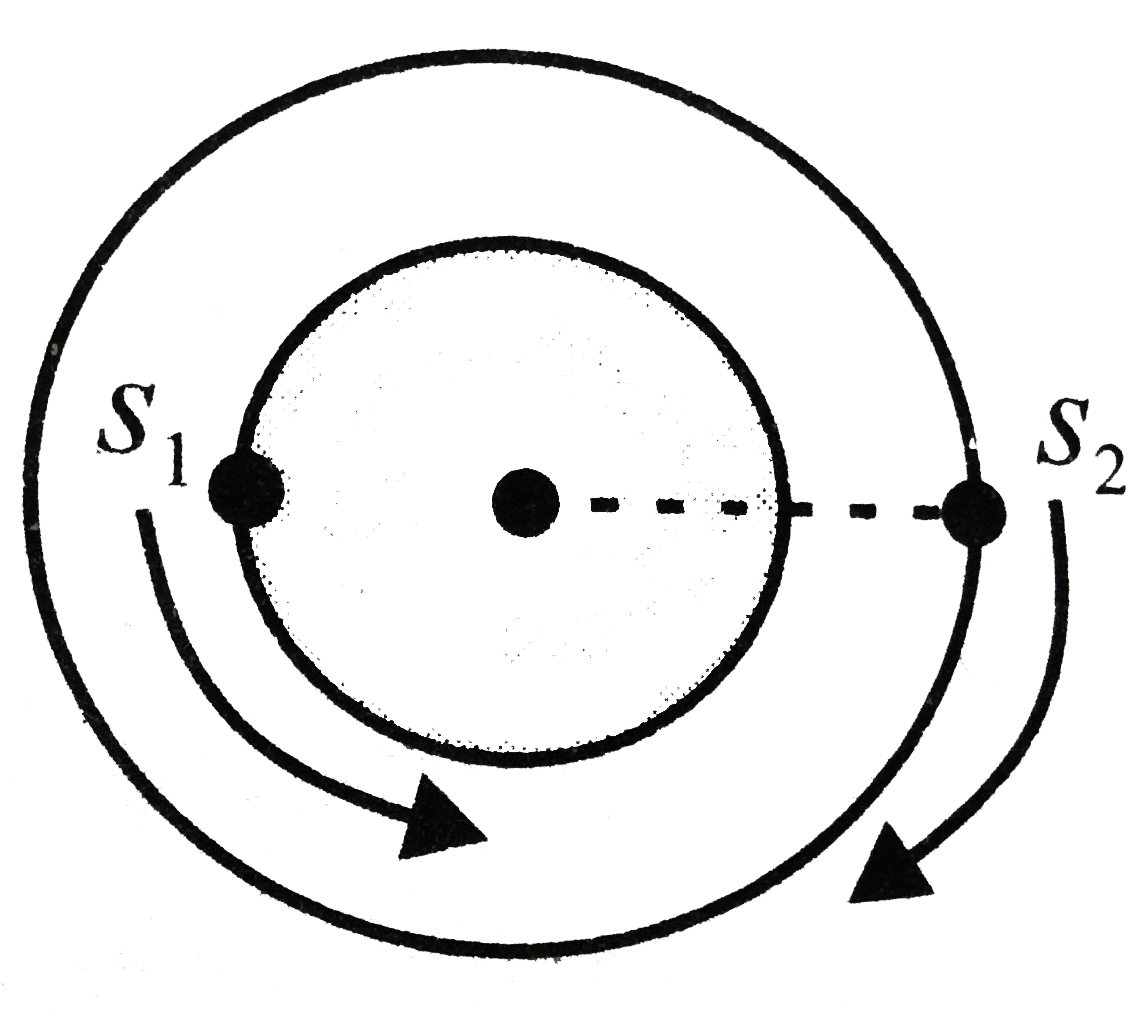
Two satellites `S_(1)` and `S_(2)` are revolving around the earth in coplanar concentric orbits in the opposite sense. At `t=0`, the position of satellites are shown in the diagram. The periods of `S_(1)` and `S_(2)` are `4h` and `24h`, respectively. The radius of orbit of `S_(1)` is `1.28xx10^(4)km`. For this situation, mark the correct statement (s).

A

The angular velocity of `S_(2)` as observed by `S_(1)` at `t=12 h` is `0.486 pi rad s^(-1)`

B

The two satellites are closest to each other for the first time at `t=12 h` and then after every `2h` they are closest to each other

C

The orbital velocity of `S_(1)` is `0.64 pixx10^(4) km`

D

The velocity of `S_(1)` relative to `S_(2)` is continuously changing in magnitude and direction both

Text Solution

Verified by Experts

The correct Answer is:

A, B, C, D

From Kepler's law `T^(2)propR^(3)`. So, `(T_(1))/(T_(2))=((R_(1))/(R_(2)))^(3/2)`
`R_(2)=((T_(2))/(T_(1)))^(2/3)xxR_(1)=(24/6)^(2/3)xx1.28xx10^(4)km`
`=3.22xx10^(4)km` orbital velocity of `S_(1)` is `v_(1)=(2piR_(1))/(T_(1))=(2pixx1.28xx10^(4))/4=0.64pixx10^(4)km`
Orbital velocity of `S_(2)` is
`v_(2)=(2piR_(2))/(T_(2))=(2pixx1.28xx10^(4))/4=0.64pixx10^(4) km`. At `t=12 h` the two satellites are closest to each other and after every `24h` they come at same position relative to each other. it is clear that direction of `v_(2)` w.r.t `v_(1)` is changing continuously in both magnitude and direction.
Angular velocity of `S_(2)` w.r.t. `S_(1)` at `t=12 h` is `omega=v_(1)+v_(2)//R_(2)-R_(1)=0.469 pi rads^(-1)`. this can be easily proved by writing the basic equations.
Promotional Banner

Topper's Solved these Questions

  • GRAVITATION

    NARAYNA|Exercise LEVEL-VI|42 Videos
  • GRAVITATION

    NARAYNA|Exercise ILLUSTRATION|49 Videos
  • GRAVITATION

    NARAYNA|Exercise LEVEL-II (H.W)|32 Videos
  • FRICTION

    NARAYNA|Exercise Passage type of questions I|6 Videos
  • KINETIC THEORY OF GASES

    NARAYNA|Exercise LEVEL-III(C.W)|52 Videos

Similar Questions

Explore conceptually related problems

Two satellites S_(1) and S_(2) are revolving around a planet in the opposite sense in coplanar circular concentric orbits. At time t = 0, the satellites are farthest apart. The periods of revolution of S_(1) and S_(2) are 3 h and 24 h respectively. The radius of the orbit of S_(1) is 3xx10^(4) km. Then the orbital speed of S_(2) as observed from

A satellite of mass M_(s) is revolving around the earth (Mass M) in a orbit of radius R. Find its angular momentum.

Two satellites S_(1) and S_(2) are revolving round a planet in coplanar and concentric circular orbit of radii R_(1) and R_(2) in te same direction respectively. Their respective periods of revolution are 1 hr and 8 hr. the radius of the orbit of satellite S_(1) is equal to 10^(4) km. Find the relative speed in kmph when they are closest.

Two satellite S_(1) and S_(2) revolve round a planet in coplanar circular orbits in the same sense. Their periods of revolution are 1hr and 8hours respectively. The radius of the orbit of S_(1) is 10^(4)km . When S_(2) is closet to S_(1) (i) the speed S_(2) relative to S_(1) as actually observed by an astronaut in S_(1) .

Two saetllites S_(1) and S_(2) revolve around a planet in coplaner circular orbit in the same sense. Their periods of revolutions are 1 hour and 8 hours respectively. The radius of orbit of S_(1) is 10^(4) km . When S_(2) is closed to S_(1) , the speed of S_(2) relative to S_(1) is pi xx 10^(n) km//h . what is the value of n ?

If a satellite of mass 400 kg revolves around the earth in an orbit with speed 200 m/s then its potential energy is

If a satellite of mass 400 kg revolves around the earth in an orbit with speed 200 m/s then its potential energy is

Two satellites S_1 and S_2 revolve around the earth at distances 3R and 6R from the centre of the earth. Find the ratio of their (a) linear speeds and (b) angular speeds.

Two satellite S_(1) and S_(2) revolve around a planet in coplanar circular orbits in the opposite sense. The periods of revolutions are T and eta T respectively. Find the angular speed of S_(2) as observed by an astronouts in S_(1) , are observed by an astronaut in S_(1) , when they are closest to each other.

NARAYNA-GRAVITATION-LEVEL-V
  1. A solid sphere of uniform density and radius 4 units is located with i...

    Text Solution

    |

  2. A double star consists of two stars having masses M and 2M. The distan...

    Text Solution

    |

  3. Two satellites S(1) and S(2) are revolving around the earth in coplana...

    Text Solution

    |

  4. A solid sphere of mass m and radius r is placed inside a hollow thin s...

    Text Solution

    |

  5. A solid sphere of mass m radius r is placed inside a hollow thin spher...

    Text Solution

    |

  6. A solid sphere of mass m radius r is placed inside a hollow thin spher...

    Text Solution

    |

  7. In the graph shown, the PE of earth-satellite system is shown by a sol...

    Text Solution

    |

  8. In the graph shown, the PE of earth-satellite system is shown by a sol...

    Text Solution

    |

  9. In the graph shown, the PE of earth-satellite system is shown by a sol...

    Text Solution

    |

  10. A triple star system consists of two stars each of mass m in the same ...

    Text Solution

    |

  11. A triple stars system consists of two stars each of mass m in the same...

    Text Solution

    |

  12. A triple star system consists of two stars each of mass m in the same ...

    Text Solution

    |

  13. Consider a hypothetical planet which is very long and cylinderical. Th...

    Text Solution

    |

  14. Consider a hypothetical planet which is very long and cylinderical. Th...

    Text Solution

    |

  15. Consider a hypothetical planet which is very long and cylinderical. Th...

    Text Solution

    |

  16. Two planets of equal mass orbit a much massive star (figure). Planet m...

    Text Solution

    |

  17. Two planets of equal mass orbit a much massive star (figure). Planet m...

    Text Solution

    |

  18. Two planets of equal mass orbit a much massive star (figure). Planet m...

    Text Solution

    |

  19. A star can be considered as spherical ball of hot gas of radius R. Ins...

    Text Solution

    |

  20. A star can be considered as spherical ball of hot gas of radius R. Ins...

    Text Solution

    |
