Home
Class 11
PHYSICS
Two planets of equal mass orbit a much m...

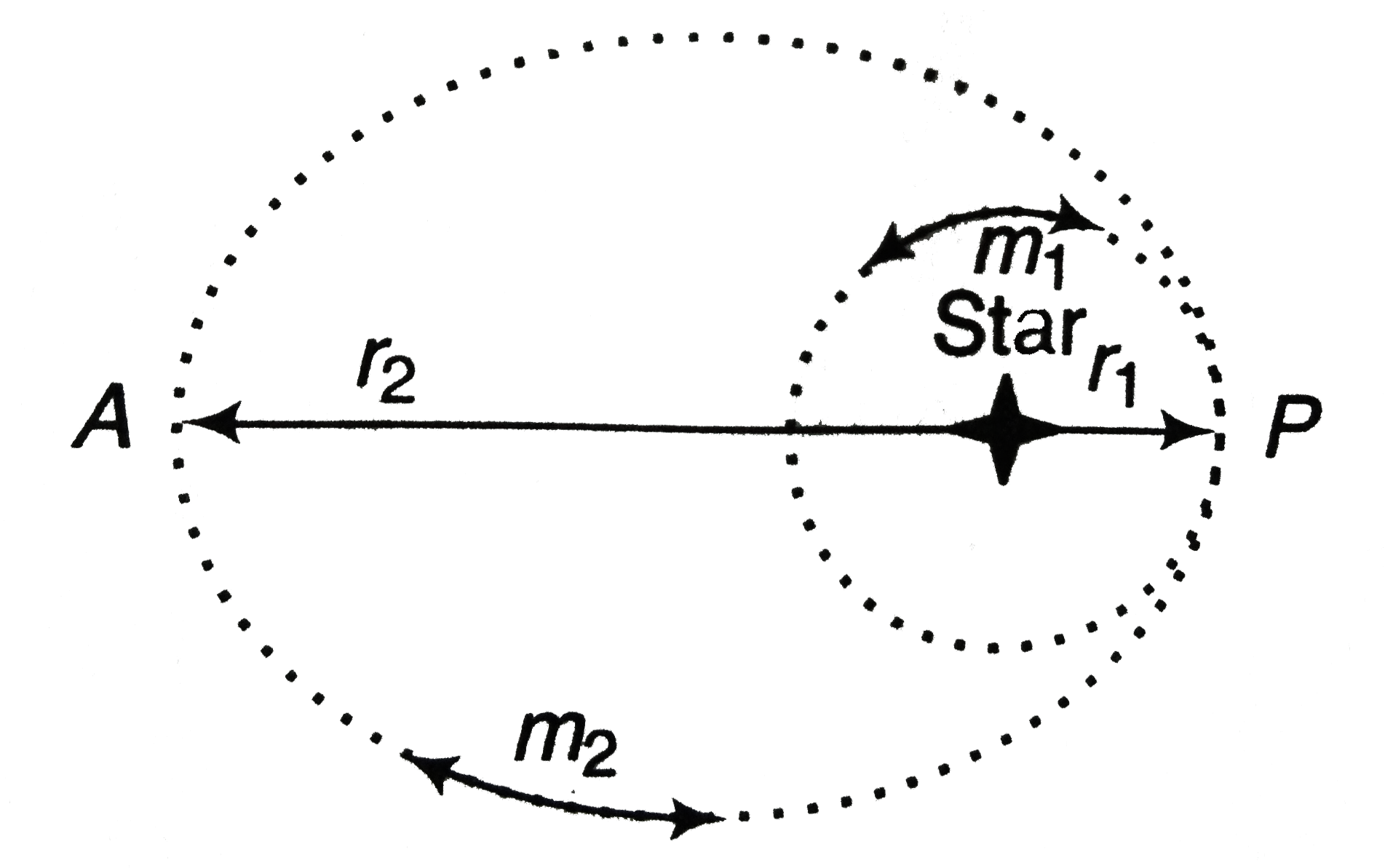
Two planets of equal mass orbit a much massive star (figure). Planet `m_(1)` moves in circular orbit of radius `1 xx 10^(8) km` with period `2 yr`. Planet `m_(2)` moves in an elliptical orbit with closest distance `r_(1) = 1 xx 10^(8) km` and farthest distance `r_(2) = 1.8 xx 10^(8) km`, as shown.

(a) Using the fact that the mean radius of an elliptical orbit is the length of the semi-major axis, find the period of `m_(2)'s` orbit.
(b) Which planet has the greater speed at point `P`? Which has the greater total energy?
(c ) Compare the speed of planet `m_(2)` at `P` with that at `A`.

A

`5.29xx10^(20) kg`

B

`1.49xx10^(25) kg`

C

`1.49xx10^(29) kg`

D

`1.49xx10^(30) Kg`

Text Solution

Verified by Experts

The correct Answer is:

C

`T=(2pir^(3//2))/(sqrt(GM)) :. M=(4pi^(2)(r^(3)))/(GT^(2))`
`=((4)(3.14)^(2)(10^(11))^(3))/((6.67xx10^(-11))(2xx365xx24xx3600)^(2))`
`=1.49xx10^(29) kg`
Promotional Banner

Topper's Solved these Questions

  • GRAVITATION

    NARAYNA|Exercise LEVEL-VI|42 Videos
  • GRAVITATION

    NARAYNA|Exercise ILLUSTRATION|49 Videos
  • GRAVITATION

    NARAYNA|Exercise LEVEL-II (H.W)|32 Videos
  • FRICTION

    NARAYNA|Exercise Passage type of questions I|6 Videos
  • KINETIC THEORY OF GASES

    NARAYNA|Exercise LEVEL-III(C.W)|52 Videos

Similar Questions

Explore conceptually related problems

Two planets of equal mass orbit a much massive star (figure). Planet m_(1) moves in circular orbit of radius 1 xx 10^(8) km with period 2 yr . Planet m_(2) moves in an elliptical orbit with closed distance r_(1) = 1 xx 10^(8) km and farthest distance r_(2) = 1.8 xx 10^(8) km , as shows. (a) Using the fact that the mean radius of an elliptical orbit is the length of the semi-major axis, find the period of m_(2)'s orbit. (b) Which planet has the greater speed at point P ? Which has the greater total energy? (c ) Compare the speed of planet m_(2) at P with that at A .

In elliptical orbit of a planet

A planet is revolving around the Sun in an elliptical orbit. Its closest distance from the Sun is r and farthest distance is R . If the orbital velocity of the planet closest to the Sun is v , then what is the velocity at the farthest point?

A plenet moving along an elliptical orbit is closest to the sun at a distance r_(1) and farthest away at a distance of r_(2) . If v_(1) and v_(2) are the linear velocities at these points respectively, then the ratio (v_(1))/(v_(2)) is

The radius of orbit of a planet is two times that of the earth. The time period of planet is

A satellite has to revolve round the earth in a circular orbit of radius 8 xx 10^(3) km. The velocity of projection of the satellite in this orbit will be -

If a planet of mass m is revolving around the sun in a circular orbit of radius r with time period, T then mass of the sun is

A planet of mass m is moving in an elliptical orbit around the sun of mass M . The semi major axis of its orbit is a, eccentricity is e . Find speed of planet V_(1) at perihelion P

All planets move in elliptical orbits with the sun situtated at one of the forci of the ellipse the point at wihich the planet is closest to the sun is

NARAYNA-GRAVITATION-LEVEL-V
  1. In the graph shown, the PE of earth-satellite system is shown by a sol...

    Text Solution

    |

  2. A triple star system consists of two stars each of mass m in the same ...

    Text Solution

    |

  3. A triple stars system consists of two stars each of mass m in the same...

    Text Solution

    |

  4. A triple star system consists of two stars each of mass m in the same ...

    Text Solution

    |

  5. Consider a hypothetical planet which is very long and cylinderical. Th...

    Text Solution

    |

  6. Consider a hypothetical planet which is very long and cylinderical. Th...

    Text Solution

    |

  7. Consider a hypothetical planet which is very long and cylinderical. Th...

    Text Solution

    |

  8. Two planets of equal mass orbit a much massive star (figure). Planet m...

    Text Solution

    |

  9. Two planets of equal mass orbit a much massive star (figure). Planet m...

    Text Solution

    |

  10. Two planets of equal mass orbit a much massive star (figure). Planet m...

    Text Solution

    |

  11. A star can be considered as spherical ball of hot gas of radius R. Ins...

    Text Solution

    |

  12. A star can be considered as spherical ball of hot gas of radius R. Ins...

    Text Solution

    |

  13. A planet revolves about the sun in an elliptical orbit of semi-major a...

    Text Solution

    |

  14. The gravitational potential energy of satellite revolving around the e...

    Text Solution

    |

  15. A particle is projected from the surface of earth with intial speed of...

    Text Solution

    |

  16. Earth is a sphere of uniform mass density. If the weight of the body i...

    Text Solution

    |

  17. Three uniform spheres, each having a mass M=5kg and radius a=2.5m are ...

    Text Solution

    |

  18. Three uniform spheres, each having a mass M=5kg and radius a=2.5m are ...

    Text Solution

    |

  19. A cord of length 64 m is used to connected a 100 kg astronaut to space...

    Text Solution

    |

  20. Two satellites of mass ratio 1:2 are revolving around the earth in cir...

    Text Solution

    |
