Home
Class 11
PHYSICS
Two satellite S(1) and S(2) revolve arou...

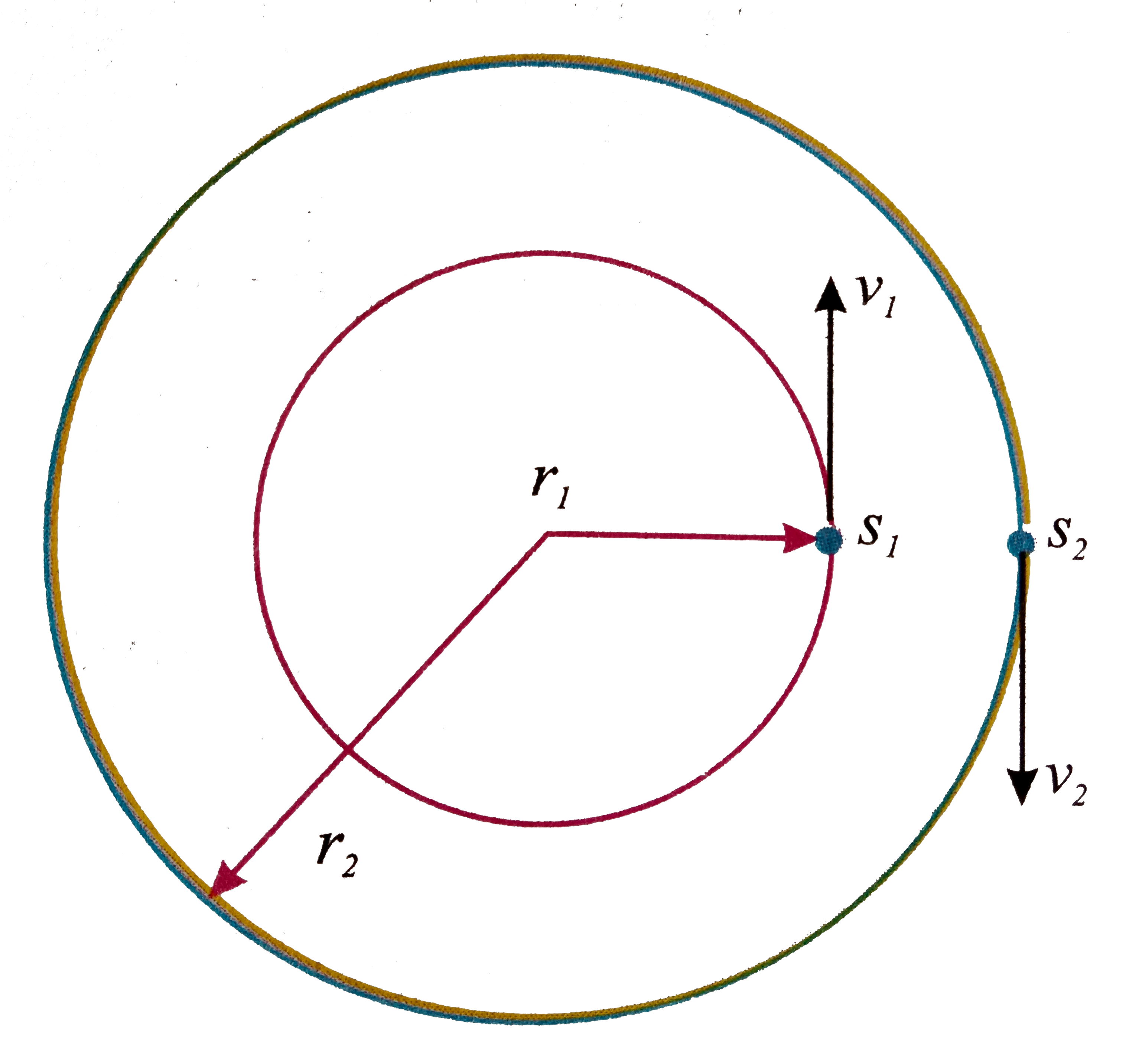
Two satellite `S_(1)` and `S_(2)` revolve around a planet in coplanar circular orbits in the opposite sense. The periods of revolutions are `T` and `eta T` respectively. Find the angular speed of `S_(2)` as observed by an astronouts in `S_(1)`, are observed by an astronaut in `S_(1)`, when they are closest to each other.

A

`omega=(2pi(n^(-1/3)+1))/(T(n^(1/3)-1))`

B

`omega=(2pi(n^(-1/3)+1))/(T^(2)(n^(2/3)-1))`

C

`omega=(2pi(n^(-1/3)+1))/(T(n^(2/3)-1))`

D

`omega=(2pi(n^(-2/3)+1))/(T(n^(-1/3)-1))`

Text Solution

Verified by Experts

The correct Answer is:
C


`Toor^(3//2)` or `rooT^(2//3)`
`:. (r_(1))/(r_(2))=((T_(1))/(T_(2)))^(2//3)=G/(etaT)^(2//3)=1/(eta^(2//3))`
`omega_(21)=(v_(2)+v_(1))/(r_(2)-r_(1))=((2pir_(2))/(T_(2))+(2pir_(1))/(T_(1)))/(r_(2)-r_(1))=(2pi(1/(T_(2))+1/(T_(1)).(r_(1))/(r_(2))))/(1-(r_(1))/(r_(2)))`
`=(2pi(1/(etaT)+1/T.1/(eta^(2//3))))/(1-eta^(1/(2//3)))=((2pi)/T(eta^(-1//3)+1))/((eta^(2//3)-1))`
Promotional Banner

Topper's Solved these Questions

  • GRAVITATION

    NARAYNA|Exercise ILLUSTRATION|49 Videos
  • GRAVITATION

    NARAYNA|Exercise EVALUATE YOURSELF -1|3 Videos
  • GRAVITATION

    NARAYNA|Exercise LEVEL-V|54 Videos
  • FRICTION

    NARAYNA|Exercise Passage type of questions I|6 Videos
  • KINETIC THEORY OF GASES

    NARAYNA|Exercise LEVEL-III(C.W)|52 Videos

Similar Questions

Explore conceptually related problems

Two satellites S_(1) and S_(2) revolve around a planet in coplanar circular orbits in the same sense their periods of revolution are 1 hour and 8hours respectively the radius of the orbit of S_(1) is 10^(4) km when S_(1) is closest to S_(2) the angular speed of S_(2) as observed by an astronaut in S_(1) is :

Two satellites S1 and S2 revolve round a planet in coplanar circular orbits in the same sense. TI1eir periods of revolution are 2 hours and 16 hours respectively. If the radius of the orbit of S_1 is 10^4 , then the radius of the orbit of S_2 is

Two satellite S_(1) and S_(2) revolve round a planet in coplanar circular orbits in the same sense. Their periods of revolution are 1hr and 8hours respectively. The radius of the orbit of S_(1) is 10^(4)km . When S_(2) is closet to S_(1) (i) the speed S_(2) relative to S_(1) as actually observed by an astronaut in S_(1) .

Two satellites S_(1) and S_(2) revolve round a planet in the same direction in circular orbits. Their periods of revolutions are 1 hour and 8 hour respectively. The radius of S_(1) is 104 km. The velocity of S_(2) with respect to S_(1) will be -

Two satellites S_(1) and S_(2) resolve round a planet in coplaner circular orbit in the same sense. Their period of revolution are 1 hour and 8 hour respectively. The radius of the orbit of S_(1) is 10^(4) km . When S_(2) is closest to S_(1) , find (a) The speed of S_(2) relative to S_(1) , (b) The angular speed of S_(2) actually observed by an astronaut is S_(1)

Two saetllites S_(1) and S_(2) revolve around a planet in coplaner circular orbit in the same sense. Their periods of revolutions are 1 hour and 8 hours respectively. The radius of orbit of S_(1) is 10^(4) km . When S_(2) is closed to S_(1) , the speed of S_(2) relative to S_(1) is pi xx 10^(n) km//h . what is the value of n ?

Two satellite S_1 and S_2 revolve roudna planet in coplanar circular orbits in the same sense. Their periods of revoltions are 1 h nd 8 h respectively. tE radius of the orbit of S_1 is 10^4 km . When S_2 is closet to S_1 ., find as. The speed of S_2 relative to S_1 and b. the angular speed of S_2 as observed by an astronaut in S_1 .

Two satellites S_1 and S_2 revole round a planet in coplanar circular orbits in the same sanse. Their periods of revolution are 1 hour and 8 hour respectively. The radius of the orbit of S_1 is 10^4 km, When S_2 is closest to S_1 find (i) the speed of S_2 relative to S_1 (ii) the angular speed of S_2 as actually observed by an astronaut is S_1.

In the above example the angular velocity of S_(2) as actually observed by an astronaut in S_(1) is -

NARAYNA-GRAVITATION-LEVEL-VI
  1. A ring of radius R = 4m is made of a highly dense material. Mass of th...

    Text Solution

    |

  2. A cosmic body A moves to the sun with velocity v(0)(when far from the ...

    Text Solution

    |

  3. Two satellite S(1) and S(2) revolve around a planet in coplanar circul...

    Text Solution

    |

  4. A particle of mass m is placed on centre of curvature of a fixed, unif...

    Text Solution

    |

  5. Given a thin homogenous disc of radius a and mass m(1). A particle of ...

    Text Solution

    |

  6. The density of the core a planet is rho(1) and that of the outer shell...

    Text Solution

    |

  7. A projectile of mass m is fired from the surface of the earth at an an...

    Text Solution

    |

  8. find the velocity of a satellite travelling in an elliptical orbit, wh...

    Text Solution

    |

  9. In astronomy order of magnitude estimation plays an important role. Th...

    Text Solution

    |

  10. A narrow tunnel is dug across a planet diametrically and a small body ...

    Text Solution

    |

  11. If the law of gravitation be such that the force of attraction between...

    Text Solution

    |

  12. A small satellite revolves around a heavy planet in a circular orbit. ...

    Text Solution

    |

  13. A satellite is orbiting around the earth in an orbitin equatorial plan...

    Text Solution

    |

  14. A planet moves aruond the sun in an elliptical orbit such that its kin...

    Text Solution

    |

  15. A smooth tunnel is dug along the radius of the earth that ends at the ...

    Text Solution

    |

  16. A cannon shell is fired to hit a target at a horizontal distance R. Ho...

    Text Solution

    |

  17. A particle moving with kinetic energy 3J makes an elastic head-on coll...

    Text Solution

    |

  18. Consider a thin spherical shell of uniform density of mass M and radiu...

    Text Solution

    |

  19. A satellite moves in an elliptical orbit about the earth. The minimum ...

    Text Solution

    |

  20. The gravitational potential change uniformly from -20 J//kg to -40J//k...

    Text Solution

    |

