Home
Class 12
PHYSICS
Assuming a particle to have the form of ...

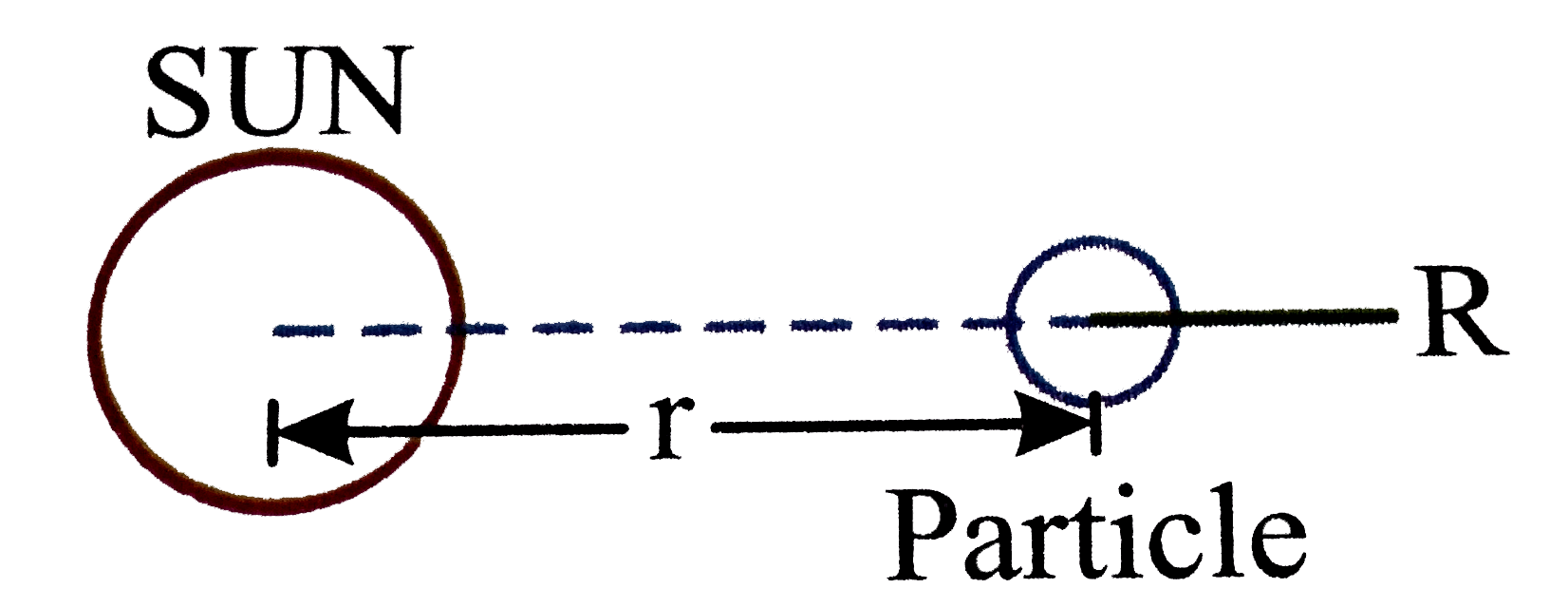
Assuming a particle to have the form of a sphere and to absorb all incident light, the radius (in mm) of a particle for which its gravitational attraction to the Sun is
Counterbalanced by the force that light exerts on it is------. The power of light radiated by the sun equals `P=4xx10^(26)W` and the density of the particle is `r=1.0 g//cm^(3)`. Use `G=(20)/(3)xx10^(-11)Nm^(2)//kg^(2)`, `pi=(25)/(8)` and mass of the sun `=2xx10^(30)kg`

A

`0.8`

B

`0.6`

C

`0.1`

D

`0.4`

Text Solution

Verified by Experts

The correct Answer is:
B


energy incident/sec on the particle
`=(P)/(4pir^(2))xxpiR^(2)=(PR^(2))/(4r^(2))`
`vecF` due to striking of photon `vecF_(1)=(vecdp)/(dt)=` change in lin. Mom. Of `1photon` in collisionxxNo. Of photons striking per sec `=(hv)/(C )xx(PR^(2))/(4r^(2)xxhv)=(PR^(2))/(4r^(2)C)`
Gravitational force on the particle
`vecF_(2)=(GM_(s)m)/(r^(2))=(GM_(s))/(r^(2))xx(4)/(3)piR^(3)rho`, `|vecF_(1)|=|vecF_(2)|`
`(PR^(2))/(4r^(2)C)=(GM_(s)xx4piR^(3)rho)/(3r^(2))impliesR=(3P)/(4GM_(s)pirhoC)=0.6`
Promotional Banner

Topper's Solved these Questions

  • ELECTRO MAGNETIC WAVES

    NARAYNA|Exercise LEVEL-I(H.W)|16 Videos
  • ELECTRO MAGNETIC WAVES

    NARAYNA|Exercise LEVEL-II(H.W)|14 Videos
  • ELECTRO MAGNETIC WAVES

    NARAYNA|Exercise LEVEL- V|4 Videos
  • ELECTRO MAGNETIC INDUCTION

    NARAYNA|Exercise Level-II (H.W)|23 Videos
  • ELECTROMAGNETIC INDUCTION

    NARAYNA|Exercise ASSERTION & REASON|6 Videos

Similar Questions

Explore conceptually related problems

Assuming a particle to have the form of a ball and to absorb all incient light, find the radius of a particle for which its gravitational attraction to the sun is counterbalanced by the forces that light exerts on it. The power of light raiated by the sun equals P = 4.10^(26)W , and the density of the particle is rho = 1.0 g//cm^(3) .

Find the velocity of escape from the sun, if its mass is 1.89xx10^(30) kg and its distance from the earth is 1.59xx10^(8) km. Take G =6.67xx10^(-11) Nm^(2) kg^(-2)

Assuming that earth's orbit around the sun is a circle of radius R=1.496xx10^(11)m compute the mass of the sun. (G=6.668xx10^(-11)Nm^(2)kg^(-2))

Calculate the force between the sun and jupiter. Assume that the mass of the sun =2xx10^30 kg, the mass of the jupiter = 1.89xx10^27 kg and the radius of the jupiter 's orbit = 7.73xx10^11m . (Use G=6.67xx10^(-11) Nm^2 //kg^2 )

Find the magnitude of the gravitational force between the Sun and the earth. (Mass of the Sun =2xx10^(30) kg, mass of the earth =6xx10^(24)kg and the distance between the centres of the Sun and the earth =1.5xx10^(11)m , (G=6.67xx10^(-11)N.m^(2)//kg^(2))

Assuming the earth of to be a uniform sphere of radius 6400 kg and density 5.5 g//c.c. , find the value of g on its surface G=6.66xx10^(-11)Nm^(2)kg^(-2)

A particle of mass 1 kg is kept on the surface of a uniform sphere of mass 20 kg and radius 1.0 m . Find the work to be done against the gravitational force between them to take the particle away from the sphere.

Calculate the force of gravitation due to earth on a ball of 1 kg mass lying on the ground.(Mass of earth =6xx10^(24) kg Radius of earth =6.4xx10^(3) km and G=6.7xx10^(-11)Nm^(2)/Kg^(2)

Estimate the mass of the sun, assuming the orbit of the earth round the sun to be a circle. The distance between the sun and earth is 1.49 xx 10^(11) m and G = 6.66 × 10^(-11) Nm^(2)//kg^(2) .

Calculate the speed of Jupiter if the mass of Jupiter is 1.9 xx 10^(27) kg . Distance from the sun is 7.8 xx 10^(11)m and the mass of the sun is 2 xx 10^(30) kg .

