Home
Class 11
CHEMISTRY
Balance the net equtation fro th reactio...

Balance the net equtation fro th reaction of potassium dichromate (VI), `K_(2) Cr_(2) O_(7)`, with sodium sulphite, `Na_(2)SO_(3)`, in an acid solution to give chromium (III) ion and and sulphate ion.
Strategy : Follow the seven -step proceduce , one step at a time.

Text Solution

Verified by Experts
Write the skeletal ionic equation :
`Cr_(2)O_7^(2-) (aq.) + SO_3^(2-) rarr Cr^(3+) (aq.) + SO_4^(2-) (aq.)`
Assing oxidation number to all the elements on both sides
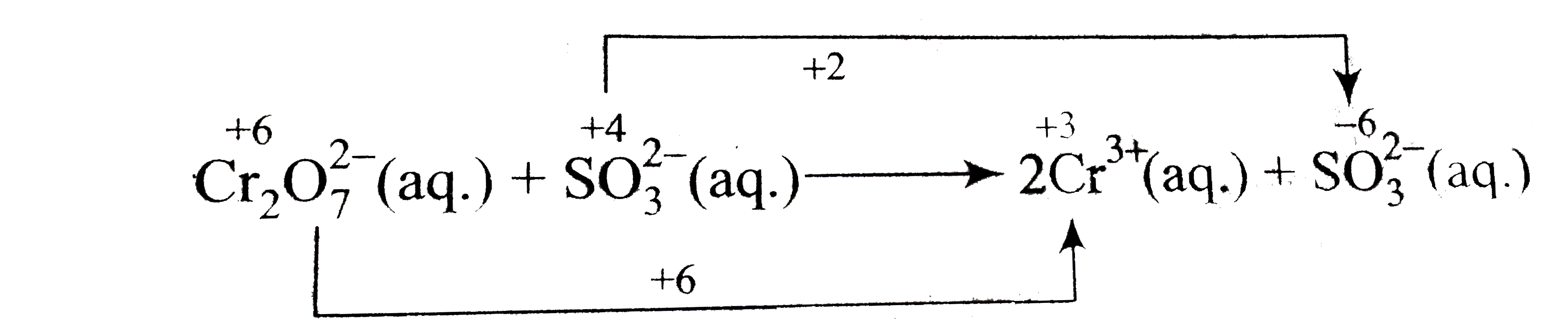
`overset(+6)(Cr_2) overset(-2)(O_7^(2-)) (aq.) + overset(+4-2)(SO_3^(2-)) (aq.) rarr overset(+3)(Cr^(3+)) (aq) + overset(+6-2)(SO_(4)^(2-)) (aq.)`
This indicates that `Cr` and S are changing their oxidation numbers.
Step 3: Identify the oxidizing and reducing agents :

`Cr_(2)O_(7)^(2)` ion is the oxidizing agent as it is reduced while ` SO_(3)^(2-)` ion is the reducing agent as it is oxdized, Since there are two Cr atoms in ` Cr_(2)O_7^(2-)` ion, we must calculate the change in oxidation number of two `Cr` atoms. Thus, the total decrease in the oxidation number of `Cr` is of ` 6` units ,. Since there is only one S atom on either side, the total increase in the oxidation number of S is of two units .
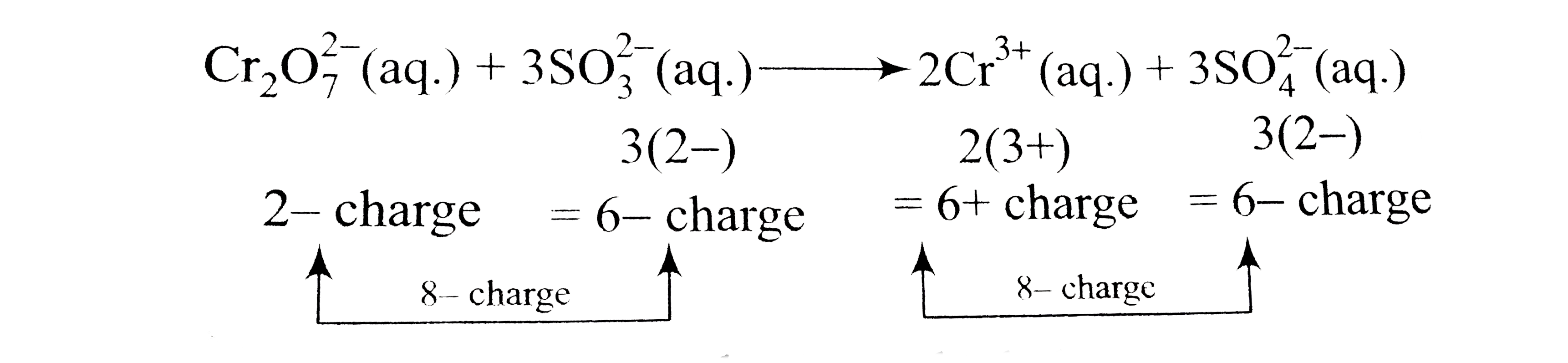
Step 4: Make the total increase and decrease in oxiation numbers equal by multiplying ` SO_3^(2-)` ion (reducing agent ) by `3` . Also multiply ` SO_(4)^(2-)` ion by `3` to balance S atoms (Step 5).
`Cr_2O_(7)^(2-) (aq.) + 3 underset(3(2-))(SO_3^(2-) (aq.)) rarr underset(2(3+))(2 Cr^(3+) (aq.)) + underset(3(2-))(3SO_4^(2-) (aq.))`

Step 5: Balance the ionic chargesd on both the sides by adding `H^(+)` ions as the reactin is carried out in acidic condition. On the left side, there are 8 units od negative charge dur to one `Cr_(2)O_7^(2-)` ion and due to three `SO_3^(2-)` ions but on the right side, there in no charge due to two `Cr^(3+)` ions and three ` SO_4^(2-)` ions. Thus, we add ` 8 H^(+)` ions on the left to make ionic charges equal.
` Cr_2O_7^(2-) (aq.) +3SO_3^(2-) (aq.) + 8H^+ (aq) rarr 2 Cr^(3+) (aq.) + 3 SO_4^(2-) (aq)`
Step 6: Finally, balance H and O atoms by adding `H_2O` molecules. There are `8H` atoms and ` 16 O` atoms on the left side while there are zero H atoms and `12 O` atoms on the right side. Thus, add `4 H_(2)O` molecules on the right side to achieve thr balancced redox reaction :
` Cr_2O_7^(2-) (aq.) + 3 SO_3^(2-) (aq.) + 8H^+ (aq.) rarr 3Cr^(3+) (aq.) + 3SO_4^(2-) (aq.) + 4H_(2)O(1)`.
Promotional Banner

Topper's Solved these Questions

  • REDOX REACTIONS

    R SHARMA|Exercise Follow-up Test 1|5 Videos
  • REDOX REACTIONS

    R SHARMA|Exercise Follow-up Test 2|5 Videos
  • PURIFICATION AND CHARATERIZATION OF ORGANIC COMPOUNDS

    R SHARMA|Exercise Archives|38 Videos
  • SOME BASIC CONCEPTS OF CHEMISTRY

    R SHARMA|Exercise Archives|26 Videos

Similar Questions

Explore conceptually related problems

Balance the following equation is alkaline medium Zn(s) = N_(3)^(-) (aq) rarr Zn^(2+) (aq.) + NH_(4)^(+) (aq) . Strategy : Follow the seven-step procedure, one step at a time.

Write balanced redox reactions for each of the following reactions: (a) Potassium dichromate (K_(2)Cr_(2)O_(7)) reacts with hydroiodic acid (HI) to produce potassium iodide, chromium (III) iodide, and solid iodine, I_(2)(s) . (b) A purple solution of aqueous potassium permanganate (KMnO_(4)) reacts with aqueous sodium sulphite (Na_(2)SO_(3)) in basic solution to yield the green magnanate ion (MnO_(4)^(2-)) and sulphate ion (SO_(4)^(2-)) . (c ) Sn^(2+) (aq) reduce I_(4)^(Ө)(aq) to I^(Ө)(aq) and is oxidised to Sn^(4+) . (d) H_(2)O_(2)(aq) oxidises Mn^(2+)(aq) to MnO_(2) in basic medium. (e) H_(2)O_(2)(aq) reduces Cr_(2)O_(7)^(2-) (aq) to green coloured Cr^(3+)(aq) in acidic medium.

Acidified K_(2)Cr_(2)O_(7) , solution turns green when Na_(2)SO_(3) is added to it. Thus is due to the formation of

Acidified K_(2)Cr_(2)O_(7) solution turns green when Na_(2)SO_(3) is added to it. This is due to the formation of

Write the equations for the reaction of phenol with the following: (i) Br_(2) water (ii) CHCl_(3)+NaOH (iii) Na_(2)Cr_(2)O_(7)+Conc. H_(2)SO_(4) .

In a redox reaction, dichromate ion (Cr_(2)O_(7)^(2-)) is reduced to Cr^(3+) ion, the equivalent mass of K_(2)Cr_(2)O_(7) in this reaction is :

R SHARMA-REDOX REACTIONS-Archives
  1. Balance the net equtation fro th reaction of potassium dichromate (VI)...

    Text Solution

    |

  2. Oxidation numbers of P in PO4^(3-), of S in SO4^(2-), and that of Cr...

    Text Solution

    |

  3. What is the stoichiometric coefficient fo Ca in the reaction ? Ca+Al...

    Text Solution

    |

  4. The number of moles of KMnO(4) that will be needed to react with one m...

    Text Solution

    |

  5. In the balanced chemical reaction IO(3)^(ө)+al^(ө)+bH^(ө)rarrcH(2)O+...

    Text Solution

    |

  6. The number of moles of KMnO(4) reduced by 1 "mol of" KI in alkaline me...

    Text Solution

    |

  7. Cr(2)O(7)^(2-)+Xoverset(H^(o+))rarrCr^(3+)+H(2)O+ "oxidised product" o...

    Text Solution

    |

  8. Which is the best description of the behaviour of bromine in the react...

    Text Solution

    |

  9. For the decolorization of 1 mol of KMnO4, the moles of H2O2 requiered...

    Text Solution

    |

  10. The elememt which forms oxides in all oxidation states +I to +V is.

    Text Solution

    |

  11. The oxidation number of carbon in . CH2Cl2 is .

    Text Solution

    |

  12. What is the net charge on ferrous ion ?

    Text Solution

    |

  13. Which of the following is the strongest oxidizing agent ?

    Text Solution

    |

  14. Which of the following is the most powerful reducing agent ?

    Text Solution

    |

  15. KI and CuSO4 solution when mixed give .

    Text Solution

    |

  16. What is the equivalent mass of IO4^(-) when it is converted into I2 i...

    Text Solution

    |

  17. In acidic medium, dichromate ion oxidizes ferrous ion to ferric ion. I...

    Text Solution

    |

  18. Which of the following is both oxidizing as well as reducing agent ?

    Text Solution

    |

  19. P(4)+NaOH+H(2)O rarr NaH(2)PO(3)+PH(3) is

    Text Solution

    |

  20. MnO(4)^(2-) (1 mole) in neutral aqueous medium is disproportionate to

    Text Solution

    |

  21. The oxidation states of sulphur in the anions SO(3)^(2-), S(2)O(4)^(2-...

    Text Solution

    |