Home
Class 12
CHEMISTRY
The precipitate of AgCI dissolves in an ...

The precipitate of AgCI dissolves in an excess of `NH_(3)` , KCN and `Na_(2)S_(2)O_(3)` solution respectively, producing complex ions represented by the following chemical formulae

A

`[Ag (NH_(3))_(2)]^(+)` , `[Ag (CN)_(2)]^(-)` and `[Ag (S_(2)O_(3))_(2)]^(3-)`

B

`Ag . 2NH_(3)` , Ag . KCN and AgCI . `S_(2)O_(3)`

C

`[Ag (NH_(3))_(2)]^(2+)` , `[Ag (CN)_(2)]^(2-)` and `[Ag (S_(2)O_(3))_(2)]^(3-)`

D

`[Ag (NH_(3))_(2)]^(+)` , `[Ag (CN)_(2)]^(2-)` and `[Ag (S_(2)O_(3))_(2)]^(3-)`

Text Solution

Verified by Experts

The correct Answer is:
A

AgCl dissolves in dilute ammonia solution to give the dimmine silver (l) ion:
`AgCI (s) + 2NH_(3) (aq) rarr [Ag(NH_(3))_(2)]^(+) (aq) + Cl^(-) (aq)`
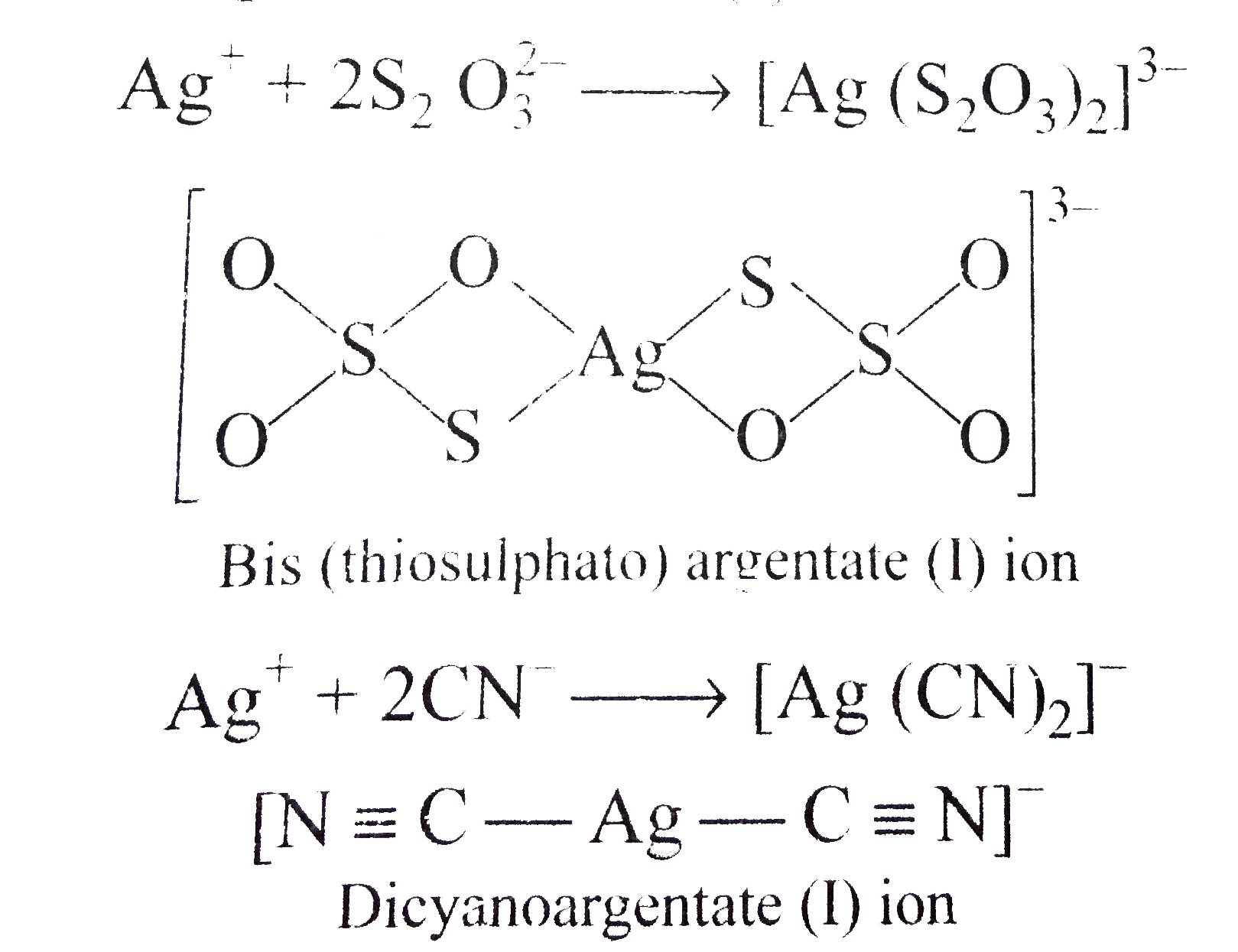
All the silver halides (including iodide) dissolve in thiosulphate and cyanide solutions giving thiosulphato and dicyano complexes of silver (l).
`Ag^(+) + 2S_(2) O_(3)^(2-) rarr [Ag(S_(2)O_(3))_(2)]^(3-)`

`Ag^(+) + 2CN^(-) rarr [Ag(CN)_(2)]^(-)`
`underset("Dicyanoargentate(l)ion")([N-=C-AgC-=N]^(-))`
Promotional Banner

Topper's Solved these Questions

  • THE D AND F BLOCK ELEMENTS

    R SHARMA|Exercise Archives|54 Videos
  • THE D AND F BLOCK ELEMENTS

    R SHARMA|Exercise Follow-up Test 6|6 Videos
  • SURFACE CHEMISTRY

    R SHARMA|Exercise Archives|18 Videos
  • THE P BLOCK ELEMENTS

    R SHARMA|Exercise Archieves|62 Videos

Similar Questions

Explore conceptually related problems

AgCl dissolved in excess of NH_(3), KCN and Na_(2)S_(2)O_(3) solutions the complex produces ions

A white percipitate of AgCl dissolves in excess of I) NH_(3)(aq)" " II)Na_(2)S_(2)O_(3)" "III)NaCn

How to standardise Na_(2)S_(2)O_(3) solution in iodometry?

When of the following precipitate is soluble in excess of NH_(3) solution?

Which of the following precipitate is soluble in excess of NH_(3) solution?

Which of the following precipitate(s) does /do not dissolve in excess of ammonia solution ?

R SHARMA-THE D AND F BLOCK ELEMENTS-Question Bank (Building the Knowledge)
  1. Which of the following is incorrect ?

    Text Solution

    |

  2. Silver halides darken in light owing to ------- , a property which is ...

    Text Solution

    |

  3. The precipitate of AgCI dissolves in an excess of NH(3) , KCN and Na(2...

    Text Solution

    |

  4. When a solution of mercuric chloride treated with an excess of stannic...

    Text Solution

    |

  5. Which of the following is not correctly matched ?

    Text Solution

    |

  6. The most common oxosalt of copper (II) is blue virtiol. It has the com...

    Text Solution

    |

  7. How many water molecules in blue vitriol are coordinated to the metal ...

    Text Solution

    |

  8. If a aqueous solution of copper (II) sulphate is saturated with ammoin...

    Text Solution

    |

  9. Which of the following has more number of unpaired d-electrons ?

    Text Solution

    |

  10. K(2)Cr(2)O(7) on heating with aqueous NaOH gives

    Text Solution

    |

  11. Cuprous compounds such as CuCI, CuCN and CuSCN are the only salts stab...

    Text Solution

    |

  12. Stainaless steel contains iron and

    Text Solution

    |

  13. Actinides

    Text Solution

    |

  14. When (NH(4))(2)Cr(2)O(7) is heated, the gas evolved is

    Text Solution

    |

  15. The common oxidation states of Ti are

    Text Solution

    |

  16. When CuSO(4) is electrolysed, using Pt electrodes

    Text Solution

    |

  17. The general valence shell electronic configuration of transition eleme...

    Text Solution

    |

  18. While extracting an element from its ore, the ore is grind and leached...

    Text Solution

    |

  19. Within each transition series, the oxidation states

    Text Solution

    |

  20. In which of the following compounds transition metal has zero oxidatio...

    Text Solution

    |

