Home
Class 12
CHEMISTRY
Which of the following is not a chelatin...

Which of the following is not a chelating ligand ?

A

Monodentate

B

Bidentate

C

Tridentate

D

Quadridentate

Text Solution

Verified by Experts

The correct Answer is:
A

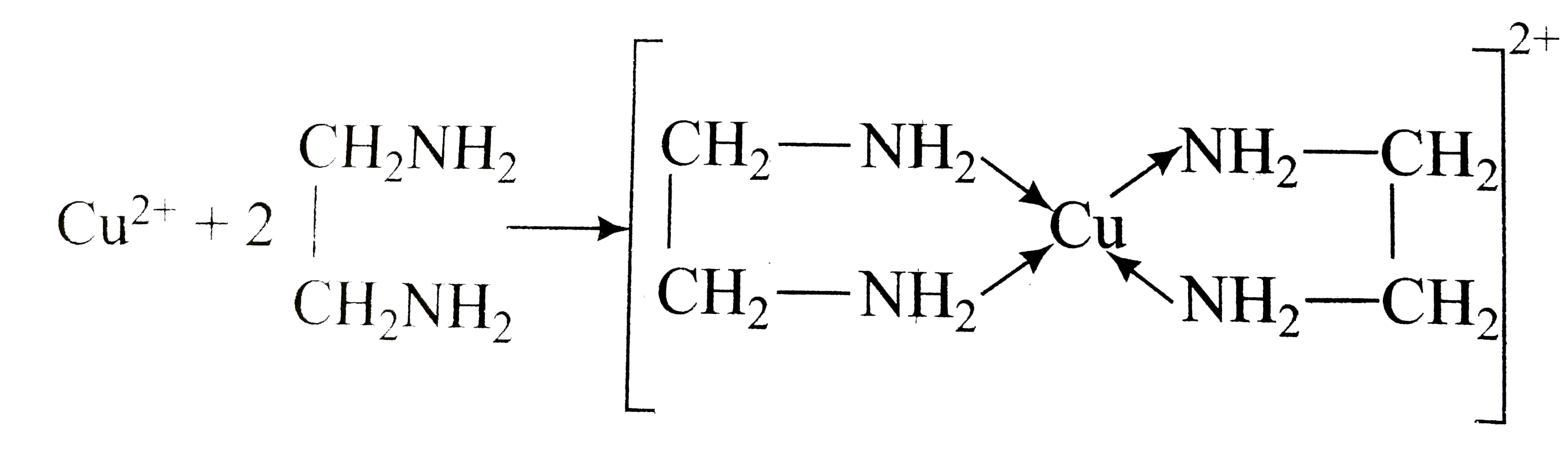
A monodenate ligand (meaning '' one - toothed'' ligand) is a ligand that bonds to a metal atom/ion through one atom of the ligand. In some complexes a ligand occupies more than one coordination position. Thus more than one atom in the ligand is bonded to the central metal. For example, ethylinediamine (en) forms a complex with coppeer ions:

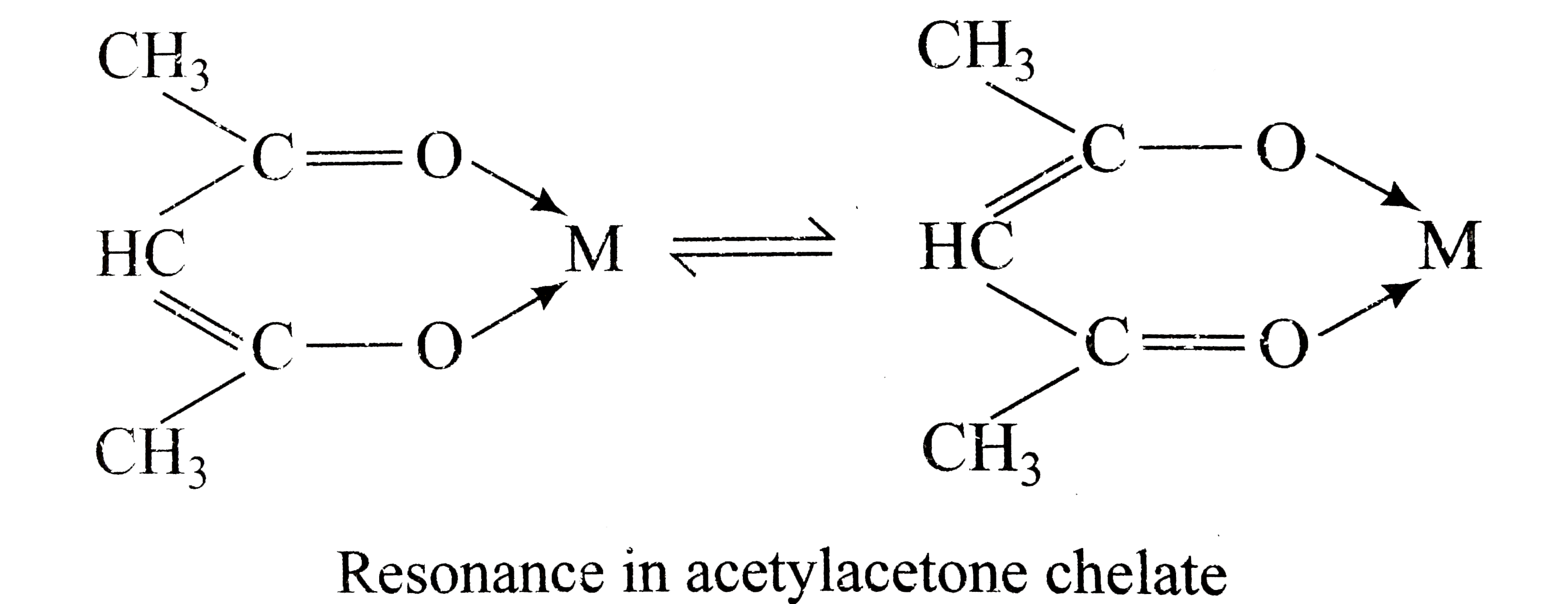
In this complex the copper is surrounded by four `-NH_(2)` group. Thus each ethylenedimine molecule is bonded to the `cu^(2+)` in two place. For this reason ethylendiamine is called a bidentate ligand (Bidentate means literally two teeth !) Thus, a ring structure is formed (in this case a pair of five-membered rings). Such rings structure are called chelates and the corresponding ligands are called chelating ligands. All chelating are polydentate ligands. A polydentate ligand (''having many teeth'') is a ligand that can bond with two or more atoms to a metal atom. A complex formed by polydentate ligands is frequently quite stable and is called a chelate. Chelated complexes are more stable than similar complexes with unidentate lengands, as dissociation of the omplex invlves breaking two bonds rather than one. Chelates are even more stable when they contian a system of alternate double and single bonds. This is better represented as a system in which electron density is delocalized and spread over the ring. Examples of this include acetylcetone and porphyrin complexes with metals.

Resonance in acetylacetone chelate
Promotional Banner

Topper's Solved these Questions

  • COORDINATION COMPOUNDS

    R SHARMA|Exercise Question Bank (Building the knowledge)|38 Videos
  • COORDINATION COMPOUNDS

    R SHARMA|Exercise Archives|56 Videos
  • CHEMISTRY IN EVERYDAY LIFE

    R SHARMA|Exercise Archives|11 Videos
  • ELECTROCHEMISTRY

    R SHARMA|Exercise Follow-up Test 11|7 Videos

Similar Questions

Explore conceptually related problems

Which of the following is not a chelating agent :

Which of the following represents chelating ligand ?

Which of the following are chelating ligands ? H_(2)O,C_(2)O_(4)^(2-) ,EDTA^(4-), CO_(3)^(2-), CO,C_(2)H_(4)

Which of the following is not a bidentate ligand?

Which of the following is not a neutral ligand ?

R SHARMA-COORDINATION COMPOUNDS-Archives
  1. Which of the following is not a chelating ligand ?

    Text Solution

    |

  2. Which of the following pairs of d-orbitals will hare electron density ...

    Text Solution

    |

  3. Jahn - Teller effect is not observed in high spin complexes of

    Text Solution

    |

  4. Which of the following has longest C-O bond length? (Free C-O bond len...

    Text Solution

    |

  5. The name of complex ion, [Fe(CN(6))]^(3-) is

    Text Solution

    |

  6. The hybridization involved in complex [Ni(CN)(4)]^(2-) is (At. No . Ni...

    Text Solution

    |

  7. The sum of coordination number and oxidation number of the metal M in ...

    Text Solution

    |

  8. Number of possible isomer for the complex [Co(en)(2)CI(2)]CI will be: ...

    Text Solution

    |

  9. Which of these statements about [Co(CN)6]^(3-) is true?

    Text Solution

    |

  10. Cobalt (III) chloride forms several octahedral complexes with amonia. ...

    Text Solution

    |

  11. The complex used as an anticancer agent is

    Text Solution

    |

  12. A magnetic moment of 1.73 B.M. will be shown by one among the followin...

    Text Solution

    |

  13. An excess of AgNO(3) is added to 100mL of a 0.01M solution of dichloro...

    Text Solution

    |

  14. Which one of the following is an outer orbital complex and exhibits pa...

    Text Solution

    |

  15. Red precipitae is obtained when ethanol solution of dimethylglyoxime i...

    Text Solution

    |

  16. Low spin complex of d^6-cation in an octahedral field will have the fo...

    Text Solution

    |

  17. The complex, [Pt(py)(NH3)BrCl] will have how many geometrical isomers?

    Text Solution

    |

  18. [Co(HN(3))(6)][Cr(CN)(6)] and [Cr(NH(3))(6)][Co(CN)(6)] are .

    Text Solution

    |

  19. The d-electron configurations of Cr^(2+), Mn^(2+), Fe^(2+) and Co^(2+)...

    Text Solution

    |

  20. Of the following complex ions, which is diamagnetic in natures?

    Text Solution

    |

  21. Which of the following complex compounds will exhibit highest magnetic...

    Text Solution

    |