Home
Class 12
CHEMISTRY
Which of the following d-electron distri...

Which of the following d-electron distribution of the diamagnetic complex `[Ni(CN)]^(2-)` is possible according to the crystal field theory ?

A

`(d_(yz))^(2) (d_(xy))^(2) (d_(z^(2)))^(2) (d_(xy))^(2)`

B

`(d_(xy))^(2) (d_(xz))^(2) (d_(yz))^(2) (d_(x^(2)-y^(2)))^(1) (d_(z^(2)))^(1)`

C

`(d_(xy))^(2) (d_(xy))^(2) (d_(yz))^(2) (d_(x^(2)-y^(2)))^(2)`

D

`(d_(xy))^(2) (d_(xz))^(2) (d_(yz))^(2) (d_(z^(2)))^(2)`

Text Solution

Verified by Experts

The correct Answer is:
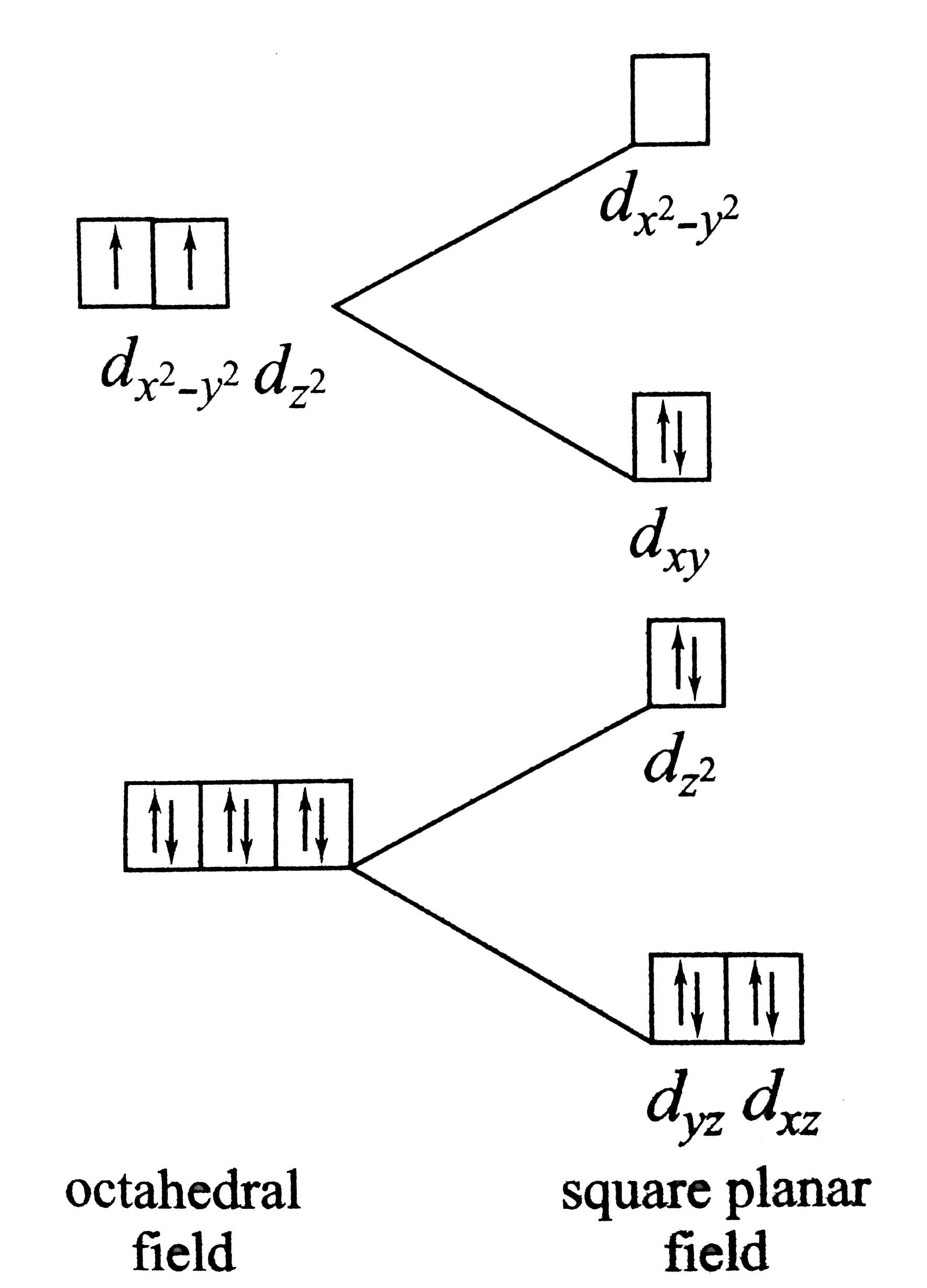
A

For the period 4 transition metals, it is only Ni that tends to form square planer complexes, such as the tetracyanidonikelate (II) ion, `[Ni(CN)_(4)]^(2-)` . These complexesare diamagnetic. We can develop a crystal field diagram to see why this is so, even though both octahedral and tetrahedral geometries result in two unpaired electrons for the `d^(8)` configuration. If we start form the octahedral field withdrawn the ligands form the z-axis, the `d_(z)^(2)` orbital will no longer g=feel the electrostatic repulsion form axial ligands, hence, it will drop substantially in energy. The other two orbitals with a-z axis component (the `d_(xz)` and `d_(yz)`) will also undergo a decrease in energy. Conversely, with the withdrawl of the aial ligands, there will be a greater electrostatic attraction on the ligands in the plane and these will become closer to the metal ion. As a result, the `d_(x^(2)-y^(2))` and `d_(z^(2))` orbitals will increase substantially in energy.

As the `Ni^(2+)` complex with `CN^(-)` ligands is diamagnetic, the splitting of the `d_(x^(2)-y^(2))` and the `d_(xy)` orbitals must be greater than the pairing for this combination. In the square planar case, only low spin complexes have been found.
Promotional Banner

Topper's Solved these Questions

  • COORDINATION COMPOUNDS

    R SHARMA|Exercise Question Bank (Building the knowledge)|38 Videos
  • COORDINATION COMPOUNDS

    R SHARMA|Exercise Archives|56 Videos
  • CHEMISTRY IN EVERYDAY LIFE

    R SHARMA|Exercise Archives|11 Videos
  • ELECTROCHEMISTRY

    R SHARMA|Exercise Follow-up Test 11|7 Videos

Similar Questions

Explore conceptually related problems

According to crystal field theory (CFT) :

Which of the following complexes diamagnetic:

Which of the following complexes is diamagnetic ?

Which of the following is diamagnetic complex

Which of the following paramagnetic complex with two unpaired electrons in t_(2g) orbital according to crystal field theory

R SHARMA-COORDINATION COMPOUNDS-Archives
  1. Which of the following d-electron distribution of the diamagnetic comp...

    Text Solution

    |

  2. Which of the following pairs of d-orbitals will hare electron density ...

    Text Solution

    |

  3. Jahn - Teller effect is not observed in high spin complexes of

    Text Solution

    |

  4. Which of the following has longest C-O bond length? (Free C-O bond len...

    Text Solution

    |

  5. The name of complex ion, [Fe(CN(6))]^(3-) is

    Text Solution

    |

  6. The hybridization involved in complex [Ni(CN)(4)]^(2-) is (At. No . Ni...

    Text Solution

    |

  7. The sum of coordination number and oxidation number of the metal M in ...

    Text Solution

    |

  8. Number of possible isomer for the complex [Co(en)(2)CI(2)]CI will be: ...

    Text Solution

    |

  9. Which of these statements about [Co(CN)6]^(3-) is true?

    Text Solution

    |

  10. Cobalt (III) chloride forms several octahedral complexes with amonia. ...

    Text Solution

    |

  11. The complex used as an anticancer agent is

    Text Solution

    |

  12. A magnetic moment of 1.73 B.M. will be shown by one among the followin...

    Text Solution

    |

  13. An excess of AgNO(3) is added to 100mL of a 0.01M solution of dichloro...

    Text Solution

    |

  14. Which one of the following is an outer orbital complex and exhibits pa...

    Text Solution

    |

  15. Red precipitae is obtained when ethanol solution of dimethylglyoxime i...

    Text Solution

    |

  16. Low spin complex of d^6-cation in an octahedral field will have the fo...

    Text Solution

    |

  17. The complex, [Pt(py)(NH3)BrCl] will have how many geometrical isomers?

    Text Solution

    |

  18. [Co(HN(3))(6)][Cr(CN)(6)] and [Cr(NH(3))(6)][Co(CN)(6)] are .

    Text Solution

    |

  19. The d-electron configurations of Cr^(2+), Mn^(2+), Fe^(2+) and Co^(2+)...

    Text Solution

    |

  20. Of the following complex ions, which is diamagnetic in natures?

    Text Solution

    |

  21. Which of the following complex compounds will exhibit highest magnetic...

    Text Solution

    |

