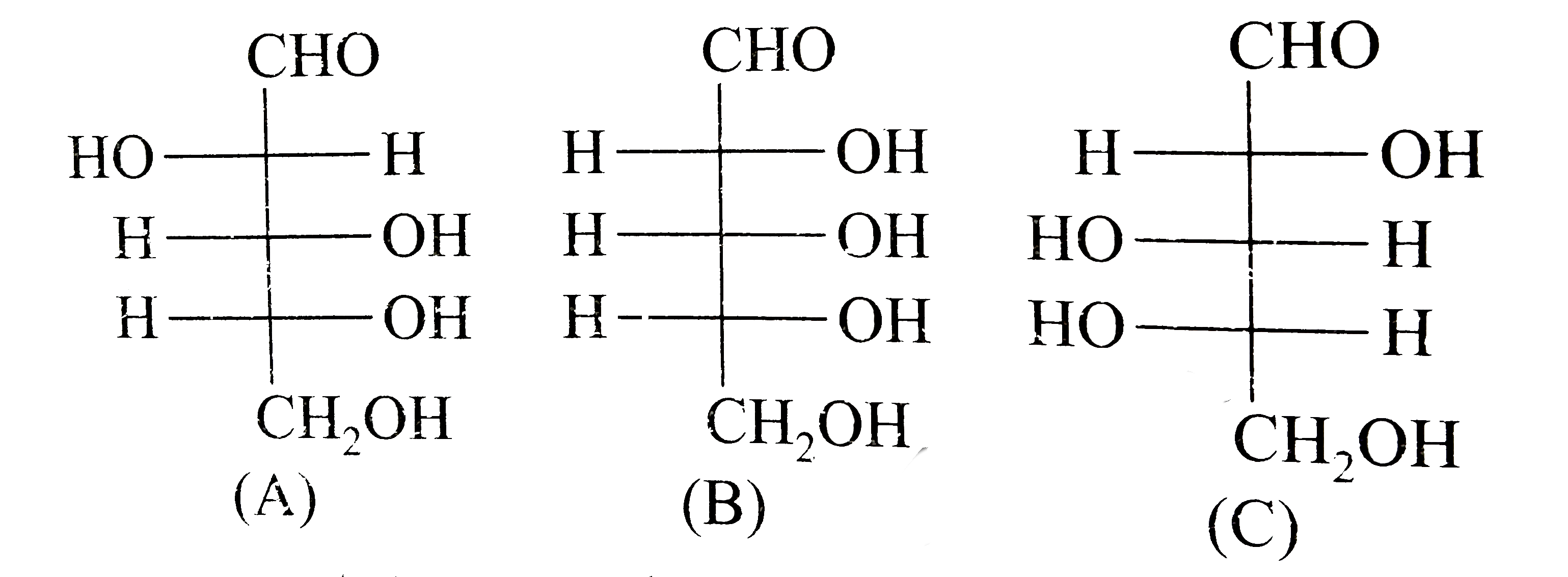
A
B
C
D
Text Solution
Verified by Experts
The correct Answer is:



Topper's Solved these Questions
Similar Questions
Explore conceptually related problems
R SHARMA-STEREOCHEMISTRY-Follow-up Test
- Which of the following compounds does not have diastereomers?
Text Solution
|
- Which of the following statements is not correct?
Text Solution
|
- Consider the following compounds The correct statement about the ...
Text Solution
|
- What is the sterostructure of the monochlobutanes obtained form the fr...
Text Solution
|
- Isopentane is allowed to undergo free-radical chlorination and the rea...
Text Solution
|
- Consider the reaction {:((R)-CH(3)CHICH(2)CH(3)+^(137)T^(-),rarrCH(3...
Text Solution
|
- Which of the following reactions occurs wiyh reacemization?
Text Solution
|
- Which of the following compounds exsits as a nonresolvable racemic mix...
Text Solution
|
- Which of the following compounds will undergo racemization on prolonge...
Text Solution
|
- What happens when an optically pure (+)-1-chlorenthylbenzne (C(6)H(5)C...
Text Solution
|
- Which of the following reaction could safely be used to relate configu...
Text Solution
|
- Which of the following is true for the given reaction? overset( :ove...
Text Solution
|
- Which of the folloiwng statements is true?
Text Solution
|
- Which of the following statements is false? (i) A D enantiomers rota...
Text Solution
|
- cis-But-2-en on reaction with Br(2) in C CI(4) produces mainly
Text Solution
|
- 1,2-Dimethy1cyclohexene reacts with HBr in C CI(4) to form mainly
Text Solution
|
- Addition of HBr to but-1-ene yields
Text Solution
|
- Cyclohexene on reaction with HOCI yields
Text Solution
|
- cis-But-2-ene on reaction with cold dilute KMnO(4) solution yields
Text Solution
|
- An alkene on reaction with Br(2)//C CI(4) produces the following produ...
Text Solution
|