Home
Class 12
CHEMISTRY
Isopentane is allowed to undergo free-ra...

Isopentane is allowed to undergo free-radical chlorination and the reaction mixture is separated. How many optically active fractions of formula `C_(5)H_(11)CI` would you expect to collect?

A

Zero

B

Two

C

One

D

Four

Text Solution

Verified by Experts

The correct Answer is:

A

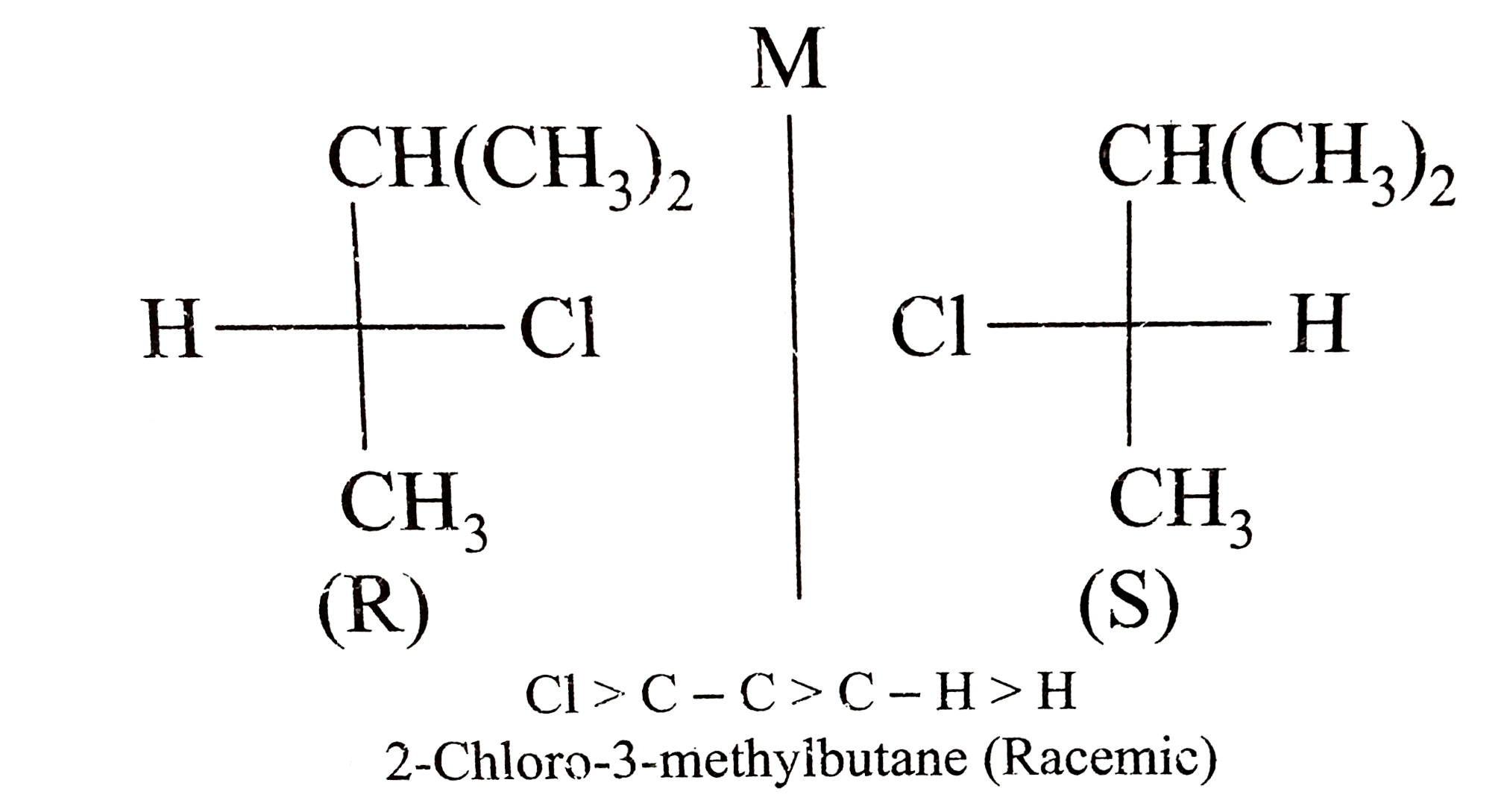
Four fractions are collected but no fraction is optically active because each fraction is eithe a single achiral compound or a racemic modification (Inactive reactants give inactive products)
`overset(CH_(3))overset(|)underset("Isopetane")(CH_(3)CH_(2)CHCH_(3))overset(CI_(2))rarroverset(CH_(3))overset(|)underset(1-"Chloro"-2-"methy1 butane")underset(**)(CH_(3)CH_(2)CHCH_(2)CI) overset(CH_(3))overset(|)underset(2-"Chloro-2-methy1 butane")underset(CI)underset(|)(+CH_(3)CH_(2)C CH_(3))+underset(2-"Chloro-3-methy1 butane")underset(CI)underset(|)(CH_(3)overset(**)CHCHoverset(CH_(3))overset(|)(CHCH_(3)))overset(CH_(3))overset(|)underset(1-"Chloro-3-methy1 butane")(+CICH_(2)CH_(2)CHCH_(3))`
Fraction 1

Fraction 2

Fraction 3, Fraction 4
`overset(CH_(3))overset(|)underset(2-"Chloro-2-methylbutane")underset(CI)underset(|)(CH_(3)H_(2)C-CH_(3)) overset(CH_(3))overset(|)underset(1-"Chloro-3-methylbutane")underset(H)underset(|)(CICH_(2)CH_(2)-C-CH_(3))`
Replacement of eithe `H` on`-CH_(2)-`(in isopentane) to give `2-`chloro`-3-`methylbutane is equally likely and replacement of any `H` on either `-CH_(3)`(in isopentan) to given `1-`chloro`2-`methylbutane is equally likely, in each case giving rise to the racemic modification.
Promotional Banner

Topper's Solved these Questions

  • STEREOCHEMISTRY

    R SHARMA|Exercise Follow-up Test 2|1 Videos
  • STEREOCHEMISTRY

    R SHARMA|Exercise Follow-up Test 3|1 Videos
  • STEREOCHEMISTRY

    R SHARMA|Exercise Follow-up Test 1|1 Videos
  • SOLUTIONS

    R SHARMA|Exercise ARCHIVES|42 Videos
  • SURFACE CHEMISTRY

    R SHARMA|Exercise Archives|18 Videos

Similar Questions

Explore conceptually related problems

How many isomeric alkyl groups have the molecular formula C_(5)H_(11) ?

Name the alkane that forms only one product of formula C_(5)H_(11) CI by chlorination.

How many structural isomers are possible for the molecular formula C_(5)H_(11) Br ?

How many chiral compounds of formula C_(5)H_(12)O will give optically inactive compound of formula C_(5)H_(10)O on heaing with H^(o+)KMnO_(4) ?

An optically active compound [A] C_(5)H_(13)N reacts with alkaline CHCl_(3) to give an optically active, compound [B]. [A] also reacts with nitrous acid to give an optically inactive alcohol [C] C_(5)H_(11)OH as the major product. What would be the structure of [A]?

It we see the reaction of methane with halogen, the rate determining step for chlorination is, endothermic reaction of the chlorine atom with methane to form methyl radical and a molecule of HCl. So free radical is the intermediate of the reaction. Formation of free radical depends upon the energy required to break a bond between a hydrogen atom and a carbon atom. Chlorination of propane and Bromination of propane. when compared it is found that bromination is more selective than chlorination. The probability factor for 3^(@),2^(@),1^(@)H atom is 5.0:3.8:1.0 at 25^(@)C for chlorination. Isobutane when reacts with chlorine in presence of ultra violet radiations yield 2 products primary hydrogen substituted and 3^(@) hydrogen substituted Find their % in product mixture

Knowledge Check

  • Optical active amine of molecular formula C_(4)H_(11)N on reaction with nitrous acid gives

    A
    butan -1-ol
    B
    2-methyl propan -1-ol
    C
    2-methyl propan -2-ol
    D
    butan -2-ol
  • How many compounds show optical isomerism of molecular formula C_5H_12O ?

    A
    2
    B
    3
    C
    4
    D
    5
  • Of the possible structure of the molecular formula C_(5)H_(11)Br how many are opticllay active ?

    A
    1
    B
    4
    C
    5
    D
    3
  • R SHARMA-STEREOCHEMISTRY-Follow-up Test
    1. Consider the following compounds The correct statement about the ...

      Text Solution

      |

    2. What is the sterostructure of the monochlobutanes obtained form the fr...

      Text Solution

      |

    3. Isopentane is allowed to undergo free-radical chlorination and the rea...

      Text Solution

      |

    4. Consider the reaction {:((R)-CH(3)CHICH(2)CH(3)+^(137)T^(-),rarrCH(3...

      Text Solution

      |

    5. Which of the following reactions occurs wiyh reacemization?

      Text Solution

      |

    6. Which of the following compounds exsits as a nonresolvable racemic mix...

      Text Solution

      |

    7. Which of the following compounds will undergo racemization on prolonge...

      Text Solution

      |

    8. What happens when an optically pure (+)-1-chlorenthylbenzne (C(6)H(5)C...

      Text Solution

      |

    9. Which of the following reaction could safely be used to relate configu...

      Text Solution

      |

    10. Which of the following is true for the given reaction? overset( :ove...

      Text Solution

      |

    11. Which of the folloiwng statements is true?

      Text Solution

      |

    12. Which of the following statements is false? (i) A D enantiomers rota...

      Text Solution

      |

    13. cis-But-2-en on reaction with Br(2) in C CI(4) produces mainly

      Text Solution

      |

    14. 1,2-Dimethy1cyclohexene reacts with HBr in C CI(4) to form mainly

      Text Solution

      |

    15. Addition of HBr to but-1-ene yields

      Text Solution

      |

    16. Cyclohexene on reaction with HOCI yields

      Text Solution

      |

    17. cis-But-2-ene on reaction with cold dilute KMnO(4) solution yields

      Text Solution

      |

    18. An alkene on reaction with Br(2)//C CI(4) produces the following produ...

      Text Solution

      |

    19. cis-But-2-ene reacts with D -N=N-D to yield the major product

      Text Solution

      |

    20. meso-2,3-Dibromobutane is treated with NaI in acetone. The mojor compo...

      Text Solution

      |