Home
Class 11
PHYSICS
A body of mass m is pushed with the init...

A body of mass m is pushed with the initial velocity `v_0` up an inclined plane set at an angle `alpha` to the horizontal. The friction coefficient is equal to k. What distance will the body cover before it stops and what work do the friction forces perform over this distance?

Text Solution

Verified by Experts
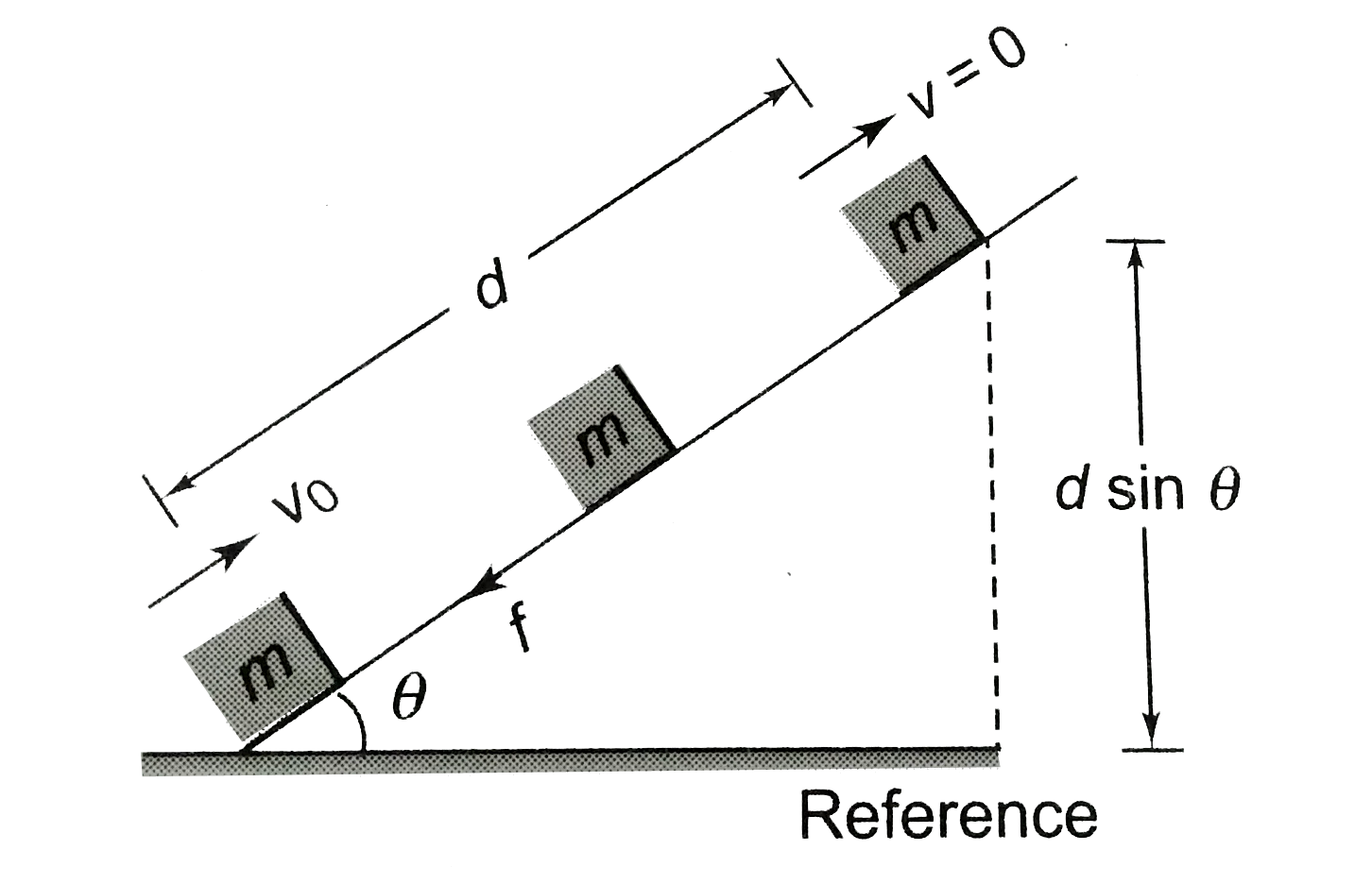

`K_1+U_1=K_2+U_2+W_f` [`W_f=fd`]
`(1)/(2)mv_0^2=mgdsintheta+mumgcosthetad`
`d=(v_0^2)/(2g(sintheta+mucostheta))`
work done by friction
`W_f^(')=-W_f=-mumgcosthetad`
`=-(mumgcosthetav_0^2)/(2g(sintheta+mucostheta))`
`=-(mumv_0^2)/(2(tantheta+mu))`
Promotional Banner

Topper's Solved these Questions

  • WORK, ENERGY AND POWER

    CP SINGH|Exercise EXERCISES|92 Videos
  • VECTORS

    CP SINGH|Exercise Excercises|66 Videos

Similar Questions

Explore conceptually related problems

A disc of mass m=50g slides with the zero initial velocity down an inclined plane set at an angle alpha=30^@ to the horizontal, having traversed the distance l=50cm along the horizontal plane, the disc stops. Find the work performed by the friction forces over the whole distance, assuming the friction coefficient k=0.15 for both inclined and horizontal planes.

A body of mass m is pushed with the initial velocity v_(0) up an inclined plane of angle of inclination theta . The co-efficient or friction between the body and the plane is mu . What is the net work done by fnction during the ascent of the body before it comes to stop ?

A disc of mass m slides with the zero initial velocity down an inclined plane of inclination theta to the harizontal, having traveled the distance d along the horizontal plane, the disc stops. Find the work performed by the friction over the whole distance, assuming the friction coefficient mu for both the inclined and horizontal planes.

A bar of mass m is pulled by means of a thread up an inclined plane forming an angle alpha with the horizontal (figure). The coefficient of friction is equal to k. Find the angle beta which is thread must form with the inclined plane for the tension of the thread to be minimum. What is it equal to?

A body with zero initial velocity slips from the top of an inclined plane forming an angle alpha with the horizontal. The coefficient of friction mu between the body and the plane increases with the distance s from the top according to the law mu = bs . After what distance the body will stop.

A small body was launched up an inclined plane set at an angle alpha=15^@ against the horizontal. Find the coefficient of friction, if the time of the ascent of the body is eta=2.0 times less than the time of its descent.

A block sliding down on an inclined plane forms an angle theta with the horizontal. The friction coefficient depends on the distance x covered as mu = kx , where k is a constant. Find the distance covered by the block till it stops and its maximum velocity over this distance. Also , sketch a graph between square of velocity and distance covered x .

A small bar starts sliding down an inclined plane forming an angle alpha with the horizontal. The friction coefficient depends on the distance x covered as k=ax , where a is a constant. Find the distance covered by the bar till it stops, and its maximum velocity over this distance.

A small mass slides down an inclined plane of inclination theta the horizontal the coefficient of friction is m = mu_(0)x , where x is the distance by the mass before it stops is .

A body with zero initial velocity slips from the top of an inclined plane forming an angle alpha with the horizontal. The coefficient of friction mu between the body and the plane increases with the distance l from the top according to the law mu = bl . The body stops before it reaches the end of the plane. Determine the time t from the beginning of motion of the body to the moment when it comes to rest.

CP SINGH-WORK, ENERGY AND POWER-EXERCISES
  1. A body of mass m is pushed with the initial velocity v0 up an inclined...

    Text Solution

    |

  2. A particle moves from position 3hati+2hatj-6hatk to 14hati+13hatj+9hat...

    Text Solution

    |

  3. A body, constrained to move in the Y-direction is subjected to a force...

    Text Solution

    |

  4. A force vecF=3hati+chatj+2hatk acting on a particle causes a displacem...

    Text Solution

    |

  5. A force F=-k(y hati + x hatj) (where k is a positive constant) acts on...

    Text Solution

    |

  6. A man displaces a block by 5 m on a rough surface (mu=(1)//(2)) by app...

    Text Solution

    |

  7. A block of mass 10kg is placed on a rough surface inclined plane of in...

    Text Solution

    |

  8. A block of mass M is pulled along a horizontal surface by applying a f...

    Text Solution

    |

  9. A cord is used to lower vertically a block of mass M, a distance d at ...

    Text Solution

    |

  10. The two blocks in an Atwood machine have masses 2.0 kg and 3.0 kg. Fin...

    Text Solution

    |

  11. A light inextensible string that gas over a smoth fixed polley as show...

    Text Solution

    |

  12. If W(1) ,W(2) and W(3) represent the work done in moving a particle f...

    Text Solution

    |

  13. A Force F acting on an object varies with distance x as shown in the h...

    Text Solution

    |

  14. Work done from d=0m to d=3m

    Text Solution

    |

  15. A particle moves along the X-axis from x=0 to x=5m under the influence...

    Text Solution

    |

  16. A force act on a 30 gm particle in such a way that the position of the...

    Text Solution

    |

  17. The displacement x of a particle of mass m kg moving in one dimension,...

    Text Solution

    |

  18. A particle of mass m moves on a straight line with its velocity varyin...

    Text Solution

    |

  19. A particle is moving along the x-axis and force acting on it is given ...

    Text Solution

    |

  20. A block of mass m at rest is acted upon by a force F for a time t. The...

    Text Solution

    |

  21. According to the work energy theorem, the work done by the net force o...

    Text Solution

    |

