Home
Class 11
PHYSICS
If W(1) ,W(2) and W(3) represent the wo...

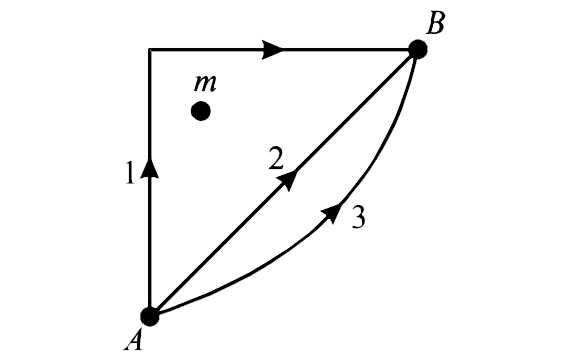
If `W_(1)` ,`W_(2)` and `W_(3)` represent the work done in moving a particle from `A` to `B` along three different paths `1`, `2` and`3` respectively (as shown ) in the gravitational field of a point mass m, find the correct relation between ` `W_(1) W_(2)` and `W_(3)`

A

`W_1gtW_2gtW_3`

B

`W_1=W_2=W_3`

C

`W_1ltW_2ltW_3`

D

`W_2gtW_1gtW_3`

Text Solution

Verified by Experts

The correct Answer is:

B

Work done by a conservative force is independent of path followed by particle.
Promotional Banner

Topper's Solved these Questions

  • WORK, ENERGY AND POWER

    CP SINGH|Exercise EXERCISES|92 Videos
  • VECTORS

    CP SINGH|Exercise Excercises|66 Videos

Similar Questions

Explore conceptually related problems

The work done in moving a particle in the gravitational field of earth from point A to point B along three different paths 1,2 and 3 are W_(1) , W_(2) and W_(3) respectively , then

A gas of given mass, is brought from stage A to B along three paths 1, 2 and 3, as shown in the figure. If the amount of work done in these three processes is respectively equal to W_(1), W_(2) and W_(3) , then–

In the following diagram the work done in moving a point charge from point P to point A, B and C is respectively as W_(A), W_(B) and W_(C) , then

A gravitational field is present in a region. A point mass is shifted from A to B , along different paths shown in the figure. If W_1, W_2 and W_3 represent the work done by gravitational force for respective paths, then

If w_(1).w_(2),w_(3) and w_(4) are work done in isothermal, adiabatic, isobaric, and isochoric reversible expansion for an ideal gas, respectively, then

A system is taken from state A to state B along two different paths 1 and 2 . The heat absorbed and work done by the system along these two paths are Q_(1) and W_(1) and W_(2) respectively.

The weight of an object in the coal mine, sea level and at the top of the mountain are W_(1),W_(2) and W_(3) respectively, then

CP SINGH-WORK, ENERGY AND POWER-EXERCISES
  1. The two blocks in an Atwood machine have masses 2.0 kg and 3.0 kg. Fin...

    Text Solution

    |

  2. A light inextensible string that gas over a smoth fixed polley as show...

    Text Solution

    |

  3. If W(1) ,W(2) and W(3) represent the work done in moving a particle f...

    Text Solution

    |

  4. A Force F acting on an object varies with distance x as shown in the h...

    Text Solution

    |

  5. Work done from d=0m to d=3m

    Text Solution

    |

  6. A particle moves along the X-axis from x=0 to x=5m under the influence...

    Text Solution

    |

  7. A force act on a 30 gm particle in such a way that the position of the...

    Text Solution

    |

  8. The displacement x of a particle of mass m kg moving in one dimension,...

    Text Solution

    |

  9. A particle of mass m moves on a straight line with its velocity varyin...

    Text Solution

    |

  10. A particle is moving along the x-axis and force acting on it is given ...

    Text Solution

    |

  11. A block of mass m at rest is acted upon by a force F for a time t. The...

    Text Solution

    |

  12. According to the work energy theorem, the work done by the net force o...

    Text Solution

    |

  13. A particle of mass 0.1 kg is subjected to a force which varies with di...

    Text Solution

    |

  14. A block of mass 2 kg is resting on a smooth surface. At what angle a ...

    Text Solution

    |

  15. Two blocks A and B have masses m and 4m, respectively. Each one is act...

    Text Solution

    |

  16. A force acting on particle is given by vecF=(3x^2hati+4yhatj)N. The ch...

    Text Solution

    |

  17. The K.E. acquired by a mass m in travelling a certain distance d, star...

    Text Solution

    |

  18. If the force acting on a body is inversely proportional to its speed, ...

    Text Solution

    |

  19. If the kinetic energy of body is directly proportional to time t, the ...

    Text Solution

    |

  20. A particle move in a straight line with retardation proportional to it...

    Text Solution

    |
