Home
Class 11
PHYSICS
A motorcycle has to move with a constant...

A motorcycle has to move with a constant speed on an overbridge which is in the form of a circular arc of radius R and has a total length L. Suppose the motorcycle starts from the highest point.
a. what can its maximum velocity be for which the contact with the road is not broken at the highest point?
b. If the motorcycle goes at speed `1/sqrt2` times the maximum found in part a. where will it lose the contact with the road?
c. What maximum uniform speed can it maintain on the bridge if it does not lose contact anywhere on the bridge?

Text Solution

Verified by Experts
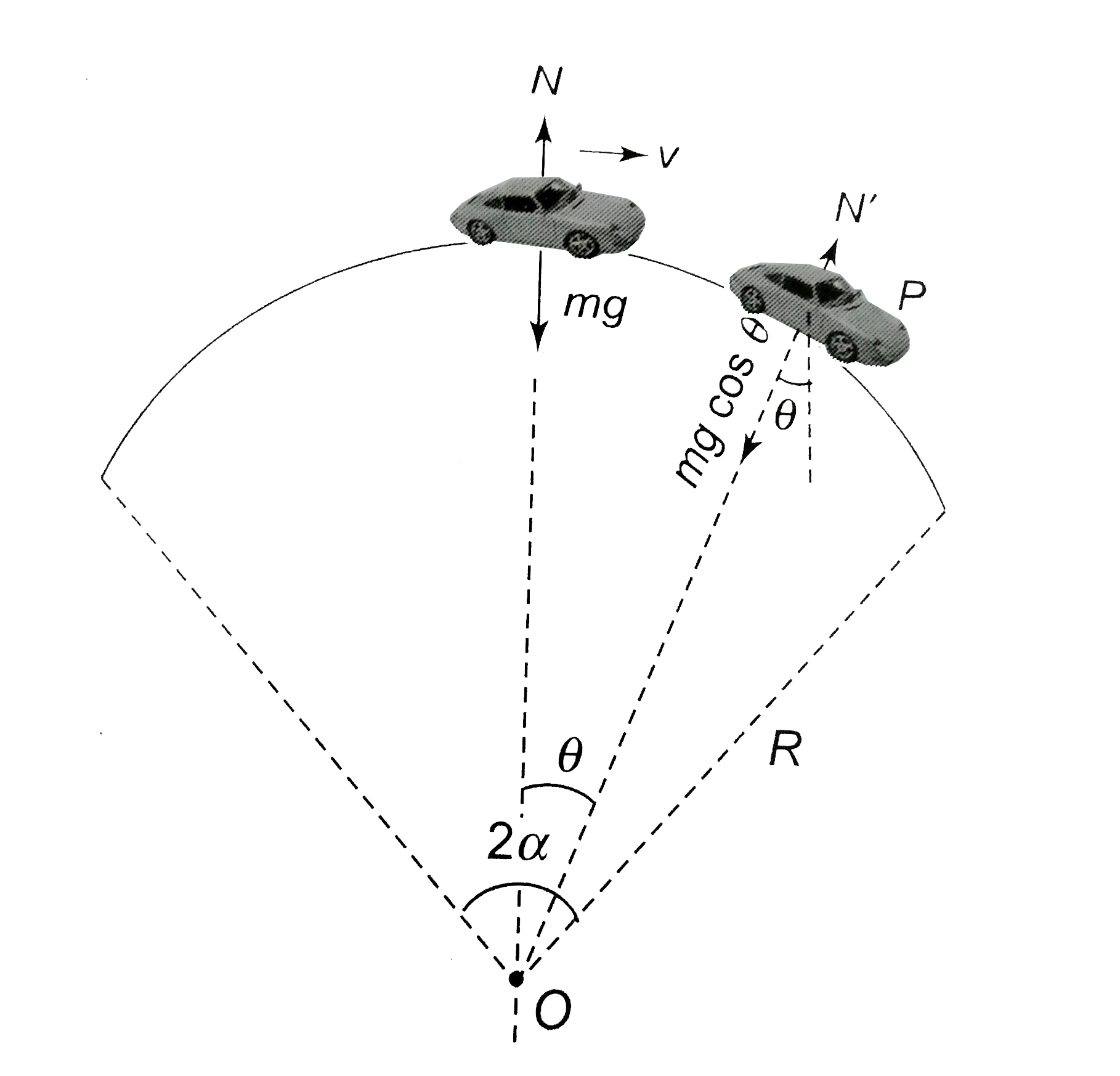
(a) Angle subtended by the arc at center `2alpha=(L)/(R )`
At the highest point:
`mg-N=(mv^(2))/(R )`
`N=mg-(mv^(2))/(R )`
For no loss of contact at the highest point
`Nge0`
`mg-(mv^(2))/(R ) ge 0 implies v le sqrt(gR)`
`v_(max)=sqrt(gR)`
(b)
At P:
`mg cos theta-N=(mv^(2))/(R )=(m)/(R )(v_(max)^(2))/(2)=(m)/(R )xx(gR)/(2)=(mg)/(2)`
when the car loses contact,`N=0`.
`cos theta=(1)/(2)impliestheta=60^(@)=(pi)/(3)`
Distance traveled by the car `=AP=(piR)/(3)`
(c ) `N=mg cos theta-(mv^(2))/(R )`, as `theta` increase, `N` decreases
As the car moves downward, normal reaction decreases. `N` will be minimum at the lowest point,i.e., `theta=alpha`.
`N_(min=mg cos alpha-(mv^(2))/(R )`
For no loss of contact, `N_(minge0`.
`mg cos alpha-(mv^(2))/(R )ge0impliesvlesqrt(gRcosalpha)`
`v_(max)=sqrt(gRcos((L)/(2R)))`

Promotional Banner

Topper's Solved these Questions

Similar Questions

Explore conceptually related problems

Which has the highest melting point?

Which has the highest boiling point?

The maximum velocity at the lowest point, so that the string just slack at the highest point in a vertical circle of radius l.

A vehicle is moving on an over bridge which is in the form of a circular arc of radius 10 m. What is the maximum speed with which a vehicle can move through the topmost point on the bridge without losing contact with the bridge ? (g = 10 m//s^(2))

Which has the highest freezing point at 1 atm ?

CP SINGH-CIRCULAR MOTION-Exercise
  1. A motorcycle has to move with a constant speed on an overbridge which ...

    Text Solution

    |

  2. A particle revolves round a circular path with a constant speed. (i...

    Text Solution

    |

  3. A particle of mass m moves in a circle of radius R with a uniform spee...

    Text Solution

    |

  4. A particle moves in a circle of radius 5 cm with constant speed and ti...

    Text Solution

    |

  5. A body is whirled in a horizontal circle of radius 20cm. It has an an...

    Text Solution

    |

  6. A particle moves in a circular orbit under the action of a central att...

    Text Solution

    |

  7. If a body moves with a constant speed in a circle

    Text Solution

    |

  8. A car runs at a constant speed on a circular track of radius 100m, tak...

    Text Solution

    |

  9. The second's hand of a watch has length 3cm. The speed of the end poin...

    Text Solution

    |

  10. For a particle in uniform circular motion , the acceleration vec(a) a...

    Text Solution

    |

  11. What is the value of linear velocity, if vecomega =hati-hatj+hatk and ...

    Text Solution

    |

  12. An object moves at a constant speed along a circular path in a horizon...

    Text Solution

    |

  13. An electric fan has blades of length 30 cm as measured from the axis o...

    Text Solution

    |

  14. Two bodies of mass 10kg and 5kg moving in concentric orbits of radii R...

    Text Solution

    |

  15. Two cars of mass m(1) and m(2) are moving in circle of radii r(1) an...

    Text Solution

    |

  16. A particle is kept fixed on as turntable rotating uniformly. As seen f...

    Text Solution

    |

  17. A particle is acted upon by a force of constant magnitude which is alw...

    Text Solution

    |

  18. The position vector of a particle in a circular motion about the origi...

    Text Solution

    |

  19. Which of the following quantities may remain constant during the motio...

    Text Solution

    |

  20. When a body is acclerated : (i) its velocity always changes (ii) its s...

    Text Solution

    |

  21. Which of the following statements is FALSE for a paricle moving in a...

    Text Solution

    |