Home
Class 11
PHYSICS
A small body A starts sliding from the h...

A small body A starts sliding from the height h down an inclined groove passing into a half-circle of radius `h//2` (figure).

Assuming the friction to be negligible, find the velocity of the body at the highest point of its trajectory (after breaking off the groove).

Text Solution

Verified by Experts
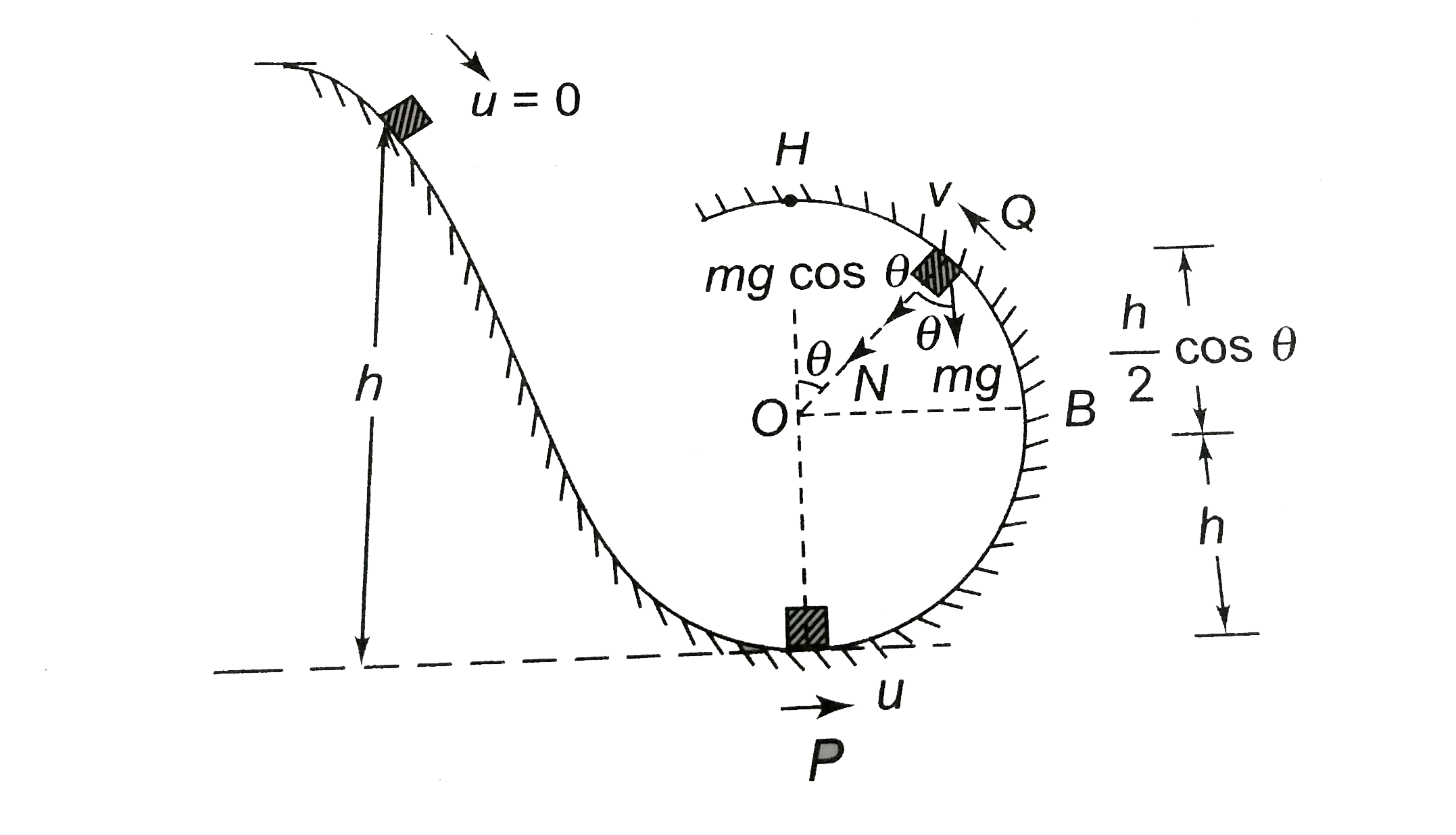
When the ball reaches at `P`, its speed

`u=sqrt(2gh)`
Radius of circle `r=(h)/(2)`
`sqrt(2gr)=sqrtgh`
`sqrt(5gr)=sqrt(2.5gh)`
`sqrt(2gr)ltu lt sqrt(5gr)`
That is the body will leave circular path somewhere between `B` and `H`
At `Q:`
`v^(2)=u^(2)-2gr(1+costheta)=gh-ghcostheta (i)`
`N+mgcostheta=(mv^(2))/(h//2)` (ii)
When the body loses contact with surface.
`N=0` (iiI)
From (i), (ii) and (iii) we get
`(gh)/(2)costheta=gh-ghcosthetarArrcostheta=(2)/(3)`
`v=sqrt((gh)/(2)costheta)=sqrt((gh)/(3))`
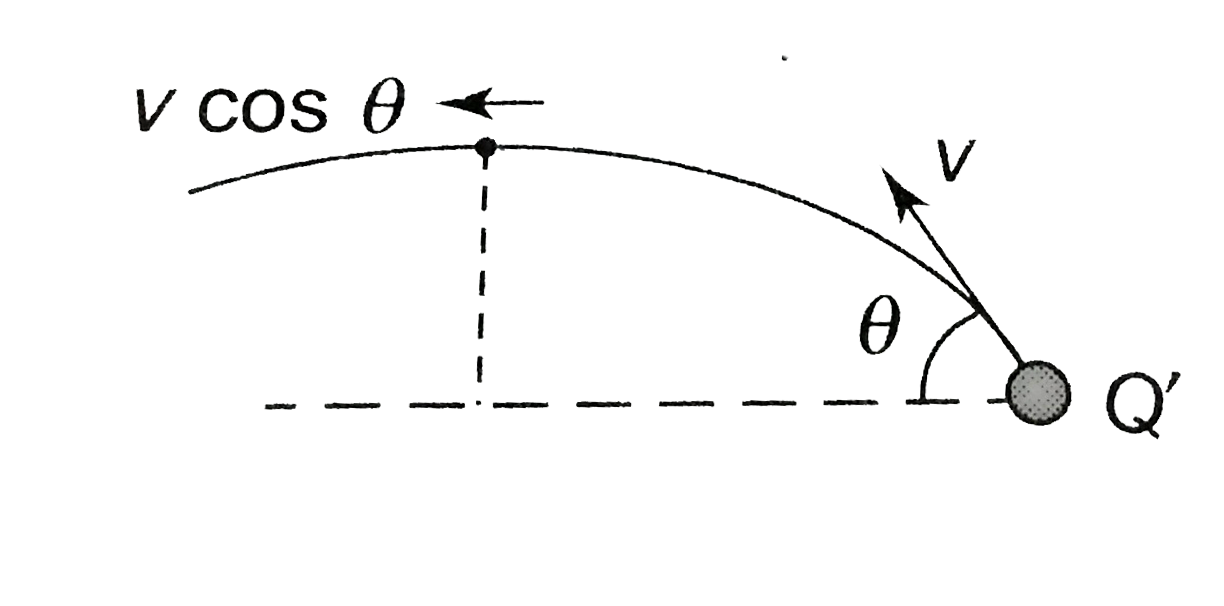
At `Q`, the body losses contact, now the body moves as a free particle in a parabolic path (projectile motion). In a projectile motion, the velocity at the highest point is horizontal and equal to `vcostheta`.
`vcostheta=(2)/(3)sqrt((gh)/(3))`
Promotional Banner

Topper's Solved these Questions

Similar Questions

Explore conceptually related problems

A body A is dropped from a height h above the ground. At the same time another body B (at a horizontal' distance d from the line of fall of A) is fired from the ground at an angle alpha to the horizontal. If the two bodies collide at the highest point of the trajectory of B the angle of projection is given by

At the moment t=0 the force F=at is applied to a small body of mass m resting on a smooth horizontal plane (a is constant). The permanent direction of this force forms an angle alpha with the horizontal (figure). Find: (a) the velocity of the body at the moment of its breaking off the plane, (b) the distance traversed by the body up to this moment.

A body of mass m is released from a height h on a smooth inclined plane that is shown in the figure. The following can be true about the velocity of the block knowing that the wedge is fixed. .

A body slides down a fixed curved track that is one quadrant of a circle of radius R , as in the figure. If there is no friction and the body starts from rest, its speed at the bottom of the track is

A small body of mass m slide without friction from the top of a hemispherical cup of radius r as shown in figure. If leaves the surface to the cup at vertial distance h below the highest point then

A body is thrown from the surface of the Earth at an angle alpha to the horizontal with the initial velocity v_0 . Assuming the air drag to be negligible, find: (a) the time of motion, (b) the maximum height of ascent and the horizontal range, at what value of the angle alpha they will be equal to each other, (c) the equation of trajectory y(x) , where y and x are displacements of the body along the vertical and the horizontal respectively, (d) the curvature radii of trajectory at its initial point and at its peak.

In the system shown in figure the masses of the bodies are known to be m_1 and m_2 , the coefficient of friction between the body m_1 and the horizontal plane is equal to k , and a pulley of mass m is assumed to be a uniform disc. The thread does not slip over the pulley. At the moment t=0 the body m_2 starts descending. Assuming the mass of the thread and the friction in the axle of the pulley to be negligible, find the work performed by the friction forces acting on the body m_1 over the first t seconds after the beginning of motion.

A small sphereical ball is released from a point at a height h on a rough track shown in figure. Assuming that it dow not slip anywhere, find its linear speed when it rolls on the horizontal part of the track.

At the equator a stationary (relative to the Earth) body falls down from the height h=500m . Assuming the air drag to be negligible, find how much off the vertical, and in what direction, the body will deviate when it hits the ground.

CP SINGH-CIRCULAR MOTION-Exercise
  1. A small body A starts sliding from the height h down an inclined groov...

    Text Solution

    |

  2. A particle revolves round a circular path with a constant speed. (i...

    Text Solution

    |

  3. A particle of mass m moves in a circle of radius R with a uniform spee...

    Text Solution

    |

  4. A particle moves in a circle of radius 5 cm with constant speed and ti...

    Text Solution

    |

  5. A body is whirled in a horizontal circle of radius 20cm. It has an an...

    Text Solution

    |

  6. A particle moves in a circular orbit under the action of a central att...

    Text Solution

    |

  7. If a body moves with a constant speed in a circle

    Text Solution

    |

  8. A car runs at a constant speed on a circular track of radius 100m, tak...

    Text Solution

    |

  9. The second's hand of a watch has length 3cm. The speed of the end poin...

    Text Solution

    |

  10. For a particle in uniform circular motion , the acceleration vec(a) a...

    Text Solution

    |

  11. What is the value of linear velocity, if vecomega =hati-hatj+hatk and ...

    Text Solution

    |

  12. An object moves at a constant speed along a circular path in a horizon...

    Text Solution

    |

  13. An electric fan has blades of length 30 cm as measured from the axis o...

    Text Solution

    |

  14. Two bodies of mass 10kg and 5kg moving in concentric orbits of radii R...

    Text Solution

    |

  15. Two cars of mass m(1) and m(2) are moving in circle of radii r(1) an...

    Text Solution

    |

  16. A particle is kept fixed on as turntable rotating uniformly. As seen f...

    Text Solution

    |

  17. A particle is acted upon by a force of constant magnitude which is alw...

    Text Solution

    |

  18. The position vector of a particle in a circular motion about the origi...

    Text Solution

    |

  19. Which of the following quantities may remain constant during the motio...

    Text Solution

    |

  20. When a body is acclerated : (i) its velocity always changes (ii) its s...

    Text Solution

    |

  21. Which of the following statements is FALSE for a paricle moving in a...

    Text Solution

    |