Home
Class 11
PHYSICS
The temperature at the bottom of a 40 cm...

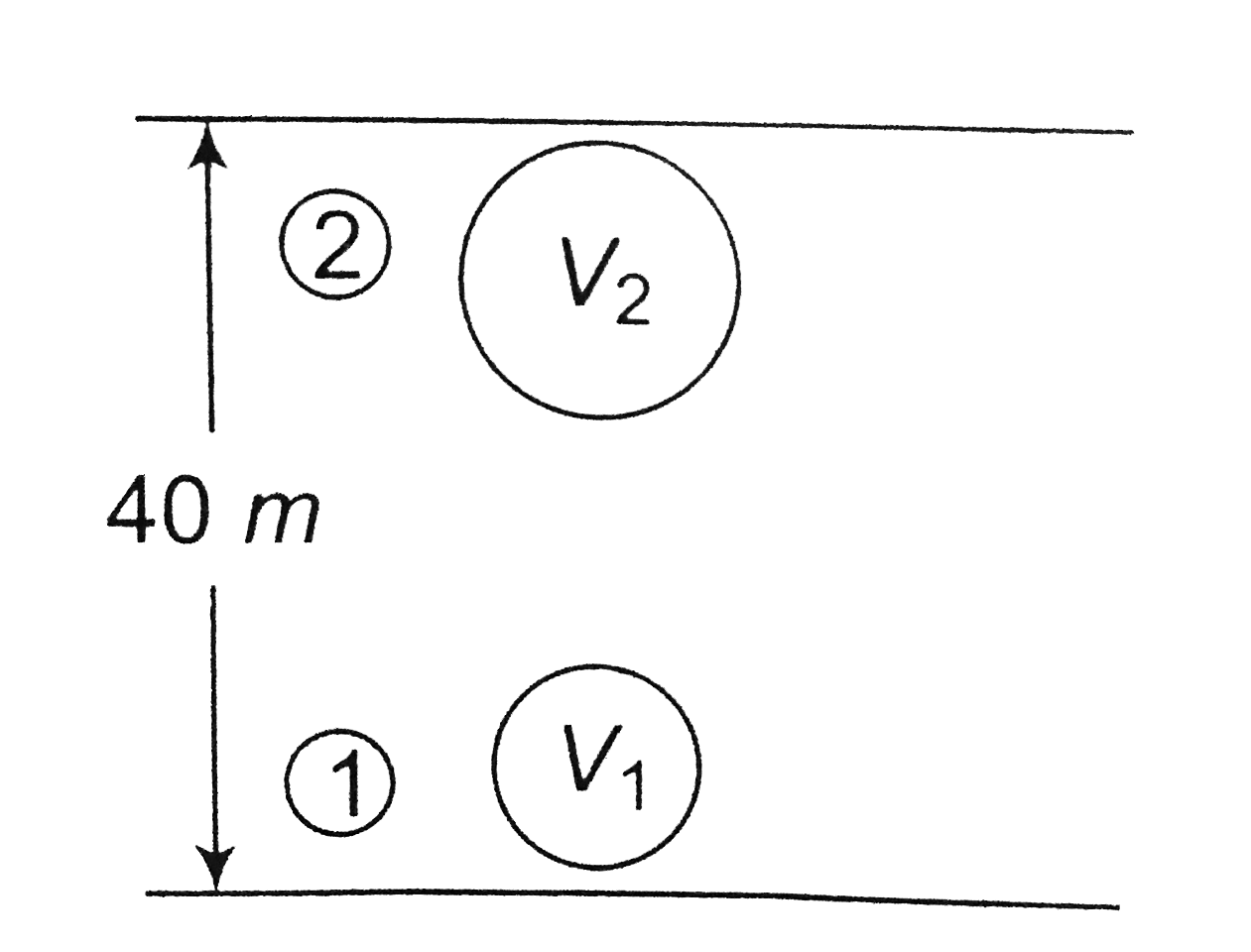
The temperature at the bottom of a `40 cm` deep lake is `12^(@)C` and that at the surface is `35^(@)C`. An air bubble of volume `1.0 cm^(3)` rises from the bottom to the surface. Its volume becomes (atmospheric pressure `= 10 m` of water)

A

`2.0 cm^(3)`

B

`3.2 cm^(3)`

C

`5.4 cm^`

D

`8.0 cm^(3)`

Text Solution

Verified by Experts

The correct Answer is:
C


`P_(1) = P_(atm) + P_(water) = 10 + 40 = 50 m` of water
`V_(1) = 1 c c, T_(1) = 12 + 273 = 285 K`
`P_(2) = P_(atm) = 10 m` of water
`V_(2) = ?, T_(2) = 35 + 273 = 308 K`
Since number of moles in the bubble remains same
`(P_(1)V_(1))/(RT_(1)) = (P_(2)V_(2))/(RT_(2))`
`(50 xx 1)/(285) = (10 V_(2))/(308) rArr V_(2) = 5.4 cm^(3)`
Promotional Banner

Topper's Solved these Questions

  • KINETIC THEORY OF GASES

    CP SINGH|Exercise Exercises|79 Videos
  • HEAT TRANSFER

    CP SINGH|Exercise Exercises|94 Videos
  • LAWS OF THERMODYNAMICS

    CP SINGH|Exercise EXERCISE|131 Videos

Similar Questions

Explore conceptually related problems

A bubble rises from the bottom of a lake 90m deep on reaching the surface, its volume becomes (take atmospheric pressure equals to 10 m of water)

As an air bubble rises from the bottom of a lake to the surface, its volume is doubled. Find the depth of the lake. Take atmospheric pressure = 76 cm of Hg.

An air bubble starts rising from the bottom of a lake. Its diameter is 3.6 mm at the bottom and 4 mm at the surface. The depth of the lake is 250 cm and the temperature at the surface is 40^@ C . What is the temperature at the bottom of the lake? Given atmospheric pressure = 76 cm of Hg and g = 980 cm//s^2 .

At the bottom of a lake where temperature is 7^(0)C the pressure is 2.8 atmosphere. An air bubble of radius 1 cm at the bottom rises to the surface. Where the temperature is 27^(0)C . Radius of air bubble at the surface is

When an air bubble rise from the bottom of a deep lake to a point just below the water surface, the pressure of air inside the bubble

(a) A spherical tank of 1.2m radius is half filled with oil of relaive density 0.8 . If the tank is given a horizontal acceleration of 10m//s^(2) . Calculate the inclination of the oil surface to horizontal and maximum pressure on the tank. (b) The volume of an air bubble is doubled as it rises from the bottom of a lake to its surface. If the atmospheric pressure is H m of mercury & the density of mercury is n times that of lake water. Find the depth of the lake.

The density of an air bubble decrease by x% as it raises from the bottom of a lake to tis surface. The water berometer reads H . The depth of lake is

Radius of an air bubble at the bottom of the lake is r and it becomes 2 r when the air bubbles rises to the top surface of the lake. If P cm of water be the atmospheric pressure, then the depth of the lake is

CP SINGH-KINETIC THEORY OF GASES-Exercises
  1. A gas has volume V and pressure p. The total translational kinetic ene...

    Text Solution

    |

  2. The average translational energy and the rms speed of molecules in a s...

    Text Solution

    |

  3. A polyatomic gas with (n) degress of freedom has a mean energy per mol...

    Text Solution

    |

  4. Three perfect gases at absolute temperature T(1), T(2) and T(3) are mi...

    Text Solution

    |

  5. Consider a mixture of oxygen and hydrogen kept at room temperature, As...

    Text Solution

    |

  6. The temperature of argon, kept in a vessel, is raised by 1^(@)C at a c...

    Text Solution

    |

  7. A vessel contains a mixture of one mole of oxygen and two moles of nit...

    Text Solution

    |

  8. A gas mixture consists of 2 moles of oxygen and 4 moles of argon at te...

    Text Solution

    |

  9. A gas is enclosed in a container which is then placed on a fast moving...

    Text Solution

    |

  10. Mean free path of a gas molecule is

    Text Solution

    |

  11. If the mean free path of atoms is doubled then the pressure of gas wil...

    Text Solution

    |

  12. Figure shows two flasks connected to each other. The volume of the fla...

    Text Solution

    |

  13. Two containers of equal volume contain the same gas at pressure P(1) a...

    Text Solution

    |

  14. Two idential container joined by a small pipe initially contain the sa...

    Text Solution

    |

  15. In the previous question let V(0) be the volume of each container. All...

    Text Solution

    |

  16. The temperature at the bottom of a 40 cm deep lake is 12^(@)C and that...

    Text Solution

    |

  17. An air bubble doubles in radius on string from the bottom of a lake to...

    Text Solution

    |

  18. When an air bubble of radius 'r' rises from the bottom to the surface ...

    Text Solution

    |

  19. If pressure of CO(2) (real gas ) in a container is given by P = (RT)/...

    Text Solution

    |

  20. The equation of state of gas is given (P + (aT^(2))/(V))V^( c) = (RT +...

    Text Solution

    |

