Home
Class 11
PHYSICS
If the above diagram initially there is ...

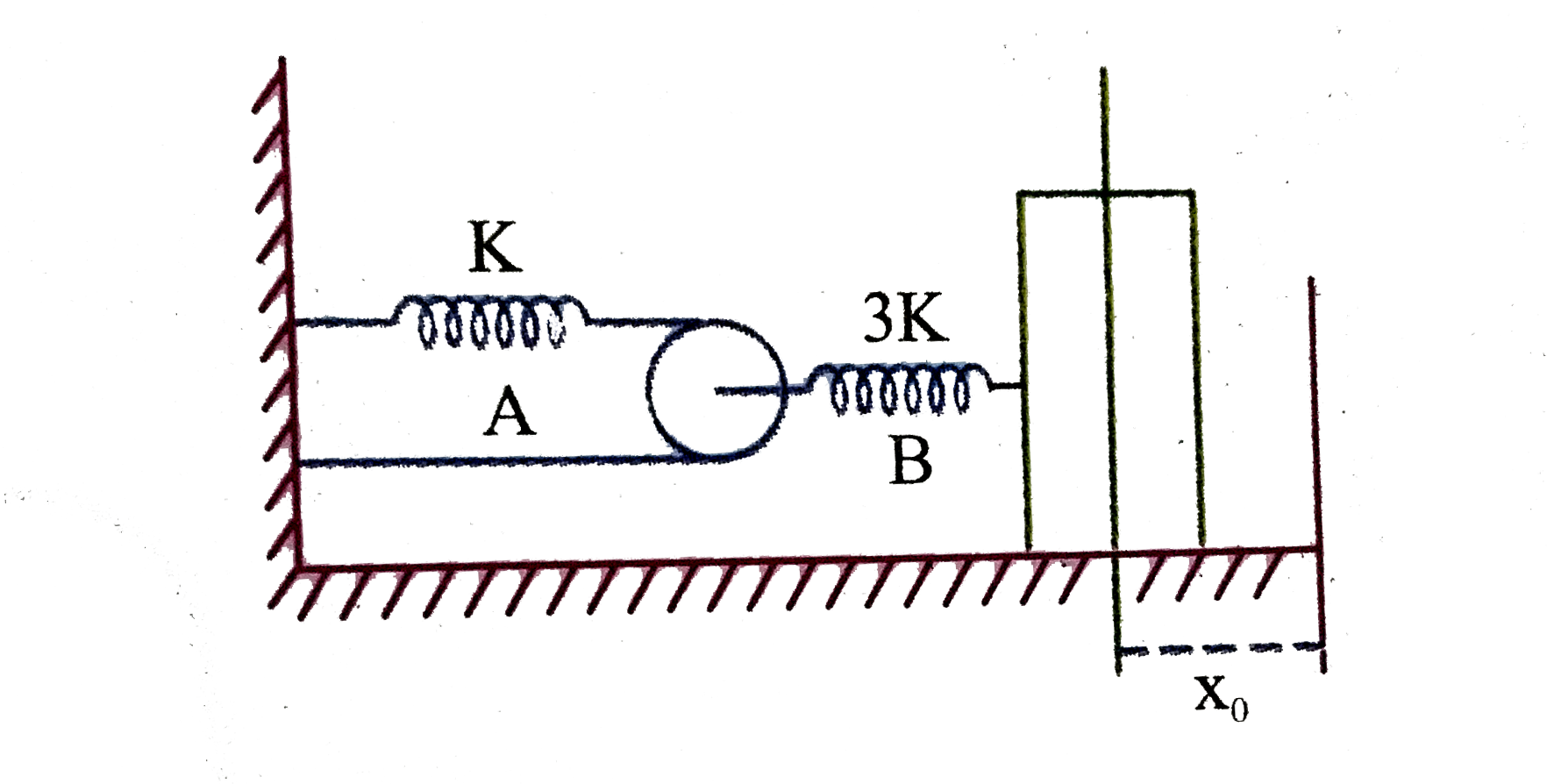
If the above diagram initially there is no elongation in spring if the block is displaced towards right by `x_(0)`. Calculate the elongation of spring A.
.

A

`(3)/(7)x_(0)`

B

`(x_(0))/(4)`

C

`(x_(0))/(7)`

D

`(x_(0))/(3)`

Text Solution

Verified by Experts

The correct Answer is:

A

`(1)/(K_(eq))=(1)/(3K)+(1)/(4K)=(7)/(12K),T=(12K)/(2)x_(0)`
`T =4K x_(1), (12)/(7) K//x_(0) =4K//x_(1),x_(1)=(3)/(7)x_(0)` .
Promotional Banner

Topper's Solved these Questions

  • NEWTONS LAWS OF MOTION

    NARAYNA|Exercise SINGLE ANSWER QUESTIONS Passage -1|1 Videos
  • NEWTONS LAWS OF MOTION

    NARAYNA|Exercise INTEGER TYPE QUESTIONS|23 Videos
  • NEWTONS LAWS OF MOTION

    NARAYNA|Exercise NCERT BASED QUESTION|33 Videos
  • MOTION IN A STRAIGHT LINE

    NARAYNA|Exercise Level 2 H.W|29 Videos
  • OSCILLATIONS

    NARAYNA|Exercise EXERCISE - IV|41 Videos

Similar Questions

Explore conceptually related problems

In the previous problem , the maximum elongation of the spring is

A spring is made of material of Young's modulus 10^(11)N//m^(2) . When a weight of 10 kg is suspended vertically the elongation produced in the spring is 4 mm. If the load is reduced to half the elongation in the spring will be

A block of mass m and relative density y( lt 1) si attached to an ideal spring of constant K. The system is initially at rest and at equilibrium. If the container acceleration upwards with a_(0) , find the increase in the elongation of the spring in equilibrium.

A small block of mass m=1kg is attached with one end of the spring of force constant K=110Nm^-1 . Other end of the spring is fixed to a rough plane having coefficient of friction mu=0.2 . The spring is kept in its natural length by an inextensible thread ties between its ends as shown in figure. If the thread is burnt, calculate the elongation of the spring when the block attains static equilibrium position.

A spring block system is placed on a rough horizontal floor. Force constant of the spring is k. The block is pulled to right to give the spring an elongation equal to x_0 and then it is released. The block moves to left and stops at the position where the spring is relaxed. Calculate the maximum kinetic energy of the block during its motion.

In figure, the stiffness of the spring is k and mass of the block is m . The pulley is fixed. Initially, the block m is held such that the elongation in the spring is zero and then released from rest. Find: a. the maximum elongation in the spring. b. the maximum speed of the block m . Neglect the mass of the spring and that of the string. Also neglect the friction.

Two blocks of mass 10 kg and 2 kg are connected by an ideal spring of spring constant K = 800 N//m and the system is placed on a horizontal surface as shown. The coefficient of friction between 10 kg block and surface is 0.5 but friction is absent between 2 kg and the surface. Initially blocks are at rest and spring is relaxed. The 2 kg block is displaced to elongate the spring by 1 cm and is then released. (a) Will 10 kg block move subsequently? (b) Draw a graph representing variation of magnitude of frictional force on 10 kg block with time. Time t is measured from that instant when 2 kg block is released to move.

Two blocks of mass 10 kg and 2 kg are connected by an ideal spring of spring constant 1000 N/m and the system is placed on a horizontal surface as shown. The coefficient of friction between 10 kg block and surface is 0.5 but friction is assumed to be absent between 2 kg and surface. Initially blocks are at rest and spring is unstretched then 2 kg block is displaced by 1 cm to elongate the spring then released. Then the graph representing magnitude of frictional force on 10 kg block and time t is : (Time t is measured from that instant when 2 kg block is released to move)

A block A of mass m=5kg is attached with a spring having force constant K=2000Nm^-1 . The other end of the spring is fixed to a rough plane, inclined at 37^@ with horizontal and having coefficient of friction m=0.25 . Block A is gently placed on the plane such that the spring has no tension. Then block A is released slowly. Calculate elongation of the spring when equilibrium is achieved. Now an inextensible thread is connected with block A and passes below pulley C and over pulley D, as shown in figure. Other end of the thread is connected with another block B of mass 3kg . Block B is resting over a table and thread is loose. If the table collapse suddenly and B falls freely through 80//9cm , the thread becomes taut, calculate combined speed of blocks at that instant, and maximum elongation of spring in the process of motion. (g=10ms^-2) .

A spring block system is placed on a rough horizontal floor. The block is pulled towards right to give spring some elongation and released.

NARAYNA-NEWTONS LAWS OF MOTION-SINGLE ANSWER QUESTIONS
  1. A particle of mass m starts moving at t =0 due to force F =F(0) sin om...

    Text Solution

    |

  2. From the given, choose the correct option .

    Text Solution

    |

  3. In the diagram shown, the acceleration of the block B as shown in rela...

    Text Solution

    |

  4. In the pulley system shown the movable pulleys A,B and C have mass m e...

    Text Solution

    |

  5. A block of mass m is placed on a wedge The wedge can be accelerated in...

    Text Solution

    |

  6. A body of mass m =18kg is placed on an inclined plane the angle of inc...

    Text Solution

    |

  7. A body of mass m =18kg is placed on an inclined plane the angle of inc...

    Text Solution

    |

  8. Two smooth block are placed at a smooth corner as shown in fig. Both t...

    Text Solution

    |

  9. Two smooth block are placed at a smooth corner as shown in fig. Both t...

    Text Solution

    |

  10. Two smooth block are placed at a smooth corner as shown in fig. Both t...

    Text Solution

    |

  11. In the figure heavy mass m moves down the smooth surface of a wedge ma...

    Text Solution

    |

  12. A weightless inextensible rope rests on a stationary wedge forming an ...

    Text Solution

    |

  13. Block is attached to system of springs. Calculate equivalent spring co...

    Text Solution

    |

  14. Block A and C starts from rest and move to the right with acceleration...

    Text Solution

    |

  15. In the arrangement shown in fig. m(1)=1kg, m(2)=2 kg. Pulleys are mass...

    Text Solution

    |

  16. Find equivalent spring constant for the system .

    Text Solution

    |

  17. In the figure the wedge is pushed with an acceleration of sqrt3 m//s ^...

    Text Solution

    |

  18. In the above diagram system is in equilibrium if applied force F is do...

    Text Solution

    |

  19. In the above diagram all surface friction less what horizontal force h...

    Text Solution

    |

  20. If the above diagram initially there is no elongation in spring if the...

    Text Solution

    |
