Home
Class 11
PHYSICS
A plank of length 20 m and mass 1kg is k...

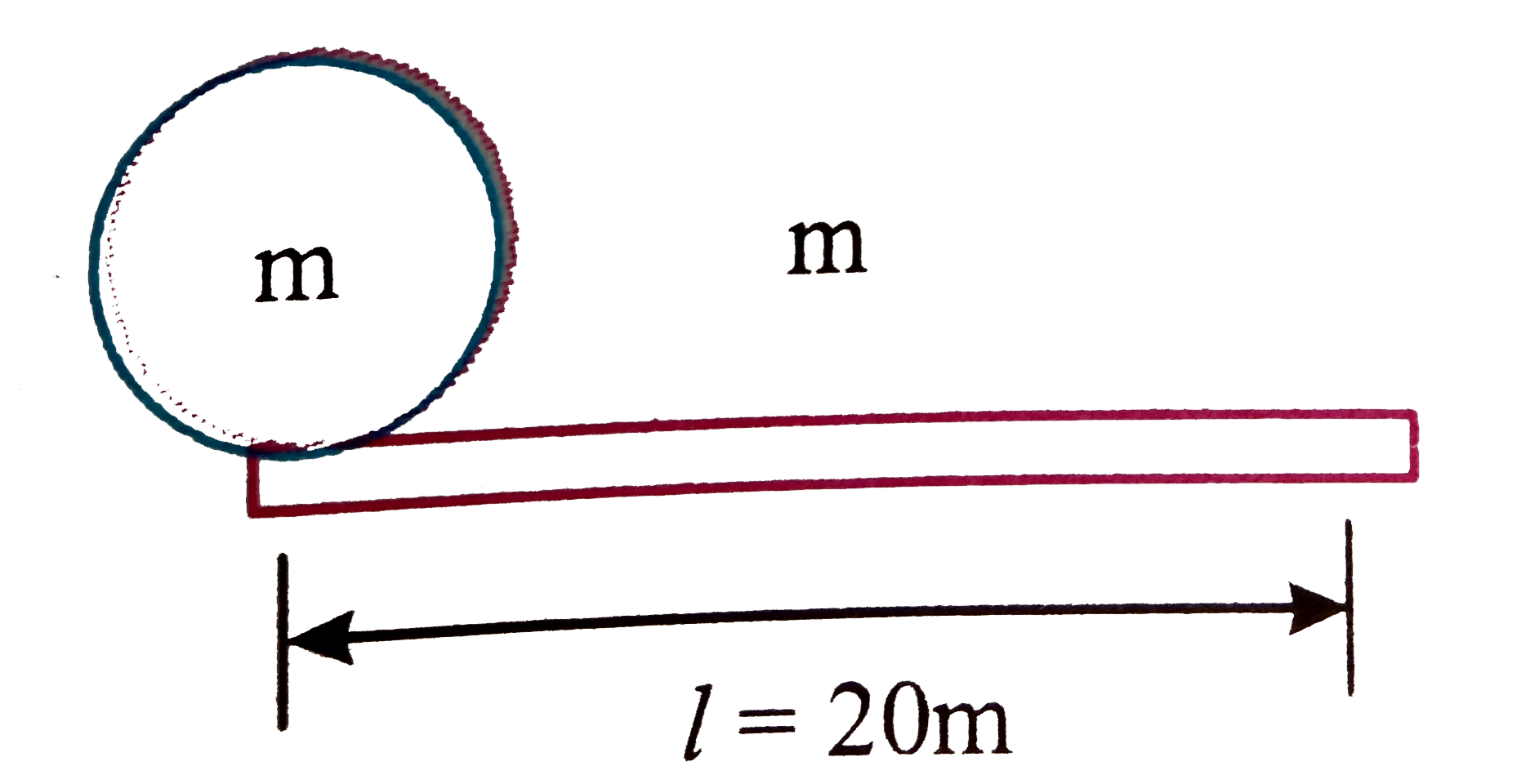
A plank of length `20 m` and mass `1kg` is kept on a horizontal smooth surface. A cylinder of mass `1lg` is kept near one end of the plank. The coefficient of friction between the two surface is `0.5`. The plank is suddenly given a velocity `20 m//s` towards left

Which of the following statements is correct ?

A

initial acceleration of cylinder is `5m//s^(2)` towards left

B

initial acceleration of cylinder is `5m//s^(2)` towards right

C

initial acceleration of cylinder is `10 m//s^(2)` towards right

D

initial acceleration of cylinder is `10m//s^(2)`

Text Solution

Verified by Experts

The correct Answer is:
B

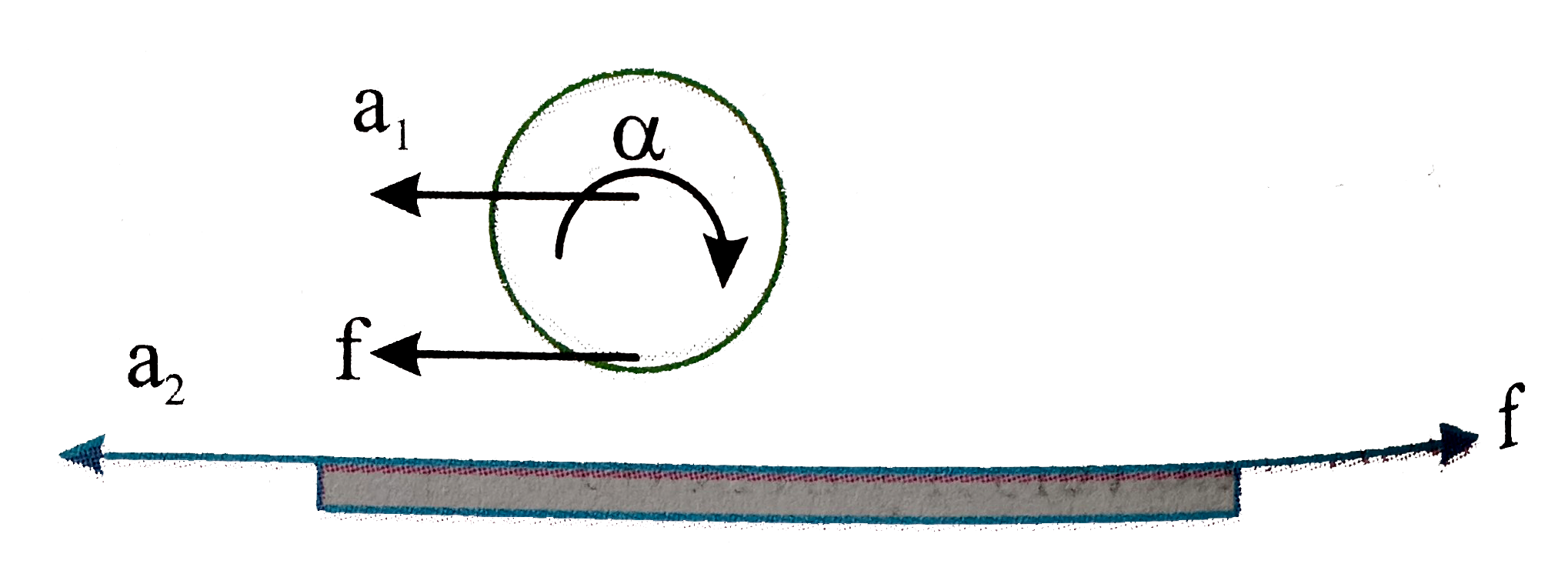
`f_(R)=(MR^(2))/2 alpha,f=5N,M=1 kg`,

`Ralpha=10 m//s^(2), a_(1)=f/M=5m//s^(2),a_(2)=5m//s^(2)`,
For `a_("contact")=a_(1), v_("contanct")=(a_(1)+Ralpha)t=15 t.....(1)`

From eqns. `(1)` and `(2)`we get
`t=1 sec`
Till the cylinder sllips on plank
`S_(rel)=u_(rel)+1/2a_(rel)t^(2),20xx1-1/2xx10xx1^(2)=15 m`
Velocity of plank when pure rolling begins
`v=20-5t=15 m//s`
Velocity of cylinder `a_(1)t=5m//s`
When pure rolling begins, friction force vanishes, velocity of plank and cylinder is constants. after pure rolling beings.
Promotional Banner

Topper's Solved these Questions

  • SYSTEM OF PARTICLES

    NARAYNA|Exercise Level-VI|78 Videos
  • SYSTEM OF PARTICLES

    NARAYNA|Exercise Level -II(H.W)|47 Videos
  • PHYSICAL WORLD

    NARAYNA|Exercise C.U.Q|10 Videos
  • SYSTEM OF PARTICLES AND ROTATIONAL MOTION

    NARAYNA|Exercise EXERCISE - IV|39 Videos

Similar Questions

Explore conceptually related problems

A plank of length 20 m and mass 1kg is kept on a horizontal smooth surface. A cylinder of mass 1lg is kept near one end of the plank. The coefficient of friction between the two surface is 0.5 . The plank is suddenly given a velocity 20 m//s towards left Time in which plank and cylinder separate

A solid cylinder is kept on one edge of a plank of same mass and length 25 m placed on a smooth surface as shown in the figure. The coefficient of friction between the cylinder and the plank is 0.5. The plank is given a velocity of 20ms^(-1) towards right. Find the time (in S) after which plank any cylinder will separate. [g=10ms^(-2)]

A block A of mass m is over a plank B of mass 2m . Plank B si placed over a smooth horizontal surface. The coefficient of friction between A and B is (1)/(2) . Blocks A is given a velocity V_(0) towards right. Then

A plank of mass m rests symmetrically on two wedges B and C of mass M. What is the acceleration of the plank? Neglect friction between all the contact surfaces.

A plank of mass 10 kg and a block of mass 2 kg are placed on a horizontal plane as shown in the figure. There is no friction between plane and plank. The coefficient of friction between block and plank is 0.5 .A force of 60 N is applied on plank horizontally. In first 2 s the work done by friction on the block is

A block A of mass m is placed over a plank B of mass 2m plank B is placed over a smooth horizontal surface .The coefficient of friction between A and B is 0.4 Block A is given a velocity v_(0) toward right Find acceleration (in ms^(-2) of B relative to A

A plank of mass 2 kg and length 1 m is placed on horizontal floor.A small block of mass 1 kg is placed on top of the plank , at its right extreme end .The coefficient of friction between plank and floor is 0.5 and that between plank and block is 0.2 . If a horizontal force = 30 N starts acting on the plank to the right ,the time after which the block will fall off the plank is (g = 10 ms^(-2))

Block m_(1) is projected on a long plank of mass m_(2) plank is placed on a smooth horizontal surface. There is friction between block and plank, coefficient of friction is mu. Block m_(1) has initial velocity v_(01) and plank has initial velocity v_(02) with (v_(01) gt v_(02)) . Which of following graphs is correct.

NARAYNA-SYSTEM OF PARTICLES-Level-V
  1. In the given figure F=10N, R=1m, mass of the body is 2kg and moment of...

    Text Solution

    |

  2. In the given figure F=10N, R=1m, mass of the body is 2kg and moment of...

    Text Solution

    |

  3. A plank of length 20 m and mass 1kg is kept on a horizontal smooth sur...

    Text Solution

    |

  4. A plank of length 20 m and mass 1kg is kept on a horizontal smooth sur...

    Text Solution

    |

  5. A plank of length 20 m and mass 1kg is kept on a horizontal smooth sur...

    Text Solution

    |

  6. A plank of length 20 m and mass 1kg is kept on a horizontal smooth sur...

    Text Solution

    |

  7. A circular hoop of mass m and radius R rests flat on a horizontal smoo...

    Text Solution

    |

  8. A circular hoop of mass m and radius R rests flat on a horizontal smoo...

    Text Solution

    |

  9. A circular hoop of mass m and radius R rests flat on a horizontal smoo...

    Text Solution

    |

  10. A circular wooden hoop of mass m and radius R rests fiat on a friction...

    Text Solution

    |

  11. A circular hoop of mass m and radius R rests flat on a horizontal smoo...

    Text Solution

    |

  12. A uniform rod of mass m is supported on two rollers each of mass m//2...

    Text Solution

    |

  13. A uniform rod of mass m is supported on two rollers each of mass m//2...

    Text Solution

    |

  14. A uniform rod of mass m is supported on two rollers each of mass m//2...

    Text Solution

    |

  15. One end of an ideal spring of unstreched length l(O)=1m, is fixed on a...

    Text Solution

    |

  16. One end of an ideal spring of unstreched length l(O)=1m, is fixed on a...

    Text Solution

    |

  17. One end of an ideal spring of unstreched length l(O)=1m, is fixed on a...

    Text Solution

    |

  18. A thin uniformed rod of mass m and length L is hinged at one end and f...

    Text Solution

    |

  19. A thin uniform rod of mass m and length L is hinged at one end and fro...

    Text Solution

    |

  20. A thin uniform rod of mass m and length L is hinged at one end and fro...

    Text Solution

    |