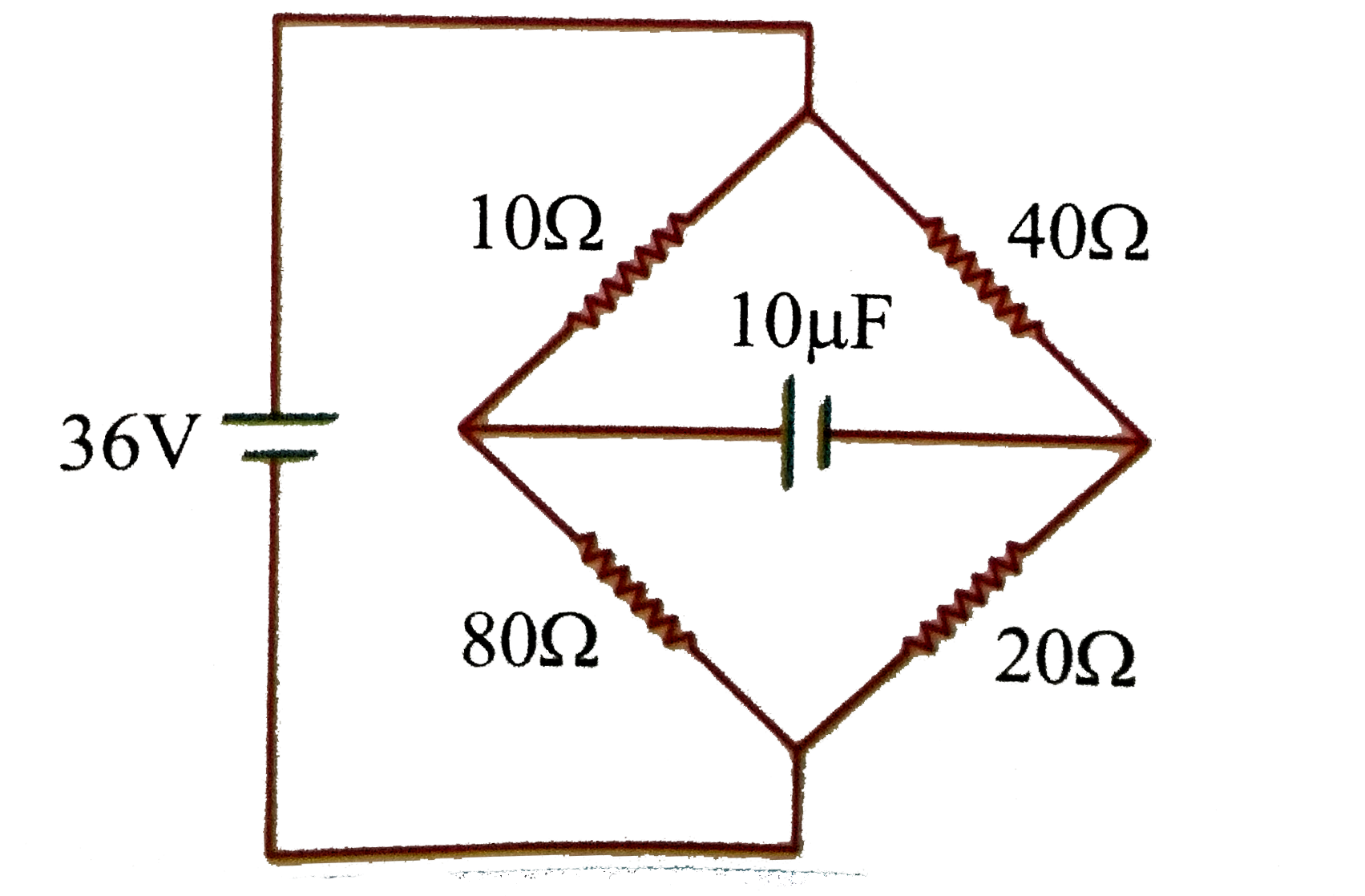
A
B
C
D
Text Solution
Verified by Experts
The correct Answer is:



Topper's Solved these Questions
Similar Questions
Explore conceptually related problems
NARAYNA-CAPACITANCE-Level-V
- A parallel plate capacitor has smooth square plates of side ''a''. It ...
Text Solution
|
- The plates of a capacitor are connected to a source of e.m.f 320 V. Be...
Text Solution
|
- The plates of a capacitor are connected to a source of emf and the ene...
Text Solution
|
- Four capacitors and two batteries are connected as shown in the diagra...
Text Solution
|
- There are 10 identical capacitors each of capacitance C.
Text Solution
|
- The plates of a parallel plate capacitor are charged by a battery and ...
Text Solution
|
- Select the correct statements (s).
Text Solution
|
- In the given circuit, find the charge on C(1),C(2),C(3),C(4) and C(5)....
Text Solution
|
- In the given circuit, K(1) and K(2) are open initially and the capacot...
Text Solution
|
- In the given circuit, K(1) and K(2) are open initially and the capacot...
Text Solution
|
- In the given circuit, K(1) and K(2) are open initially and the capacot...
Text Solution
|
- In the given circuit, K(1) and K(2) are open initially and the capacot...
Text Solution
|
- In Figure the plate A has 100 muC charge, while the plate B has 60 mu ...
Text Solution
|
- In Figure the plate A has 100 muC charge, while the plate B has 60 mu ...
Text Solution
|
- In Figure the plate A has 100 muC charge, while the plate B has 60 mu ...
Text Solution
|
- In the fig. shown the circuit is in steady state. what is the pot...
Text Solution
|
- In the fig. shown the circuit is in steady state. If the battery ...
Text Solution
|
- In the fig. shown the circuit is in steady state. How long does i...
Text Solution
|
- In the circuit shown in figure. The charge on capacitor C(2) in steady...
Text Solution
|
- The electric field between the plates of a parallel-plate capacitor of...
Text Solution
|