Home
Class 12
PHYSICS
Two parallel-plate capacitors with diffe...

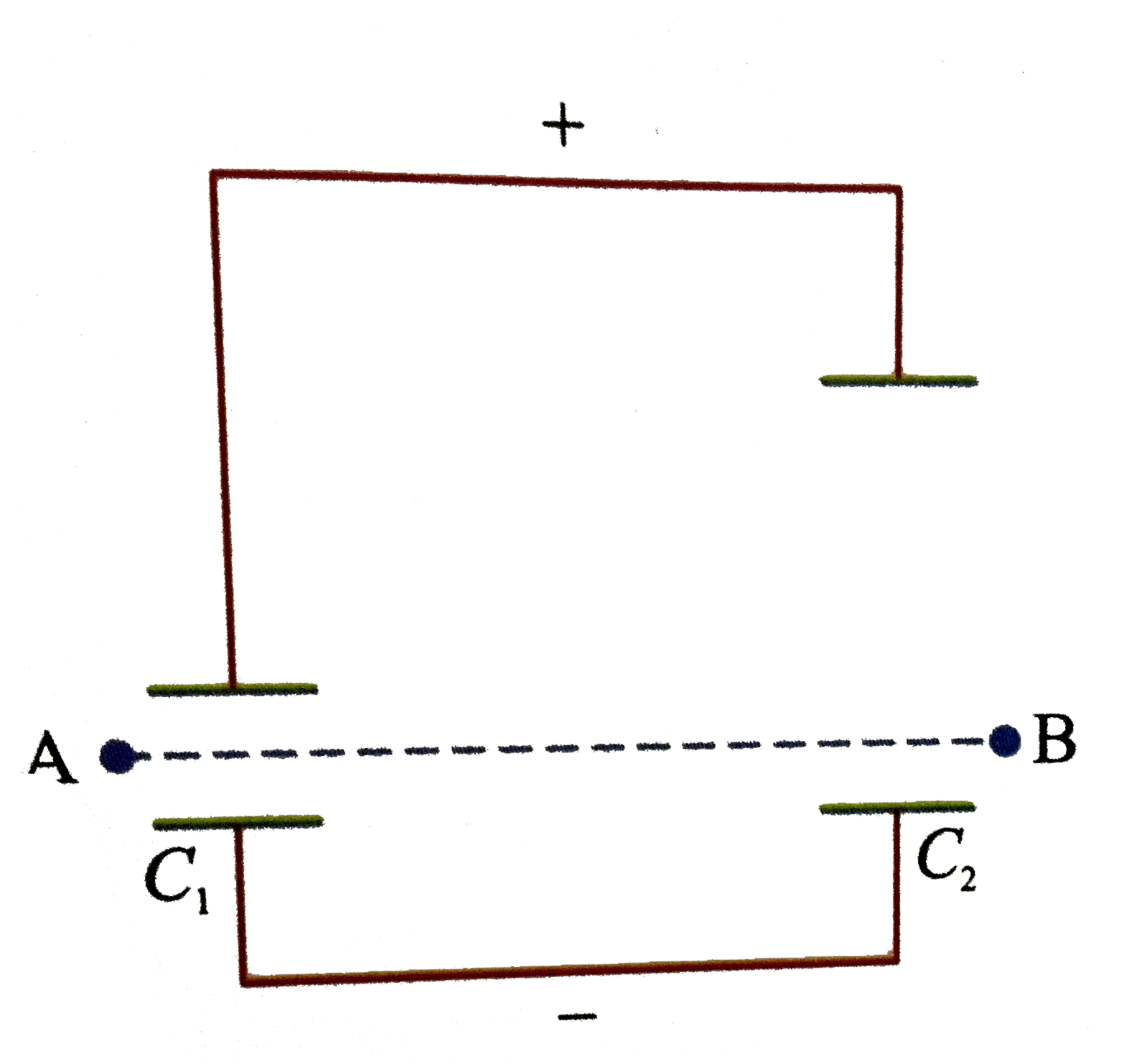
Two parallel-plate capacitors with different distances between the plates are connected in parallel to a voltage source. A point positive charge is moved from a point `A`, that is exactly in the middle between the plates of a capacitor `C_(1)` to a point `B`(or a capacitor `C_(2)` that lies at a distance from the negative plate of `C_(2)` equal to half the distance between the plates of `C_(1)`) During this process of moving the charge.
.

A

The potential at `A` is greater than point at `B`

B

The potential at `A` is less than potential at `B`

C

The work done to move that point positive charge from `A` to `B` is greater than zero.

D

The work done to move the point positive charge from `A` to `B` is zero.

Text Solution

Verified by Experts

The correct Answer is:

B, C
Promotional Banner

Topper's Solved these Questions

Similar Questions

Explore conceptually related problems

Two parallel-plate capacitors with different distances between the plates are connected in parallel to a voltago source. A poin t posit.ivo charge is moved from a point 1 that is ex aetly j n the midtlle between the plates of a capacitor Cl to a point 2 (or a capacitor C2 ) that lies at a distance from the negative plate of C2 equal to half the distance between the plates of Cl. Is any work done in the process?

As the distance between the plates of a parallel plate capacitor decreased

Force of attraction between the plates of a parallel plate capacitor is

Force Between The Plates Of A Parallel Plate Capacitor

A parallel plate capacitor having plate area A and separation between the plates d is charged to potential V .The energy stored in capacitor is ....???

In a parallel plate capacitor, the distance between the plates is d and potential difference across the plate is V . Energy stored per unit volume between the plates of capacitor is

A parallel-plate capacitor is filled with a dielectric upto one-half of the distance between the plates. The manner in which, the potential between the plates varies is illustrated in the figure .

NARAYNA-CAPACITANCE-Level-VI
  1. Four capacitors and two batteries are connected as shown in the diagra...

    Text Solution

    |

  2. A parallel plate air capacitor is connected to a battery. The quantiti...

    Text Solution

    |

  3. A parallel plate capacitor is charged and the charging battery is then...

    Text Solution

    |

  4. Three parallel plate capacitors C(1) = 4 muF,C(2) =2mu F,C(3) = 6muF w...

    Text Solution

    |

  5. Three parallel plate capacitors C(1) = 4 muF,C(2) =2mu F,C(3) = 6muF w...

    Text Solution

    |

  6. A parallel plate capacitor has smooth square plates of side ''a''. It ...

    Text Solution

    |

  7. Two parallel-plate capacitors with different distances between the pla...

    Text Solution

    |

  8. A parallel-plate capacitor is filled with a dielectric upto one-half o...

    Text Solution

    |

  9. A capacitor of capacitance 2 mu F is initially connected to a battery ...

    Text Solution

    |

  10. Solve the above problem, if 20 V battery is connected with unlike pola...

    Text Solution

    |

  11. A conducting slab is in between a parallel plate capacitor. The thickn...

    Text Solution

    |

  12. In the circuit shown in the figure four capacitors are connected to a ...

    Text Solution

    |

  13. In the circuit diagram shown here seven capacitors are connected to a ...

    Text Solution

    |

  14. In the circuit diagram shown here seven capacitors are connected to a ...

    Text Solution

    |

  15. In the circuit diagram shown here seven capacitors are connected to a ...

    Text Solution

    |

  16. In the circuit diagram shown here seven capacitors are connected to a ...

    Text Solution

    |

  17. In the circuit diagram shown here seven capacitors are connected to a ...

    Text Solution

    |

  18. Four capacitors C(1)(=1 muF),C(2)(=2muF),C(3)(=3muF) and C(4)(=4 muF) ...

    Text Solution

    |

  19. Four capacitors C(1)(=1 muF),C(2)(=2muF),C(3)(=3muF) and C(4)(=4 muF) ...

    Text Solution

    |

  20. Four capacitors C(1)(=1 muF),C(2)(=2muF),C(3)(=3muF) and C(4)(=4 muF) ...

    Text Solution

    |
