Home
Class 12
PHYSICS
Four capacitors C(1)(=1 muF),C(2)(=2muF)...

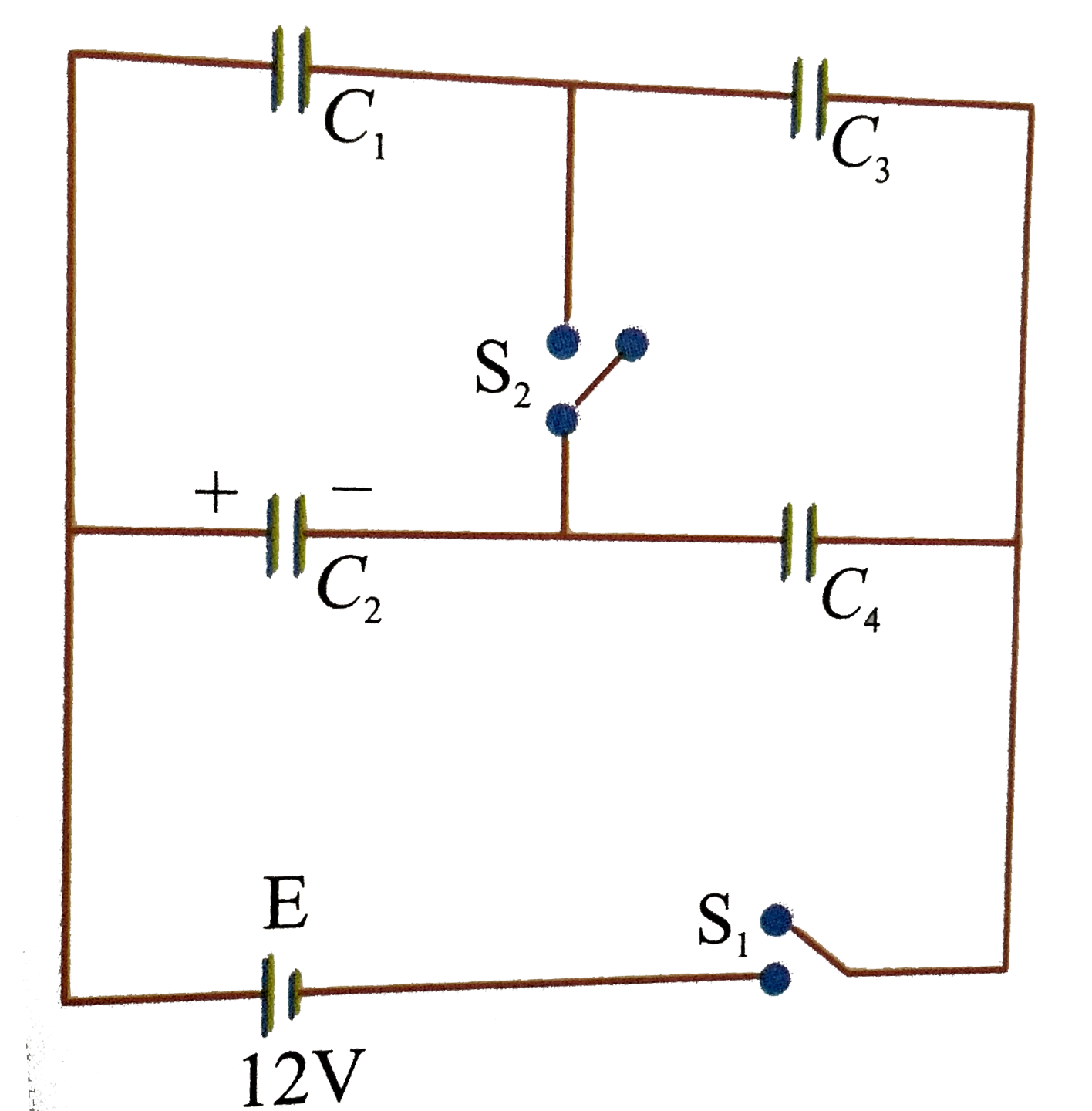
Four capacitors `C_(1)(=1 muF),C_(2)(=2muF),C_(3)(=3muF)` and `C_(4)(=4 muF)` are connected in a network as shown in the diagram. The emf of the battery is `E = 12 V` and its internal resistance is negligible. The keys `S_(1)` and `S_(2)` can be independetly put on or off. Indicate the charge on the capacitors by `q_(1),q_(2),q_(3)` and `q_(4)` respectively and the potential drops across them by `V_(1),V_(2),V_(3)` and `V_(4)` respectively.

Initially both the keys are open. Then the key `S_(1)` is closed. Then the charges on the capacitors are.

A

`q_(1)=q_(2)=16 mu C,q_(3)=q_(4) = 9 muC`

B

`q_(1) =q_(3) =16 muC,q_(2)=q_(4) = 9 mu C`

C

`q_(1)=q_(4) =9 muC, q_(2)=q_(3) =16 muC`

D

`q_(1)=q_(3)=9 muC,q_(2) =q_(4) =16 mu C`

Text Solution

Verified by Experts

The correct Answer is:

D

Refer to the circuit network in the problem.
With both keys `S_(1)` and `S_(2)` initially open, it now `S_(1)` is closed, the capacitance `C_(1)` and `C_(3)` are in series as also the capacitors `C_(2)` and `C_(4)`
Hence `q_(1)=q_(3)=(VC_(1)C_(3))/(C_(1)+C_(3))=(12 xx 1xx3)/((1+3))=9 muC`
Also `q_(2)=q_(4)=(VC_(2)C_(4))/(C _(2)+C_(4))=(12 xx 2xx4)/((2+4))=16 muC`.
Promotional Banner

Topper's Solved these Questions

Similar Questions

Explore conceptually related problems

Four capacitors C_(1)(=1 muF),C_(2)(=2muF),C_(3)(=3muF) and C_(4)(=4 muF) are connected in a network as shown in the diagram. The emf of the battery is E = 12 V and its internal resistance is negligible. The keys S_(1) and S_(2) can be independetly put on or off. Indicate the charge on the capacitors by q_(1),q_(2),q_(3) and q_(4) respectively and the potential drops across them by V_(1),V_(2),V_(3) and V_(4) respectively. Initially key S_(2) is closed. Then the key S_(1) is now closed. Then the charges on the capacitors are.

Four capacitors C_(1)(=1 muF),C_(2)(=2muF),C_(3)(=3muF) and C_(4)(=4 muF) are connected in a network as shown in the diagram. The emf of the battery is E = 12 V and its internal resistance is negligible. The keys S_(1) and S_(2) can be independetly put on or off. Indicate the charge on the capacitors by q_(1),q_(2),q_(3) and q_(4) respectively and the potential drops across them by V_(1),V_(2),V_(3) and V_(4) respectively. Initially key S_(2) is open. The key S_(1) is closed and teh capacitors are charged. If now key S_(2) be closed, the charge that will flow across this key is.

Four capacitors C_(1)=8 muF , C_(2)=2 muf, C_(3)=6 muF , and C_(4)=6, muF are arranged as shown in. Find the charge on all the capacitors in the circuit. .

Three capacitors C_(1),C_(2) and C_(3) are connected as shown in, The potentials of P,Q , and R are V_(1),V_(2), and V_(3) , respectively. Find the potential V_(0) at the function O . .

Four capacitors with capacitances C_(1) = 1 muF, C_(2) = 1.5 muF, C_(3) = 2.5 muF and C_(4) = 0.5 muF are connected as shown in Fig, to a 30 voltg source. The potentail difference between points a and b is

Three uncharged capacitors of capacities C_(1),C_(2) and C_(3) are connected as shown in the figure to one another and the potentials V_(1),V_(2) and V_(3) respectively. Then the potential at O will be .

In the circuit shown the capacitors are C_(1)=15muF, C_(2)=10muF and C_(3)=25 muF . Find the potential difference across each capacitor.

Five capacitors of capacitances C_(1) = C_(5) = 1 muF , C_(2) = C_(3) = C_(4) = 2 muF are connectes as shown in Fig. Calculate equivalent capacitance of the system between points A and B .

if two capacitors of capacities C_(1)=4muF and C_(2)=1muF are connected in series, the ratio of the potential drops across the capacitors C_(1) and C_(2) is

In the circuit shown the capacitors are C_(1)=15muF, C_(2)=10muF and C_(3)=25 muF . Find the charge on each capacitor and

NARAYNA-CAPACITANCE-Level-VI
  1. Four capacitors and two batteries are connected as shown in the diagra...

    Text Solution

    |

  2. A parallel plate air capacitor is connected to a battery. The quantiti...

    Text Solution

    |

  3. A parallel plate capacitor is charged and the charging battery is then...

    Text Solution

    |

  4. Three parallel plate capacitors C(1) = 4 muF,C(2) =2mu F,C(3) = 6muF w...

    Text Solution

    |

  5. Three parallel plate capacitors C(1) = 4 muF,C(2) =2mu F,C(3) = 6muF w...

    Text Solution

    |

  6. A parallel plate capacitor has smooth square plates of side ''a''. It ...

    Text Solution

    |

  7. Two parallel-plate capacitors with different distances between the pla...

    Text Solution

    |

  8. A parallel-plate capacitor is filled with a dielectric upto one-half o...

    Text Solution

    |

  9. A capacitor of capacitance 2 mu F is initially connected to a battery ...

    Text Solution

    |

  10. Solve the above problem, if 20 V battery is connected with unlike pola...

    Text Solution

    |

  11. A conducting slab is in between a parallel plate capacitor. The thickn...

    Text Solution

    |

  12. In the circuit shown in the figure four capacitors are connected to a ...

    Text Solution

    |

  13. In the circuit diagram shown here seven capacitors are connected to a ...

    Text Solution

    |

  14. In the circuit diagram shown here seven capacitors are connected to a ...

    Text Solution

    |

  15. In the circuit diagram shown here seven capacitors are connected to a ...

    Text Solution

    |

  16. In the circuit diagram shown here seven capacitors are connected to a ...

    Text Solution

    |

  17. In the circuit diagram shown here seven capacitors are connected to a ...

    Text Solution

    |

  18. Four capacitors C(1)(=1 muF),C(2)(=2muF),C(3)(=3muF) and C(4)(=4 muF) ...

    Text Solution

    |

  19. Four capacitors C(1)(=1 muF),C(2)(=2muF),C(3)(=3muF) and C(4)(=4 muF) ...

    Text Solution

    |

  20. Four capacitors C(1)(=1 muF),C(2)(=2muF),C(3)(=3muF) and C(4)(=4 muF) ...

    Text Solution

    |
