

Home
Class 11
PHYSICS
The resultant of two forces,one double t...

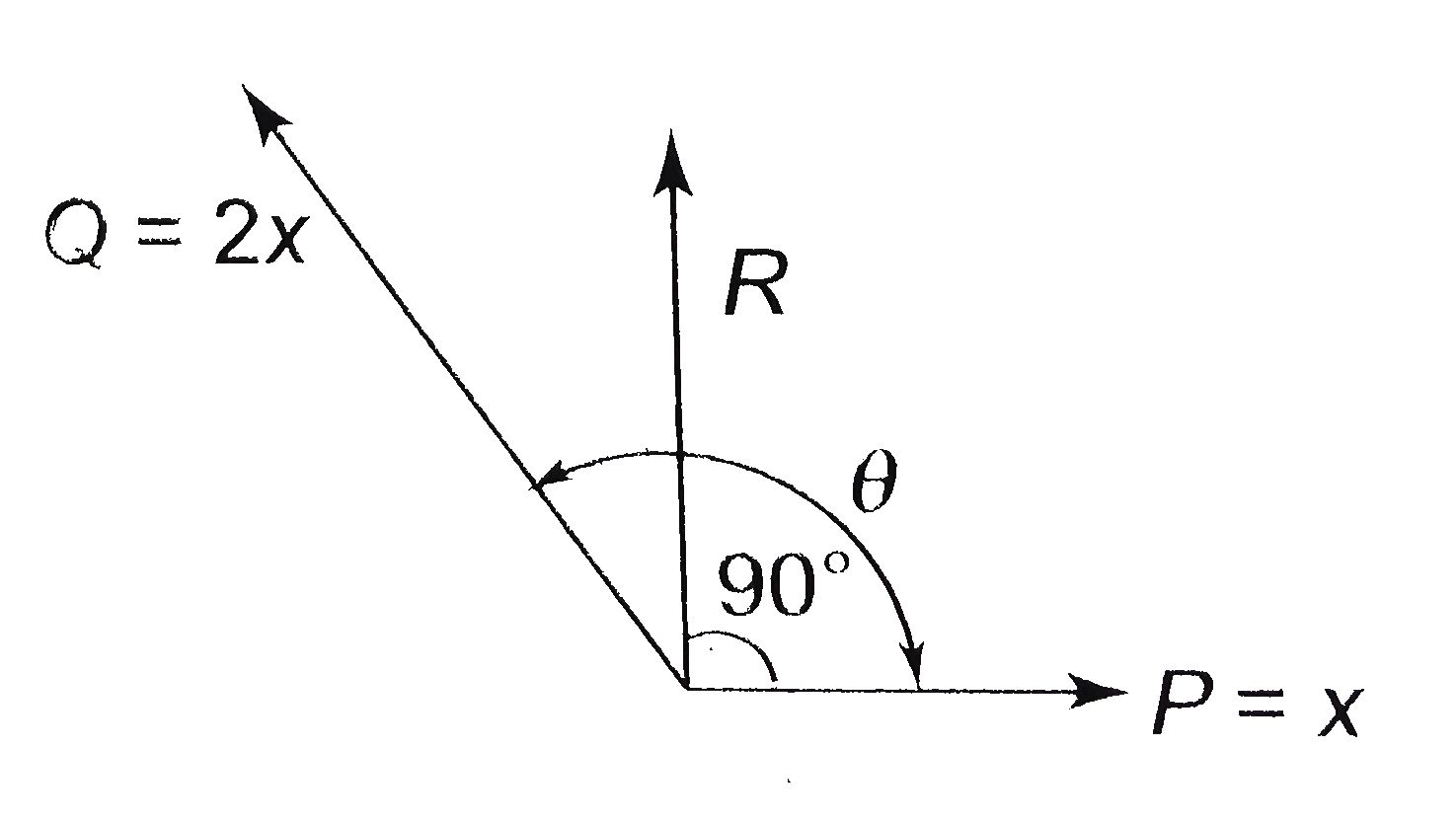
The resultant of two forces,one double the other in magnitude,is perpendicular to the smaller of the two forces.The angle between the two forces is

Text Solution

Verified by Experts

`tan alpha = (Q sin theta)/(P + Q cos theta)`
`tan 90 = oo = (1)/(0) = ( 2x sin theta)/( x + 2x cos theta)`
`x + 2 x cos theta = 0`
`cos theta = -(1)/(2) rArr theta = 120^(@)`
Promotional Banner

Topper's Solved these Questions

  • VECTORS

    CP SINGH|Exercise Excercises|66 Videos
  • UNITS, DIMENIONS AND MEASUREMENTS

    CP SINGH|Exercise Exercises|63 Videos
  • WORK, ENERGY AND POWER

    CP SINGH|Exercise EXERCISES|92 Videos

Similar Questions

Explore conceptually related problems

Two forces with equal magnitudes F act on a body and the magnitude of the resultant force is F /3. The angle between the two forces is

If the resultant of two forces of magnitudes p and 2p is perpendicular to p , then the angle between the forces is

Two forces with equal magnitudes F act on body and the magnitude of the resultant forces is (F)/(3). The angle between the two forces is

The resultant of two forces of magnitudes 4 N and 4 sqrt(2) N makes 90^(@) with the smaller force. Then angle between those two forces is ?

Two force F_(1)" and "F_(2) are acting on a body. One force is double that of the other force and the resultant is equal to the greater force. Then the angle between the two forces is :-

Two forces F_(1) and F_(2) are acting on a body. One force is double that of the other force and the resultant is equal to the greater force. Then the angle between the two forces is

Two forces, each of magnitude F have a resultant of the same magnitude F. The angle between the two forces is

CP SINGH-VECTORS-Excercises
  1. The resultant of two forces,one double the other in magnitude,is perpe...

    Text Solution

    |

  2. A vector is not changed if

    Text Solution

    |

  3. Two forces, each of magnitude F have a resultant of the same magnitude...

    Text Solution

    |

  4. Two vectors acting through a point are in the ratio 3 : 5. If the angl...

    Text Solution

    |

  5. The magnitude of vectros vec A, vec B and vec C are 12, 5 and 13 units...

    Text Solution

    |

  6. If vec(A)=vec(B)+vec(C ), and the magnitudes of vec(A),vec(B),vec(C ) ...

    Text Solution

    |

  7. Two forces, while acting on particle in opposite directions,have the r...

    Text Solution

    |

  8. One of the following forces is double and the other resultant is equal...

    Text Solution

    |

  9. Two vectors of magnitude 4 and 6 are acting through a point. If the ma...

    Text Solution

    |

  10. The resultant of vecA and vecB makes an angle alpha with vecA and beta...

    Text Solution

    |

  11. Which of the sets given below may represent the magnitudes of three ve...

    Text Solution

    |

  12. The following sets of three vectors act on a body, whose resultant ...

    Text Solution

    |

  13. Three vectors vec(P) , vec(Q) and vec( R) are such that |vec(P)| , |ve...

    Text Solution

    |

  14. Three forces 9 , 12 and 15 N acting at a point are in equilibrium . T...

    Text Solution

    |

  15. If the resultant of n forces of different magnitudes acting at a point...

    Text Solution

    |

  16. Let vec(C )= vec(A)+vec(B) then

    Text Solution

    |

  17. Forces of 1 and 2 units act along the lines x = 0 and y = 0. The equ...

    Text Solution

    |

  18. The sum of two forces at a point is 16N. if their resultant is normal...

    Text Solution

    |

  19. A particle is being acted upon by four forces of 30 N due east , 20 N ...

    Text Solution

    |

  20. Six vector vec(a) through vec(f) have the magnitudes and direction ind...

    Text Solution

    |

  21. If N-vectors of equal magnitude are acting through a point and angle b...

    Text Solution

    |