Home
Class 11
PHYSICS
A particle is moving along a circle with...

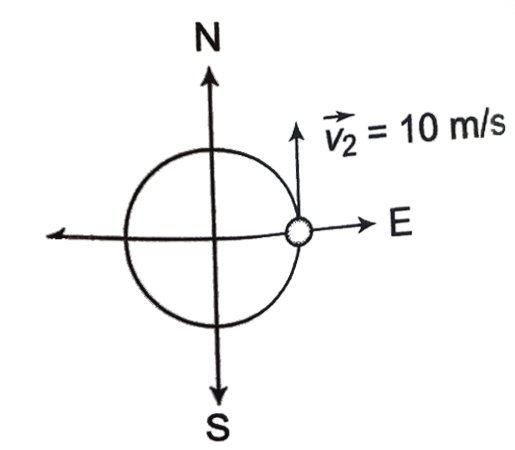
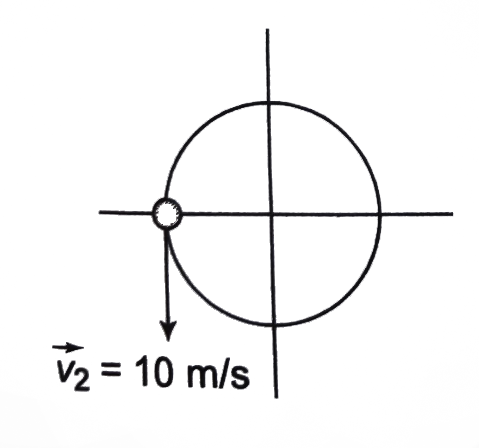
A particle is moving along a circle with a uniform speed `10 m//s`. At `t = 0` , the particle is moving along east. Find the change in velocity (magnitude and direction) in (a) `1//4th` revolution , (b) `1//2` revolution , ( c) `3//4th` revolution and (d) `1` revolution.

Text Solution

Verified by Experts
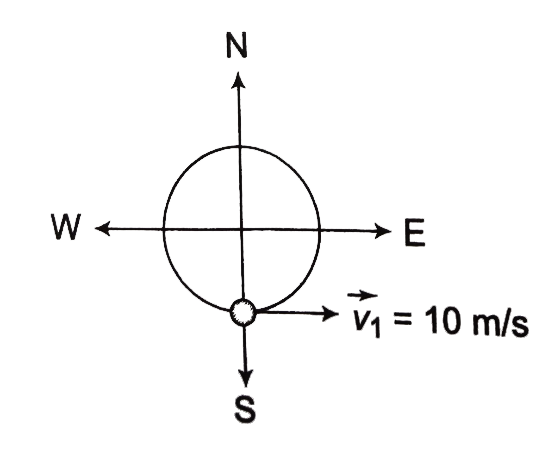
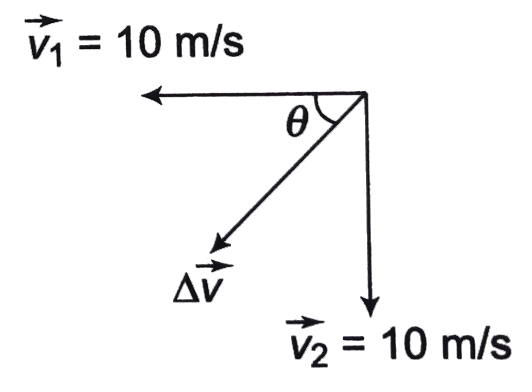
(a) Change in velocity `Delta vec(v) = vec(v_(2)) - vec(v_(1)) = vec(v_(2)) + (-vec(v_(1)))`
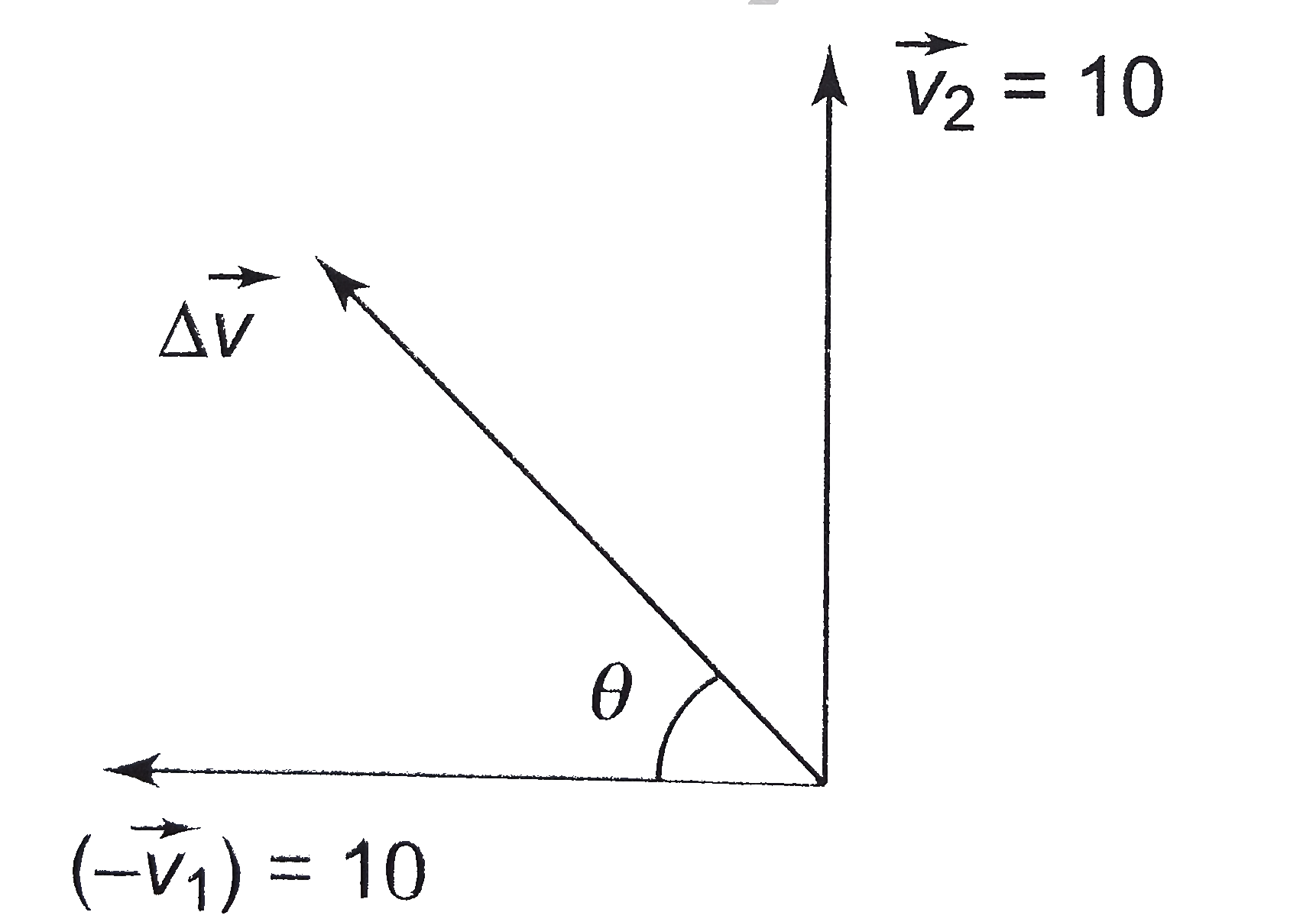
Here , we want to subtract `vec(v_(1))` from `vec(v_(2))`. For this , reverse the direction of `vec(v_(1))` and then add to `vec(v_(2))`.
`Delta v = sqrt((10)^(2) + (10)^(2)) = 10 sqrt(2) m//s`
`tan theta = (10)/(10) = 1 rArr theta = 45^(@)`
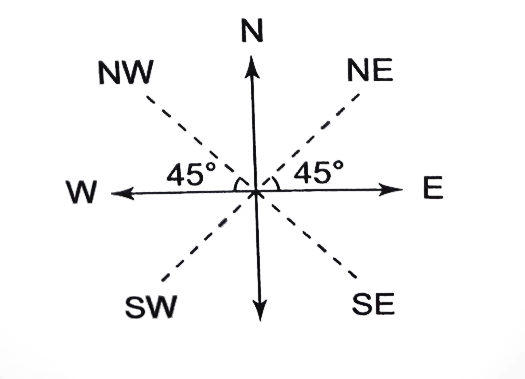
Change in velocity is `10 sqrt(2) m//s` along the north - west.
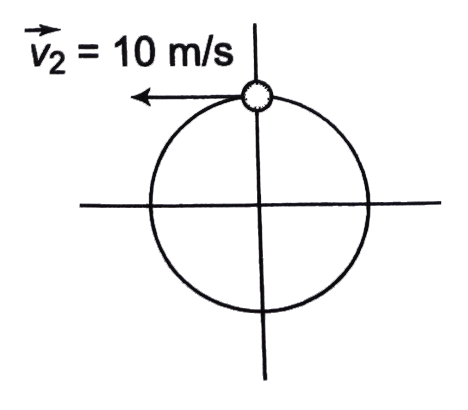
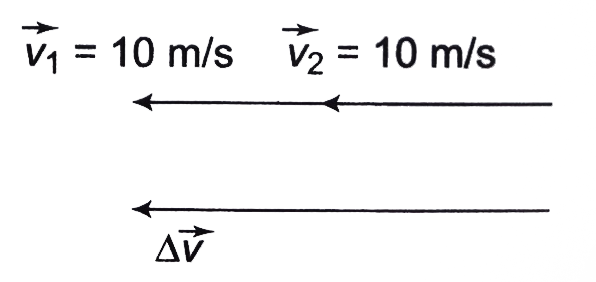
(b) `Delta v = 10 + 10 = 20 m//s`
Change in velocity is `20 m//s` along the west.
(c ) ` Delta v = 10 sqrt(2) m//s`
`theta = 45^(@)`
Change in velocity is `10 sqrt(2) m//s` along the south - west.
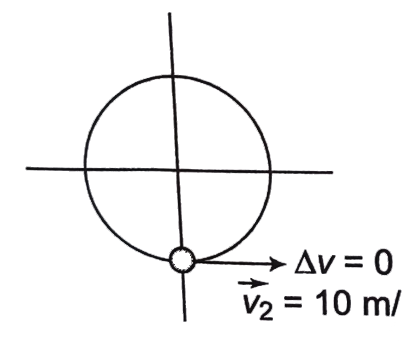
(d) Change in velocity ` = 0`


Promotional Banner

Topper's Solved these Questions

  • VECTORS

    CP SINGH|Exercise Excercises|66 Videos
  • UNITS, DIMENIONS AND MEASUREMENTS

    CP SINGH|Exercise Exercises|63 Videos
  • WORK, ENERGY AND POWER

    CP SINGH|Exercise EXERCISES|92 Videos

Similar Questions

Explore conceptually related problems

A particle is moving along a circle of radius R with a uniform speed v . At t = 0 , the particle is moving along the east. Find the average acceleration (magnitude and direction) in (a) 1//4 th revolution and (b) 1//2 revolution.

A particle is moving along a circular path of radius 5 m with uniform speed of 5 m//s . What will be time taken by the particle in half revolution?

A particle is moving along circular path of radius 40 m with a uniform speed of 20m//s . Then the time taken for the particle to complete half revolution will be

A particle is moving with a constant speed in a circular orbit. Find the change in its velocity when it completes half the revolution.

A particle is moving along a circle with a uniform speed v . Find (a) change in the magnitude of velocity and (b) the magnitude of change in the velocity when it has rotated an angle theta . (0 lt theta lt 90^(@))

A particle is moving along a circular path of radius 6 m with uniform speed of 8 ms^(–1) . The average acceleration when the particle completes one half of the revolution is -

An aeroplane is flying with a uniform speed of 100 km/h along the circumference of a circle. The change in velocity in half the revolution will be in km/h)

A particle of mass 2 kg moves on a circular path with constant speed 10 m // s . Find change in speed and magnitude of change in velocity. Whan particle completes half revolution.

A particle is moving with uniform speed 0.5 m//s along a circle of radius 1m then the angular velocity of particle is (in rad s^(-1) )

A body is moving with uniform speed v on a horizontal circle in anticlockwise direction from A as shown in figure. What is the change in velocity in (a) half revolution (b) first quarter revolution.

CP SINGH-VECTORS-Excercises
  1. A particle is moving along a circle with a uniform speed 10 m//s. At t...

    Text Solution

    |

  2. A vector is not changed if

    Text Solution

    |

  3. Two forces, each of magnitude F have a resultant of the same magnitude...

    Text Solution

    |

  4. Two vectors acting through a point are in the ratio 3 : 5. If the angl...

    Text Solution

    |

  5. The magnitude of vectros vec A, vec B and vec C are 12, 5 and 13 units...

    Text Solution

    |

  6. If vec(A)=vec(B)+vec(C ), and the magnitudes of vec(A),vec(B),vec(C ) ...

    Text Solution

    |

  7. Two forces, while acting on particle in opposite directions,have the r...

    Text Solution

    |

  8. One of the following forces is double and the other resultant is equal...

    Text Solution

    |

  9. Two vectors of magnitude 4 and 6 are acting through a point. If the ma...

    Text Solution

    |

  10. The resultant of vecA and vecB makes an angle alpha with vecA and beta...

    Text Solution

    |

  11. Which of the sets given below may represent the magnitudes of three ve...

    Text Solution

    |

  12. The following sets of three vectors act on a body, whose resultant ...

    Text Solution

    |

  13. Three vectors vec(P) , vec(Q) and vec( R) are such that |vec(P)| , |ve...

    Text Solution

    |

  14. Three forces 9 , 12 and 15 N acting at a point are in equilibrium . T...

    Text Solution

    |

  15. If the resultant of n forces of different magnitudes acting at a point...

    Text Solution

    |

  16. Let vec(C )= vec(A)+vec(B) then

    Text Solution

    |

  17. Forces of 1 and 2 units act along the lines x = 0 and y = 0. The equ...

    Text Solution

    |

  18. The sum of two forces at a point is 16N. if their resultant is normal...

    Text Solution

    |

  19. A particle is being acted upon by four forces of 30 N due east , 20 N ...

    Text Solution

    |

  20. Six vector vec(a) through vec(f) have the magnitudes and direction ind...

    Text Solution

    |

  21. If N-vectors of equal magnitude are acting through a point and angle b...

    Text Solution

    |