Home
Class 11
PHYSICS
Find the resultant of vec(F(1)) + vec(F(...

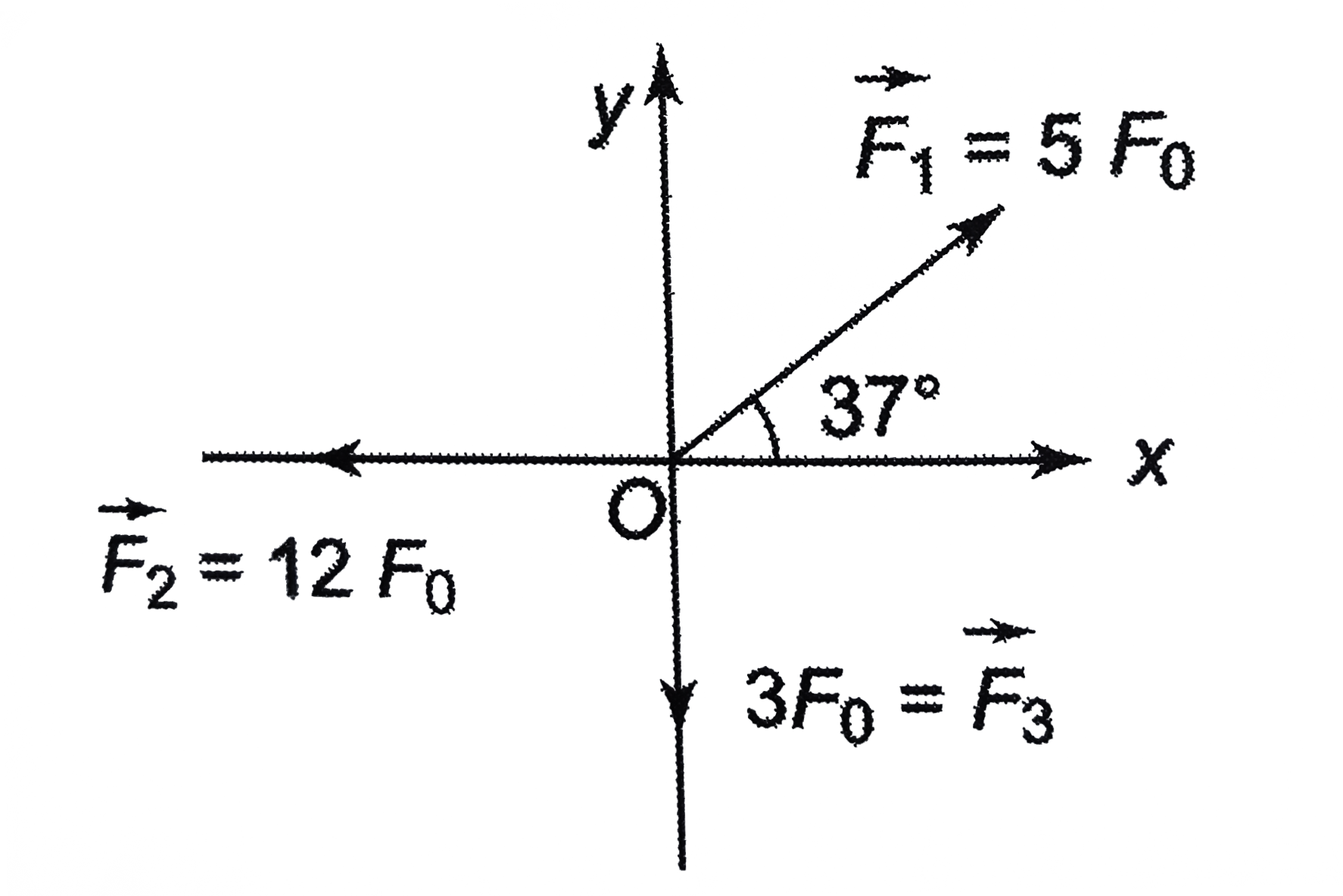
Find the resultant of `vec(F_(1)) + vec(F_(2)) - vec(F_(3)) ( sin 37^(@) = (3)/(5) , cos 37^(@) = (4)/(5))`

Text Solution

Verified by Experts
`vec(R) = vec(F_(1)) + vec(F_(2)) - vec(F_(3)) = vec(F_(1)) + vec(F_(2)) + (-vec(F_(3)))`
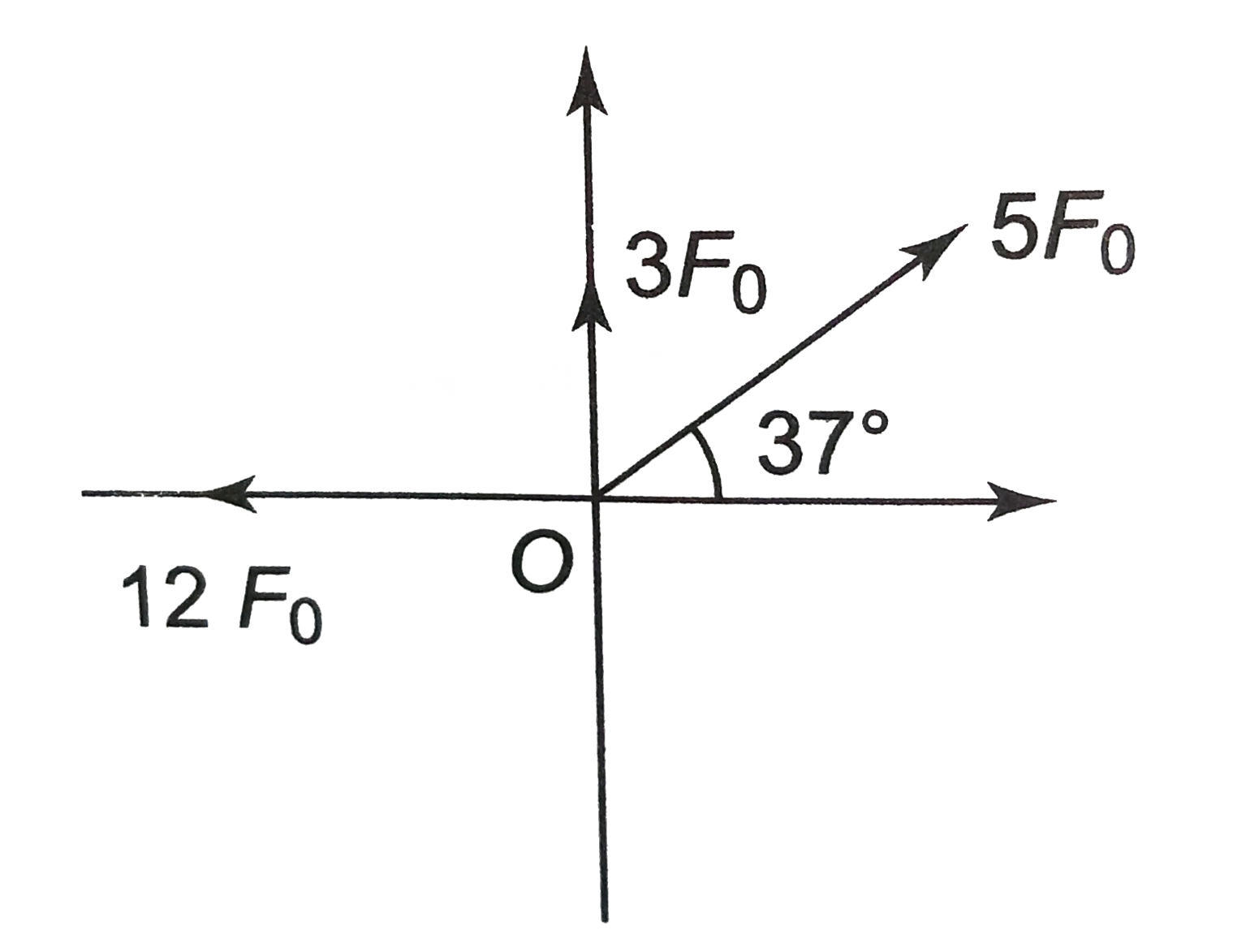
Reverse the direction of `vec(F_(3))` and add vectors by the component approach.
`F_(x) = 5 F_(0) cos 37^(@) - 12 F_(0)`
` = 5 F_(0) xx (4)/(5) - 12 F_(0) = - 8 F_(0)`
`F_(y) = 5 F_(0) sin 37^(@) + 3 F_(0)`
` = 3 F_(0) xx (3)/(5) + 3 F_(0) = 6 F_(0)`
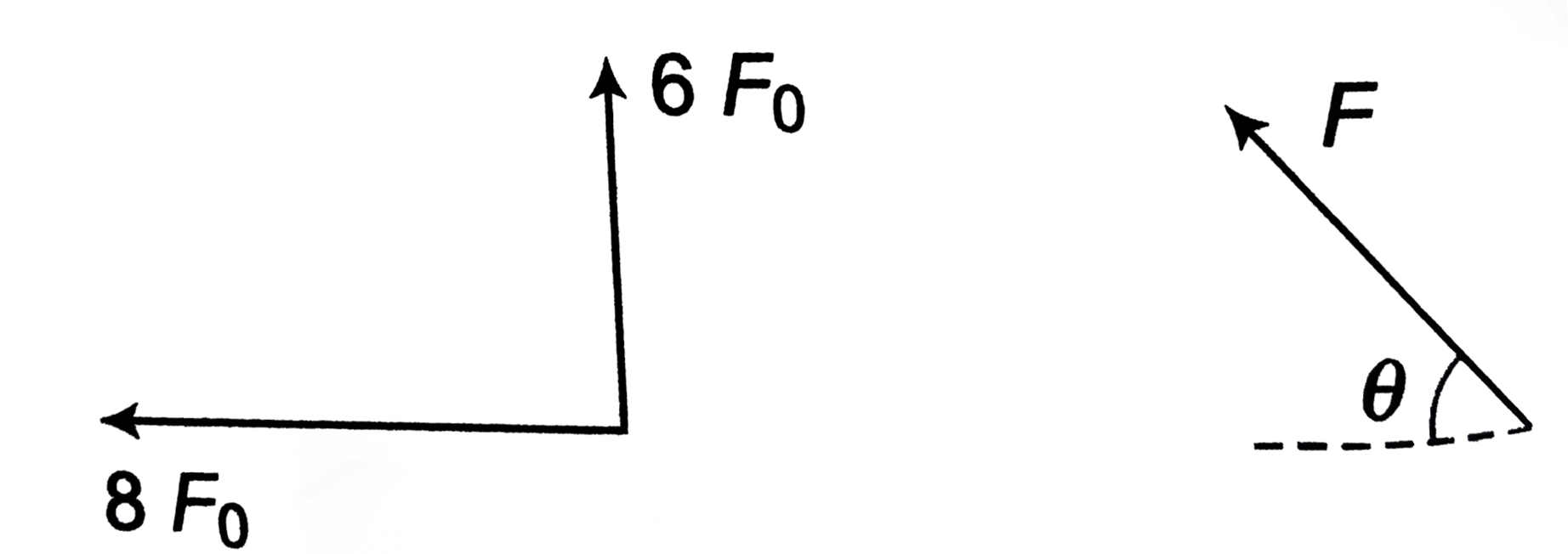
`F = sqrt((8 F_(0))^(2) + (6 F_(0))^(2)) = 10 F_(0)`
`tan theta = (6 F_(0))/( 8 F_(0)) = (3)/(4) rArr theta = 37^(@)`

Promotional Banner

Topper's Solved these Questions

  • VECTORS

    CP SINGH|Exercise Excercises|66 Videos
  • UNITS, DIMENIONS AND MEASUREMENTS

    CP SINGH|Exercise Exercises|63 Videos
  • WORK, ENERGY AND POWER

    CP SINGH|Exercise EXERCISES|92 Videos

Similar Questions

Explore conceptually related problems

Find the resultant of the following forces. [sin 37^(@) = (3)/(5) ,cos 37^(@) = (4)/(5) , sin 53^(@) = (4)/(5) , cos 53^(@) = (3)/(5)]

Five forces vec(F)_(1) ,vec(F)_(2) , vec(F)_(3) , vec(F)_(4) , and vec(F)_(5) , are acting on a particle of mass 2.0kg so that is moving with 4m//s^(2) in east direction. If vec(F)_(1) force is removed, then the acceleration becomes 7m//s^(2) in north, then the acceleration of the block if only vec(F)_(1) is action will be:

A body placed in free space, is simultaneously acted upon by three forces vec(F_(1)),vec(F_(2)) " and " vec(F_(3)) . The body is in equilibrium and the forces vec(F_(1)) " and "vec(F_(2)) are known ot be 36 N due north and 27 N due east respectively. Which of the following best describes the force vec(F_(3)) ?

Find 3 -dimensional vectors vec v_ (1), vec v_ (2), vec v_ (3) satisfying vec v_ (1) * vec v_ (1) = 4, vec v_ (1) * vec v_ (2) = - 2, vec v_ (1) * vec v_ (3) = 6, vec v_ (2) * vec v_ (2) = 2, vec v_ (2) * vec v_ (3) = - 5, vec v_ (3) * vec v_ (3)

A particle,in equilibrium,is subjected to four forces vec F_(1),vec F_(2),vec F_(3) and vec F_(4)vec F_(1)=-10hat k,vec F_(2)=u((4)/(13)hat i-(12)/(13)hat j+(3)/(13)hat k),vec F_(3)=v(-(4)/(13)hat i-(12)/(13)hat j+(3)/(13)hat k),vec F_(4)=w(cos thetahat i+sin thetahat j) then find the values of u,v and w

A moving perticle of mass m is acted upon by five forces overset(vec)(F_(1)),overset(vec)(F_(2)),overset(vec)(F_(3)),overset(vec)(F_(4)) and overset(vec)(F_(5)) . Forces overset(vec)(F_(2)) and overset(vec)(F_(3)) are conservative and their potential energy funcations are U and W respectively. Speed of the particle changes from V_(a) to V_(b) when it moves from position a to b . Choose the correct option :

The base vectors vec a_ (1), vec a_ (2), vec a_ (3) are given in terms vectors vec b_ (1), vec b_ (2), vec b_ (3) vec a_ (1) = 2vec b_ (1) + 3vec b_ (1) -vec b_ (1), vec a_ (2) = vec a_ (1) -2vec b_ (2) + 2vec b_ (3), vec a_ (3) = - 2vec b_ ( 1) + vec b_ (2) -2vec b_ (3) if vec F_ (1) = 3vec b_ (1) -vec b_ (2) + 2vec b_ (3), Express vec F in terms of vec a_ (1) , vec a_ (2), vec a_ (3)

If three forces vec(F_(1)),+vec(F_(2))andvec(F_(3)) are represented by three sides of a triangle and vec(F_(1))+vec(F_(2))=-vec(F_(3)) , then these three forces are concurrent forces and satisfy the condition for equilibrium . Statement II : A triangle made up of three forces vecF_(1),vecF_(2)andvecF_(3) as sides taken in the same order ,satisfy the condition for translatory equilibrium . In the light of the above statements ,choose the most appropriate answer from the options given below :

A smooth track in the form of a quarter circle of radius 6 m lies in the vertical plane. A particle moves from P_(1) to P_(2) under the action of forces vec F_(1),vecF_(2) and vec F_(3) Force vec F_(1) is 20N, Force vec F_(2) is always 30 N in magnitude. Force vec F_(3) always acts tangentiallly to the track and is of magnitude 15 N . Select the correct alternative (s) : .

Examine for coplanarity of the following sets of points 3vec(a) + 2vec(b) -5vec(c), 3vec(a) + 8vec(b) + 5vec(c), -3vec(a) + 2vec(b) + vec(c) , vec(a) + 4vec(b) - 3vec(c) .

CP SINGH-VECTORS-Excercises
  1. Find the resultant of vec(F(1)) + vec(F(2)) - vec(F(3)) ( sin 37^(@) =...

    Text Solution

    |

  2. A vector is not changed if

    Text Solution

    |

  3. Two forces, each of magnitude F have a resultant of the same magnitude...

    Text Solution

    |

  4. Two vectors acting through a point are in the ratio 3 : 5. If the angl...

    Text Solution

    |

  5. The magnitude of vectros vec A, vec B and vec C are 12, 5 and 13 units...

    Text Solution

    |

  6. If vec(A)=vec(B)+vec(C ), and the magnitudes of vec(A),vec(B),vec(C ) ...

    Text Solution

    |

  7. Two forces, while acting on particle in opposite directions,have the r...

    Text Solution

    |

  8. One of the following forces is double and the other resultant is equal...

    Text Solution

    |

  9. Two vectors of magnitude 4 and 6 are acting through a point. If the ma...

    Text Solution

    |

  10. The resultant of vecA and vecB makes an angle alpha with vecA and beta...

    Text Solution

    |

  11. Which of the sets given below may represent the magnitudes of three ve...

    Text Solution

    |

  12. The following sets of three vectors act on a body, whose resultant ...

    Text Solution

    |

  13. Three vectors vec(P) , vec(Q) and vec( R) are such that |vec(P)| , |ve...

    Text Solution

    |

  14. Three forces 9 , 12 and 15 N acting at a point are in equilibrium . T...

    Text Solution

    |

  15. If the resultant of n forces of different magnitudes acting at a point...

    Text Solution

    |

  16. Let vec(C )= vec(A)+vec(B) then

    Text Solution

    |

  17. Forces of 1 and 2 units act along the lines x = 0 and y = 0. The equ...

    Text Solution

    |

  18. The sum of two forces at a point is 16N. if their resultant is normal...

    Text Solution

    |

  19. A particle is being acted upon by four forces of 30 N due east , 20 N ...

    Text Solution

    |

  20. Six vector vec(a) through vec(f) have the magnitudes and direction ind...

    Text Solution

    |

  21. If N-vectors of equal magnitude are acting through a point and angle b...

    Text Solution

    |