Home
Class 11
PHYSICS
A particle moves towards east with veloc...

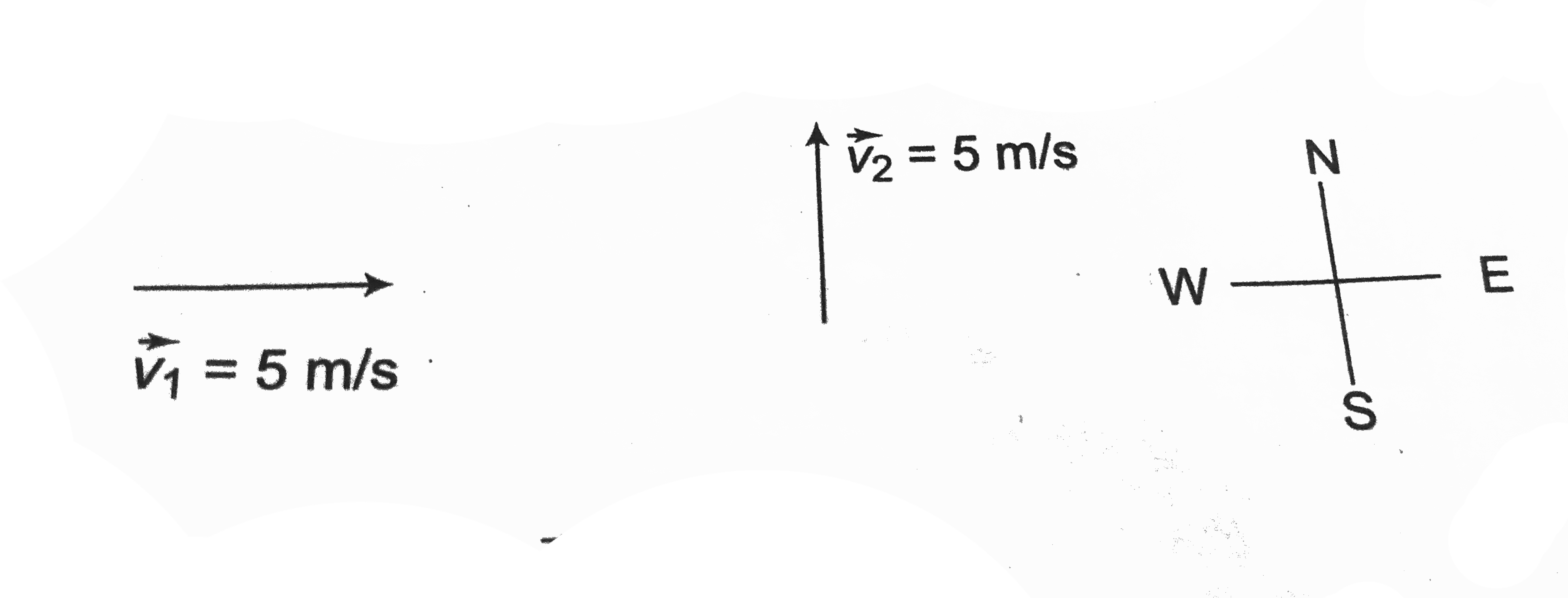
A particle moves towards east with velocity `5m//s`. After `10 seconds` its direction changes towards north with same Velocity. The average acceleration of the particle is

A

Zero

B

`(1)/(sqrt(2)) m//s^(2) N -W`

C

`(1)/(sqrt(2)) m//s^(2) N - E`

D

`(1)/(sqrt(2)) m//s^(2) S -W`

Text Solution

Verified by Experts

The correct Answer is:
B


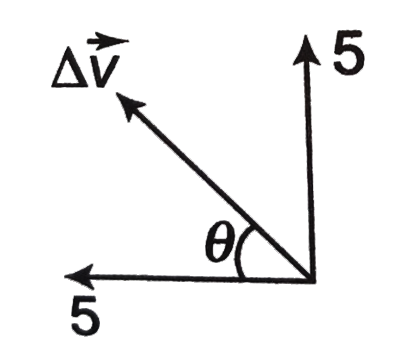
`Delta vec(v) = vec(v_(2)) - vec(v_(1)) = vec(v_(2)) + (-vec(v_(1)))`

`Delta v = 5 sqrt(2) m//s`
`theta = 45^(@)`
Change in velocity ` = 5 sqrt(2) m//s , NW`
`vec(a) = (Delta v)/(Delta t) = (5 sqrt(2))/(10) = (1)/(sqrt(2)) m//s^(2) , NW`
Promotional Banner

Topper's Solved these Questions

  • VECTORS

    CP SINGH|Exercise Excercises|66 Videos
  • UNITS, DIMENIONS AND MEASUREMENTS

    CP SINGH|Exercise Exercises|63 Videos
  • WORK, ENERGY AND POWER

    CP SINGH|Exercise EXERCISES|92 Videos

Similar Questions

Explore conceptually related problems

A particle is moving eastwards with a velocity of 5 ms_(-1) . In 10 seconds the velocity changes to 5 ms^(-1) northwards. The average acceleration in this time is

A particle is moving due to eastwards with a velocity of 5 ms^(-1) . In 10 seconds the velocity changes to 5 ms^(-1) northwards. Calculate the average acceleration of the particle in this time.

A particle is moving eastwards with velocity of 5 m//s . In 10 sec the velocity changes to 5 m//s northwards. The average acceleration in this time is.

A particle is moving eastwards with a velocity 5ms^(-1) , changes its direction northwards in 10 seconds and moves with same magnitude of velocity. The average acceleration is

A body is moving with velocity 30 m//s towards east. After 10 s its velocity becomes 40 m//s towards north. The average acceleration of the body is.

A particle is moving eastwards with a velocity of 5 m//s . In 10 s the velocity changes to 5 m//s nothwards. The average acceleration in this time is

(a) A particle is moving eastward with a velocity of 5 m/s. If in 10 s the velocity changes by 5 m//s northwards. What is the average acceleration in this time ? (b) What is the retardation of a moving particle if the relation between time and position is, t = Ax^(2) + Bx ? (where A and B are appropriate constants)

A particle moves in the direction of east for 2s with velocity of 15 ms^(-1). Then it moves towards north for 8s with a a velocity of 5 ms^(-1). The average velocity of the particle is

A paricle is moving eastwards with a velocity of 5m//s . In 10s the velocity changes to 5m//s northwards. Find the average acceleration in this time.

CP SINGH-VECTORS-Excercises
  1. ABCDEF is a regular hexagon, Fig. 2 (c ) .65. What is the value of ...

    Text Solution

    |

  2. A truck travelling due to north at 20m s^(-1) turns west and travels a...

    Text Solution

    |

  3. A particle moves towards east with velocity 5m//s. After 10 seconds it...

    Text Solution

    |

  4. The length of second's hand in watch is 1 cm. The change in Velocity o...

    Text Solution

    |

  5. Aparticle moves with a speed v changes direction by an angle theta, w...

    Text Solution

    |

  6. Let the angle between two non - zero vectors vec(A) and vec(B) be 120^...

    Text Solution

    |

  7. The component of a vector is

    Text Solution

    |

  8. One of the two rectangular components of a force is 20 N and it makes ...

    Text Solution

    |

  9. While travelling from one station to another , a car travels 75 "km no...

    Text Solution

    |

  10. A person moves 30 m north, then 30 m est, then 30sqrt(2) south-west. H...

    Text Solution

    |

  11. Find the resultant of the three vectors vec(OA), vec(OB) and vec(OC) s...

    Text Solution

    |

  12. Three forces acting on a body are shown in figure. To have the resulta...

    Text Solution

    |

  13. The x- component of the resultant of several vectors (i) is equal to...

    Text Solution

    |

  14. A hall has the dimensions 10 m xx 12 m xx 14 m. A fly starting at one ...

    Text Solution

    |

  15. If a unit vector is represented by 0.5 hat(i) + 0.8 hat(j) + c hat(k) ...

    Text Solution

    |

  16. If vec(A) = 3 hat(i) - 4 hat(j) and vec(B) = 2 hat(i) + 16 hat(j) then...

    Text Solution

    |

  17. If a particle moves from the point A(1 , 2 , 3) to the point B( 4 , 6 ...

    Text Solution

    |

  18. The unit vector parallel to the resultant of the vectors vec(A) = hat(...

    Text Solution

    |

  19. If vec(A) = 3 hat(i) + 6 hat(j) - 2hat(k) , the directions of cosines ...

    Text Solution

    |

  20. If a vector vec(A) make angles alpha , beta and gamma, respectively ,...

    Text Solution

    |