Home
Class 11
PHYSICS
Find the acceleration and tension in the...

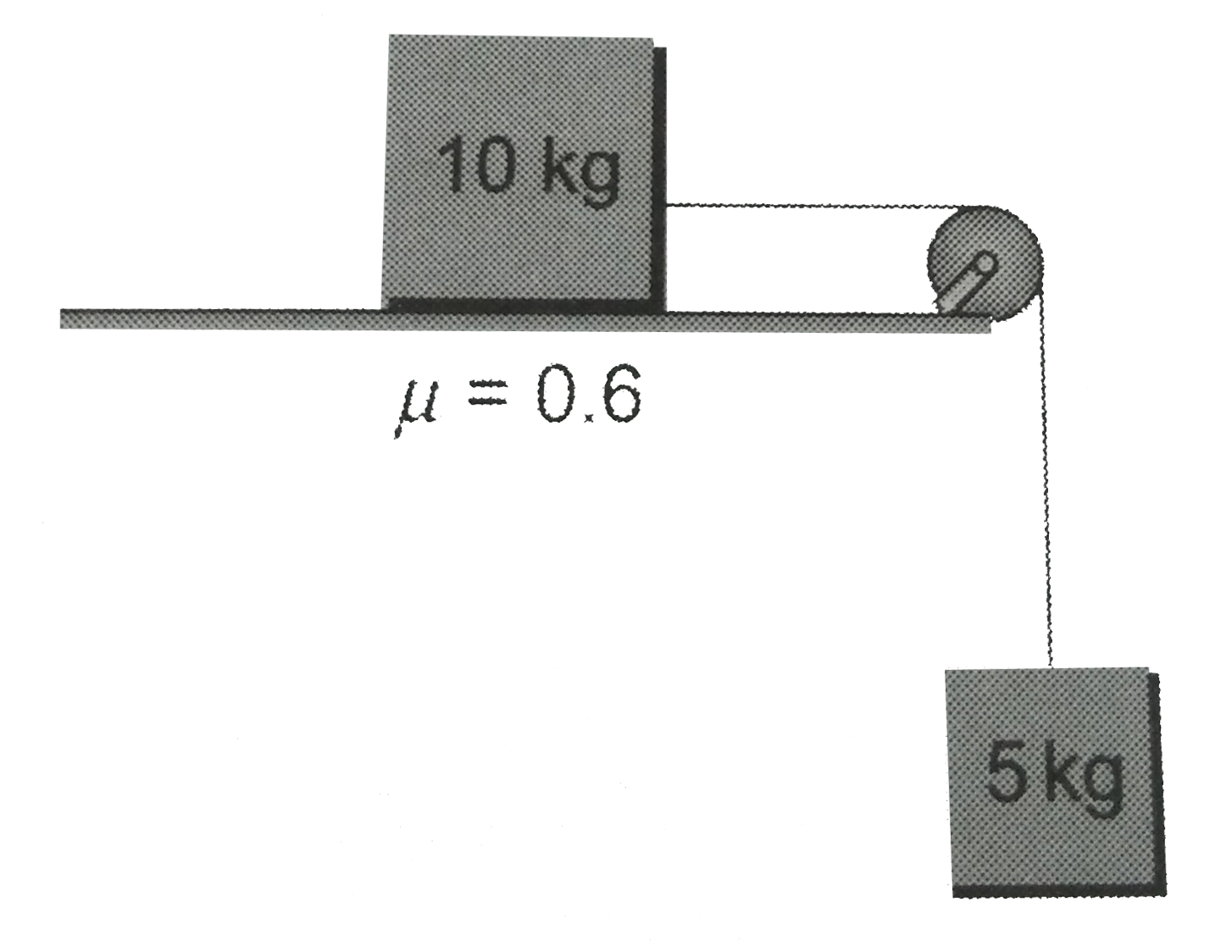
Find the acceleration and tension in the string in the following cases . The pulley and string are massless.
(a)
(b)

Text Solution

Verified by Experts
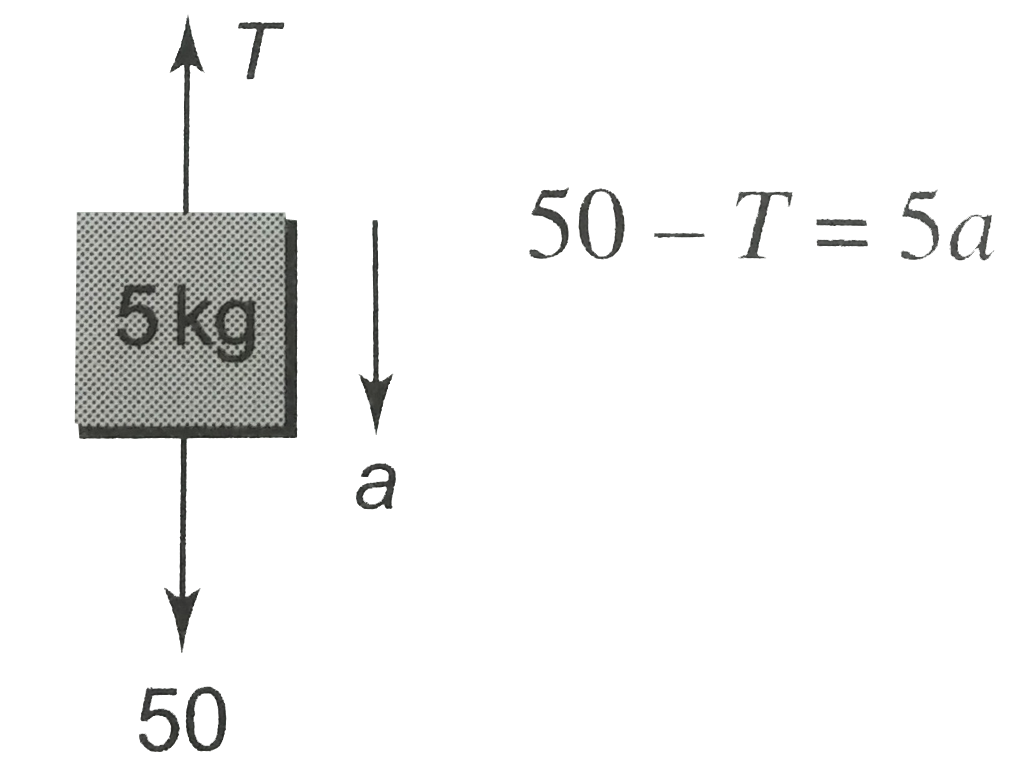
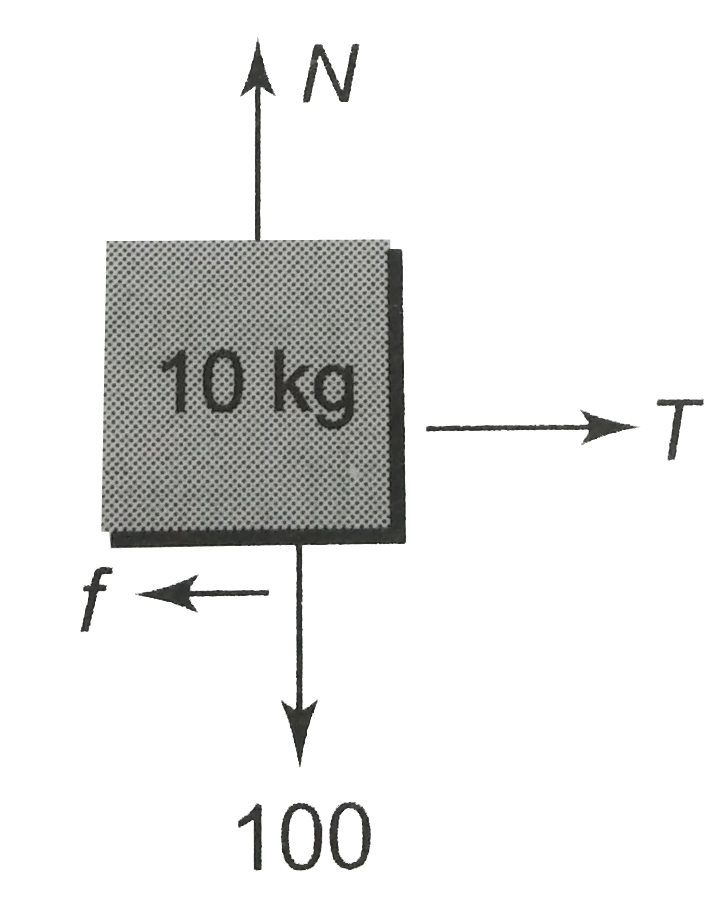
(a) `50 - T = 5a` (i)
`uarr : N - 100 = 0 rArr N = 100`
`f = mu N = 0.6 xx 100 = 60 N`
`T - f = 10 a`
`T - 60 = 10 a` (ii)
Solving `a = -(2)/(3) m//s^(2)` , but the acceleration cannot be negative . The blocks are at rest, `T = 50 N`.
In this problem , we committed a mistake , we applied the maximum value of friction force but friction is a self - adjusting force which varies from zero to a certain maximum value. Here the value of friction `50 N` is sufficient to prevent relative motion. When there is relative motion , friction is fully developed but when the blocks are at rest , friction or acceleration force `= 5g = 50 N` , opposing force (maximum value) `= 60 N`.
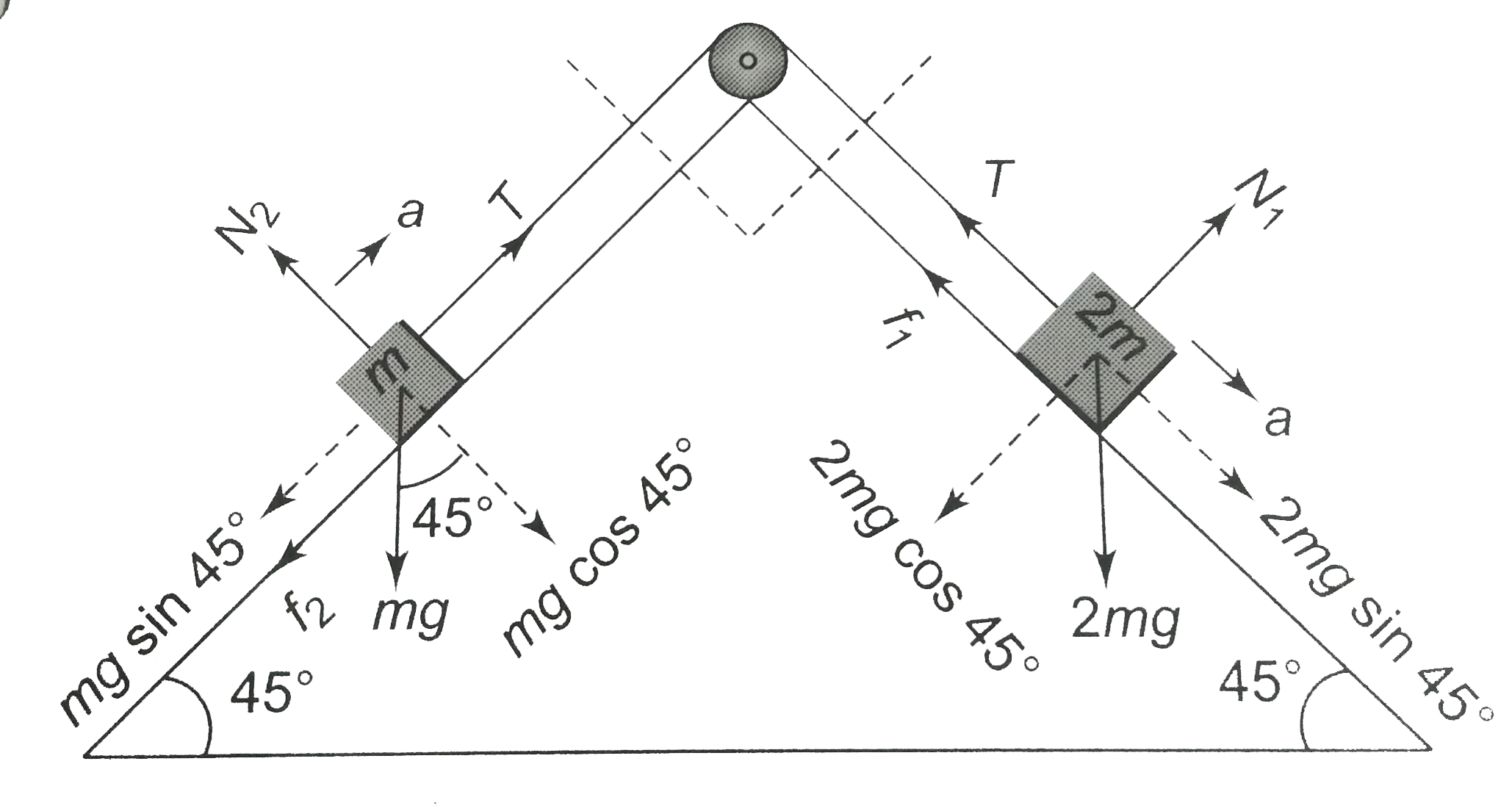
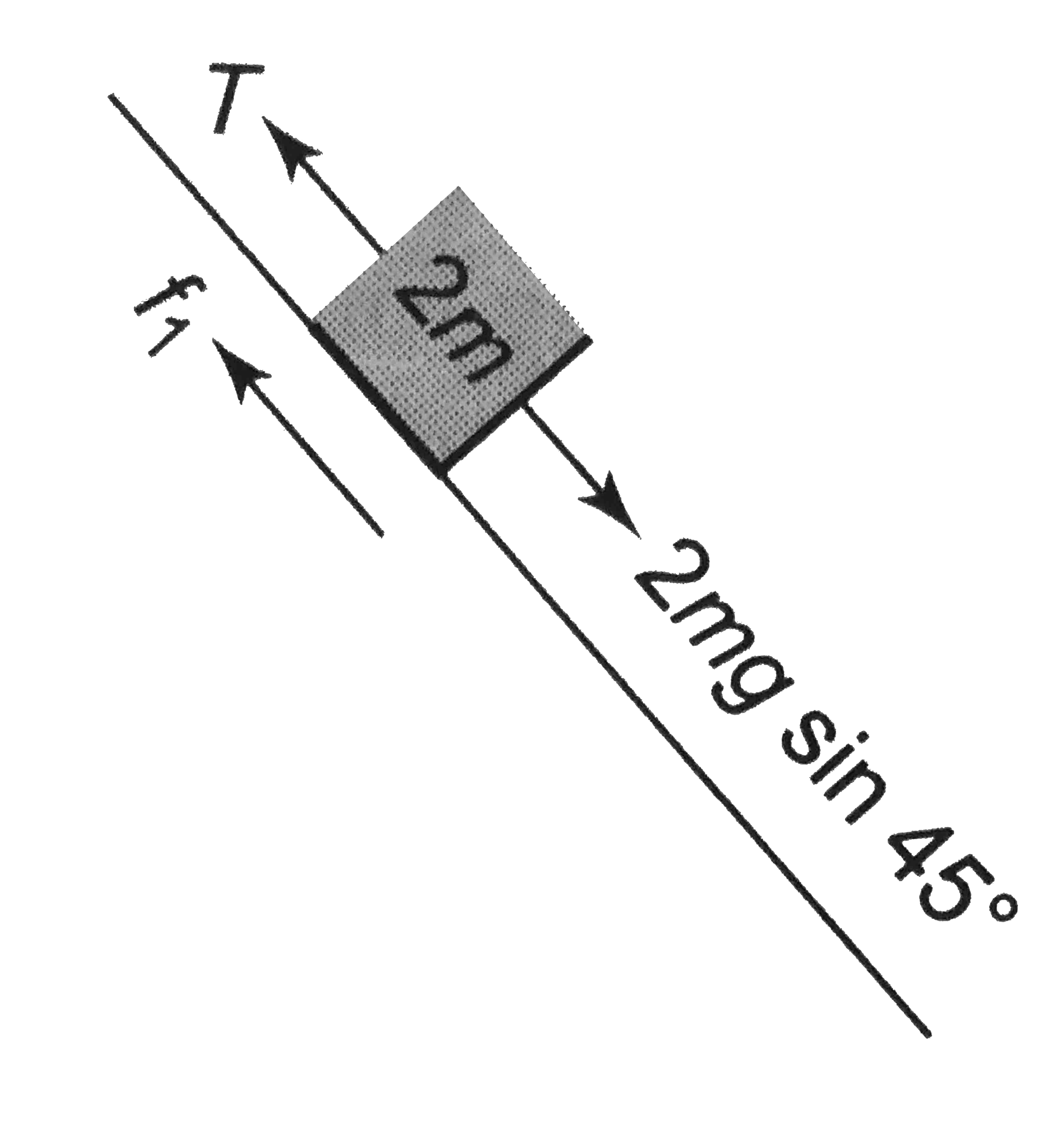
(b) For block of mass `2m`,
`N_(1) = 2mg cos 45^(@) = sqrt(2) mg`
`f_(1) = mu_(1) N_(1) = (sqrt(2))/(3) mg`
Along the plane : `2 mg sin 45^(@) - T - F_(1) = 2 ma`
`sqrt(2) mg - T - (sqrt(2))/(3) mg = 2 ma` (i)
For block of mass `m`:
`N_(2) = mg cos 45^(@) = (mg)/(sqrt(2))`.
`f_(2) = mu_(2) N_(2) = ( 2mg)/( 3 sqrt(2))`
Along the plane : `T - mg sin 45^(@) - f_(2) = ma`
`T - (mg)/(sqrt(2)) - (2mg)/(3 sqrt(2)) = ma` (ii)
Adding (i) and (ii) , we get
`3 ma = - (2mg)/(3 sqrt(2)) rArr a = -(g)/(9 sqrt(2)) = -ve`
Let the block of mass `m` move downward by solving , acceleration comes out to be `- ve` , i.e. system will not move , the blocks are at rest.
OR
Let the block of mass `2 m` moves downward , the force which tries to accelerate the system `= 2 mg sin 45^(@) - mg sin 45^(@) = (mg)/(sqrt(2))`.
Oppsing force `= f_(1) + f_(2) = ((sqrt(2))/(3) + (2)/(3 sqrt(2))) mg = (4 mg)/( 3sqrt(2))`
`(mg)/(sqrt(2)) lt ( 4mg)/(3 sqrt(2))` , so the system is at rest
Tension : Block of mass `2 m`
`2 mg sin 45^(@) = T + f_(1)`
`sqrt(2) mg = T + (sqrt(2))/(3) mg`
`T = (sqrt(2) - (sqrt(2))/(3))mg = ( 2sqrt(2) mg)/( 3)`
Block of mass `m`
`T = mg sin 45^(@) + f_(2) = (mg)/(sqrt(2)) + f_(2)`
`f_(2) = ((2 sqrt(2))/(3) - (1)/(sqrt(2))) = (mg)/(3 sqrt(2))`
The friction force is fully developed , where the friction coefficient is smaller , hence we have to use the block of `2 m` to find tension.


Promotional Banner

Topper's Solved these Questions

Similar Questions

Explore conceptually related problems

Find the common acceleration and tension in each string.

Find tension /tensions in the string/strings in the following cases:

Find the acceleration blocks in fig. The pulley and the string are massless.

Find out the acceleration of the blocks and tensions in the strings.

The tension in the string in the pulley system shown in .

In the arrangement shown, find the acceleration of each block, tension in the string and reaction in the pulley. The string and pulley are light (massless) (m_(1)gtm_(2)) . Neglect the friction in pulley.

The system shown in fig, is released from rest. Calculate the tension in the string and the force exerted by the string on the pulleys, assuming pulleys and strings are massless.

Figure shows a pulley of mass m and radius r with two blocks of masses m_(1) and m_(2) attached with a light and unstretchable string. Find the acceleration of the blocks, tensions in the string and the force exerted by the pulley on the celling from which it is hanging. Assume no slipping between the string and the wheel.

In the following problems, string is light, pulleys are smooth and massless. (a) find the acceleration of each block and tension in the string. (b) If tension in the string is 15 N and acceleration of each block is 1 m//s^(2) , find the value of friction coefficients mu_(1) and mu_(2).

CP SINGH-FRICTION-Exercises
  1. Find the acceleration and tension in the string in the following cases...

    Text Solution

    |

  2. Choose the correct option

    Text Solution

    |

  3. Consider a car moving on a straight road with a speed of 100m//s. The ...

    Text Solution

    |

  4. A car is moving along a stight horizontal road with a speed v(0) . If ...

    Text Solution

    |

  5. Two cars of unequal masses use similar tyres. If they are moving at th...

    Text Solution

    |

  6. An ice cube is kept on an inclined plane of angle 30^(@). The coeffici...

    Text Solution

    |

  7. Starting from rest , a body slides down at 45^(@) inclined plane in tw...

    Text Solution

    |

  8. A smooth block is released at rest on a 45^@ incline and then slides a...

    Text Solution

    |

  9. A block is released from the top of an inclined plane of inclination t...

    Text Solution

    |

  10. The upper half of an inclined plane of inclination 45^(@) is perfectly...

    Text Solution

    |

  11. A body is sliding down an inclined plane (mu = (1)/(2)). If the normal...

    Text Solution

    |

  12. A ball is thrown vertically with some velocity . A constant air resist...

    Text Solution

    |

  13. In an imaginary atmosphere, the air exerts a small force F on any part...

    Text Solution

    |

  14. Two objects A and B are thrown upward simultaneously with the same spe...

    Text Solution

    |

  15. A ball is thrown vertically upward with speed 10 m//s and it returns t...

    Text Solution

    |

  16. A particle is projected up a rough inclined plane of inclination theta...

    Text Solution

    |

  17. A particle is projected up a 37^(@) rough incline with velocity v(0). ...

    Text Solution

    |

  18. As shown in the figure , the friction force acting on the block is

    Text Solution

    |

  19. The friction force acting on the block at time t = 4 s will be

    Text Solution

    |

  20. A block of mass 2kg rests on a rough inclined plane making an angle of...

    Text Solution

    |

  21. Consider the situation as shown in the figure. Choose the correct opti...

    Text Solution

    |