Home
Class 11
PHYSICS
A cubical block of wood of edge 3 cm flo...

A cubical block of wood of edge 3 cm floats in water. The lower surface of the cube just touches the free end of a vertical spring fixed at the bottom of the pot. Find the maximum weight that can be put on the block without wetting it. Density of wood =`800 kgm^-3` and spring constant of the spring `=50Nm^-1 Take g=10ms^-2`.
,

Text Solution

Verified by Experts

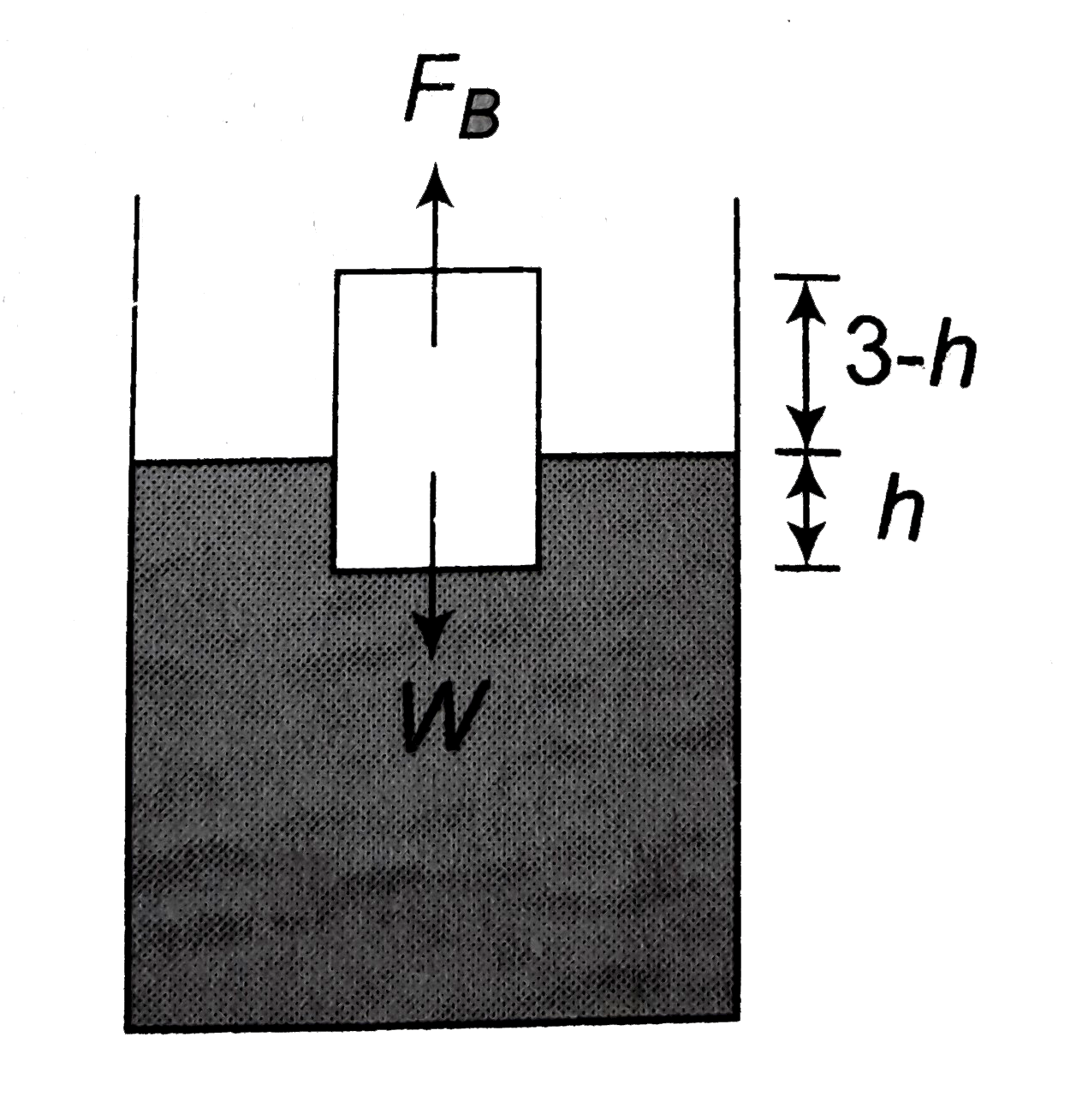
In case of floatation
`W = F_B`
`sigma Vg = rho_omega V'g`
`V` : volume of block
`V'` : immersed volume
`V' = (sigma)/(rho_omega) V = (800)/(1000) V = 0.8 V = 0.8 a^3`
Length of block inside water is `h`
`a^2 h = 0.8 a^3 rArr h = 0.8 a = 0.8 xx 3 = 2.4 cm`
Compressiond of spring `x = 3 -h= 0.6 cm`
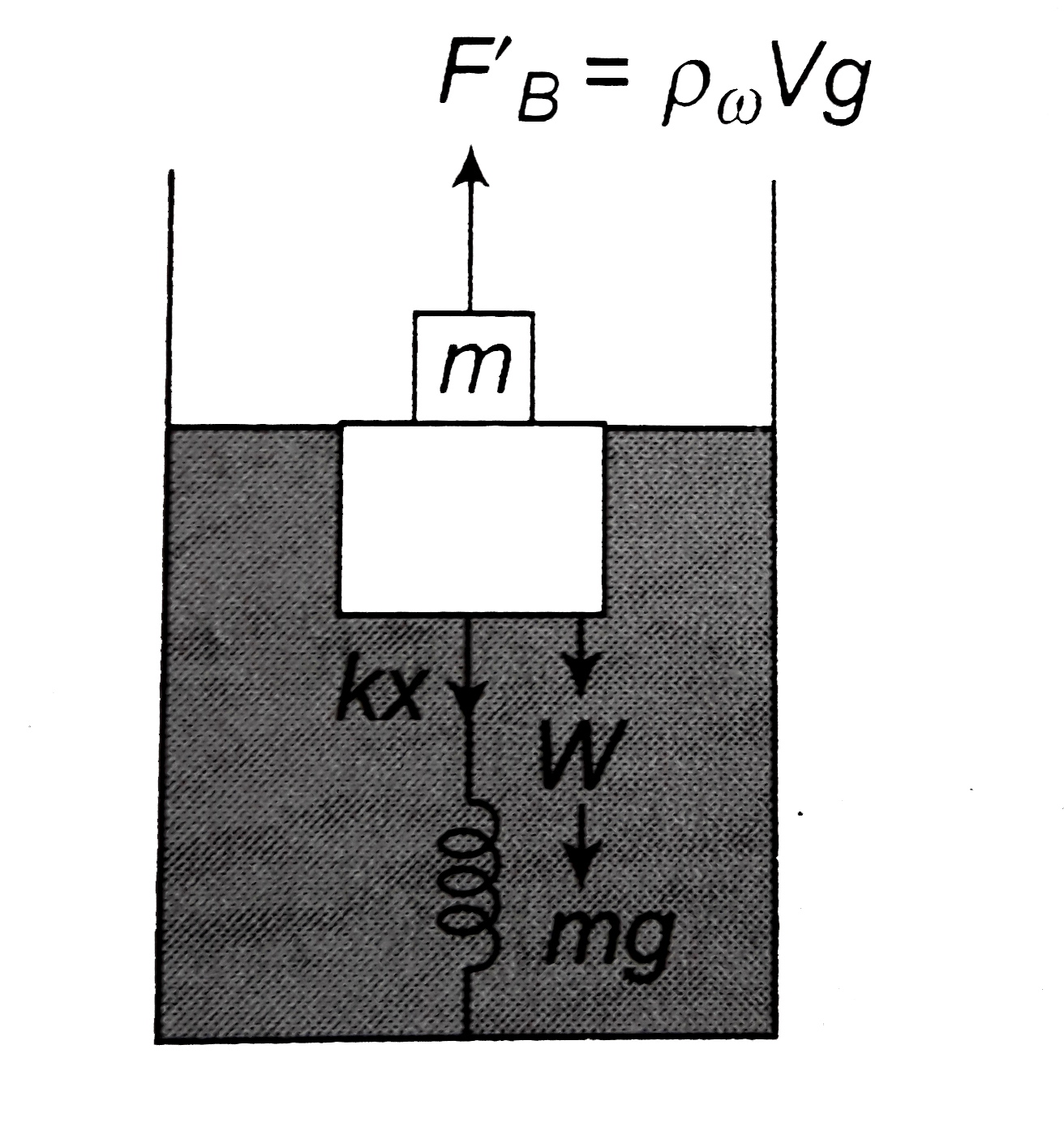
In equilibrium
`mg + W = F'_B + kx`
`mg + sigma Vg = rho_omega Vg + kx`
`mg = (rho_omega - sigma)Vg + kx`
=`(1000 - 800) (3 xx 10^-2) xx 10 + 50 xx 0.6 xx 10^-2`
=`2 xx 10^3 xx 27 xx 10^-6 + 30 xx 10^-2`
=`0.054 + 0.3`
=`0.35 N`.

.
Promotional Banner

Topper's Solved these Questions

Similar Questions

Explore conceptually related problems

A cubical block of wood of edge 3 cm floats in water. The lower surface of the cube just touches the free end of a vertical spring fixed at the bottom of the pot. Find the maximum weight that can be put on the block without wetting it. Density of wood =800kg//m^(3) and spring constant of the spring =50N//m . Take g=10m//s^(2)

A cubical block of wood of edge a and density rho floats in water of density 2rho . The lower surface of the cube just touches the free end of a mass less spring of force constant K fixed at the bottom of the vessel. The weight W put over the block so that it is completely immersed in water without wetting the weight is

A cubical block of side 0.5 m floats on water with 30% of its volume under water. What is the maximum weight that can be put on the block without fully submerging it under water? [Take, density of water = 10^(3) kg//m^(3) ]

A spring is attached to a wooden cubical block of edge 5cm and placed in a water conatiner as shown in figure. Calculate the maximum weight to be placed on the block so that it is just immersed in water completely. Density of wood =700"kg/m"^(3) , spring constant of spring =70N//m, g=10m//s^(2) . Assume that initially spring is in its normal length.

A cubical block 'A' of mass m_(0)(=a^(3)rho=3 kg) of edge 'a' and density rho floats in a liquid of density 3rho . The lower surface of the cube just touches the free end of massless spring of spring of spring constant k(=a^(2)rho g) fixed at the bottom of the vessel. Another block 'B' of mass 'm' is lept over block 'A', so that is completely immersed in liquid without wetting the block 'B'. Then find the value of m in kg.

A cubical block of wood of side 5 cm is placed on a table. Find the thrust by the block wood on the table, if density of wood is 5g cm^(-3) and g is 10 ms^(-2) .

From the fixed pulley, masses 2 kg, 1 kg and 3 kg are suspended as shown is figure. Find the extension in the spring when acceleration of 3 kg and 1 kg is same if spring constant of the spring k = 100 N/m. (Take g = 10 ms^(-2) )

A cubical block of wood 10 cm on a side, floats at the interface of oil and water as shown in figure. The density of oil is 0.6 g cm^(-3) and density of water is 1 g cm^(-3) . The mass of the block is

A cubical block of wood 10cm on a side floats at the interface between oil and water, as in fig. with its lower face 2 cm below the interface. The intensity of the oli is 0.6 g cm^(-3) . The mass of the block is

A cubical block of wood of length 5 cm is kept on a table top. The density of the block is 800 kg//m^3 and g = 9.8 m//s^2 . Find the pressure exerted by the wooden block on the table top.

CP SINGH-FLUID MECHANICS-Exercises
  1. A cubical block of wood of edge 3 cm floats in water. The lower surfac...

    Text Solution

    |

  2. In making an alloy, a substance of specific gravity s(1) and mass m(1)...

    Text Solution

    |

  3. A liquid can easily change its shape but a solid can not because

    Text Solution

    |

  4. Consider the equations P=Lim(/\srarr0)F/(/\S) and P1-P2=rhogz In a...

    Text Solution

    |

  5. The three vessels shown in figure have same base area. Equal volumes o...

    Text Solution

    |

  6. Equal mass of three liquids are kept in three identical cuylindrical v...

    Text Solution

    |

  7. Figure shows a siphon. The liquid shown in water. The pressure differe...

    Text Solution

    |

  8. A beaker containing a liquid is kept inside a big closed jar. If the a...

    Text Solution

    |

  9. If pressure at half the depth of a lake is equal to 2//3 pressure at t...

    Text Solution

    |

  10. A vertical U tube of uniform cross section contains mercury in both o...

    Text Solution

    |

  11. In a hydraulic press the small cylinder has a diameter of 'd1' cm, whi...

    Text Solution

    |

  12. An inverted bell lying at the bottom of a lake 47.6 m deep has 50 cm^3...

    Text Solution

    |

  13. The height to which a cylindrical vessel be filled with a homogenous l...

    Text Solution

    |

  14. A triangular lamina of area A and height h is immersed in a liquid of ...

    Text Solution

    |

  15. By sucking a straw a student can reduce the pressure in his lungs to 7...

    Text Solution

    |

  16. Two communicating vessels contain mercury. The diameter of one vessel ...

    Text Solution

    |

  17. Suppose the pressure at the surface of mercury in as barometer tube is...

    Text Solution

    |

  18. To construct a barometer, a tube of length 1m is filled completely wit...

    Text Solution

    |

  19. The vessel shown in the figure has a two sections of areas of cross-se...

    Text Solution

    |

  20. A beaker containing a liquid of density rho moves up with an accelerat...

    Text Solution

    |

  21. The pressure in a liquid at two points in the same horizontal plane ar...

    Text Solution

    |