Home
Class 11
PHYSICS
Two identical blocks A and B, each of ma...


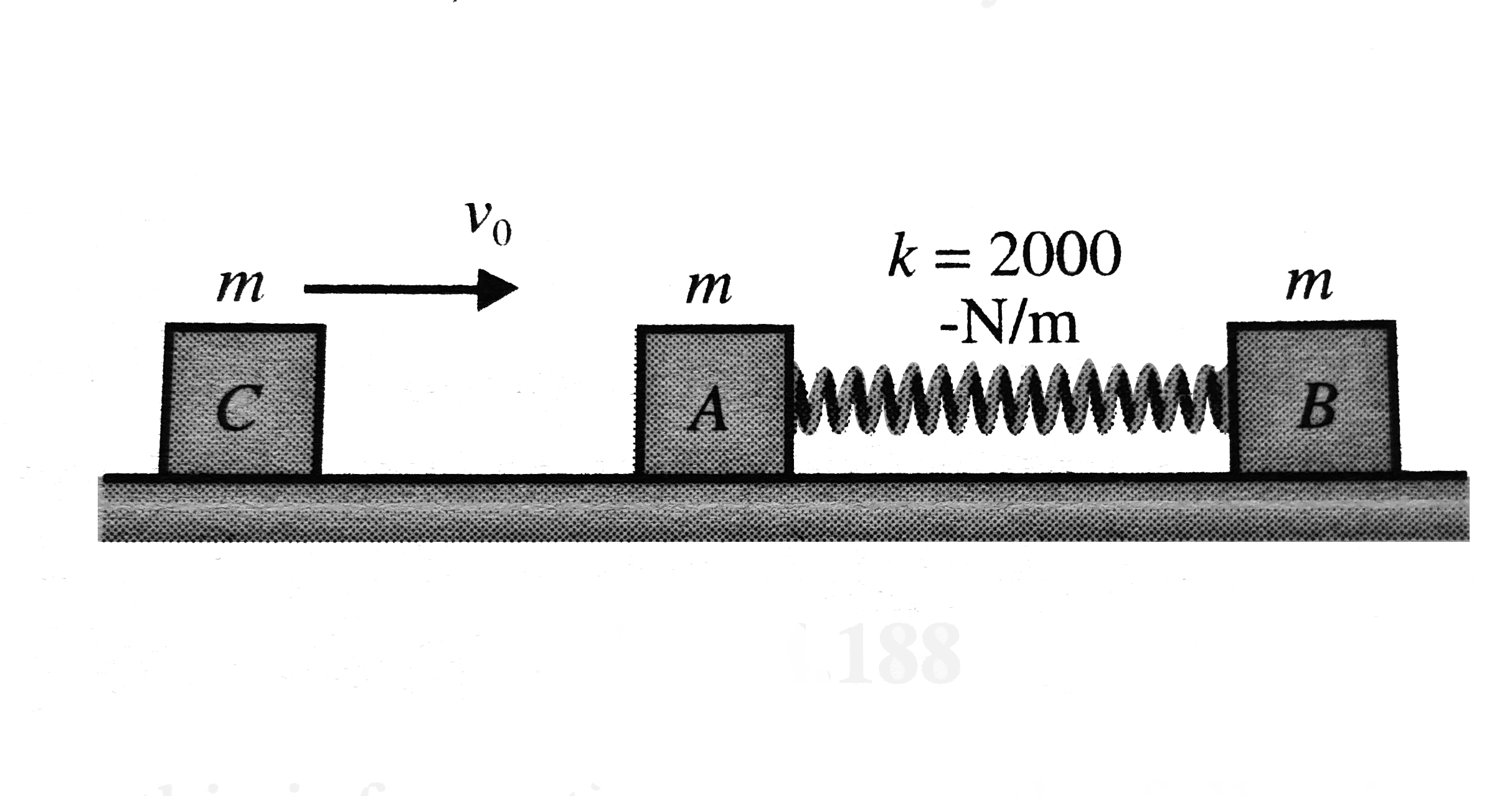
Two identical blocks A and B, each of mass `m=3kg`, are connected with the help of an ideal spring and placed on a smooth horizontal surface as shown in Fig. Another identical blocks C moving velocity `v_0=0.6(m)/(s)` collides with A and sticks to it, as a result, the motion of system takes place in some way
Based on this information answer the following questions:
Q. After the collision of C and A, the combined body and block B would


A

oscillate about centre of mass of sysetm and centre of mass is a rest.

B

oscillate about centre of mass of sysetm and centre of mass of moving

C

oscillate but about different locations other than the centre of mass.

D

not oscillate

Text Solution

Verified by Experts

The correct Answer is:
B

`B` accelerates and combined mass decelerates. The centre of mass of the system continues to move rightward with constant speed. While both the blocks oscillate about centre of mass.
The velocity just after collision is: `v = (v_(0))/(2)` The velocity of centre of mass is:
`V_(c.m) = (m_(1)v_(1)+m_(2)v_(2))/(m_(1)+m_(2)), T = 2pi sqrt((mu)/(k))`: reduced mass concept:
Oscillation energy of the system is: `E = (1)/(2) (2m) v^(2)`
Translational kinetic energy of the centre of mass of the system `= (1)/(2) (3m) v_(cm)^(2)`
The remaining energy is oscillating between kinetic and potential energy during the motion of blocks: Oscillating energy `=` maximum elastic potential energy
Promotional Banner

Topper's Solved these Questions