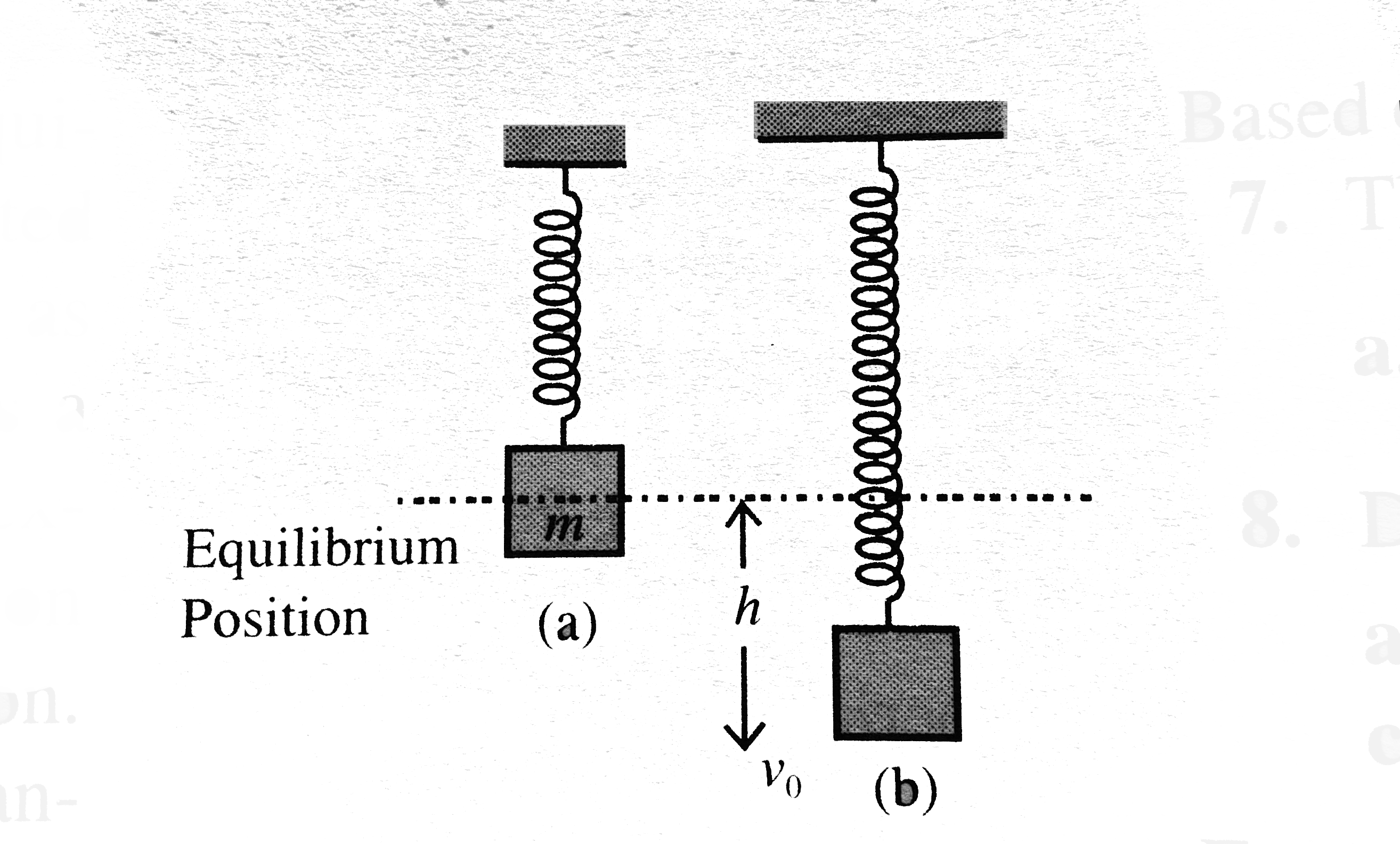
A block of mass m is connected to a spring constant k and is at rest in equilibrium as shown. Now, the block is Displacement by h below its equilibrium position and imparted a speed `v_0` towards down as shown in the Fig. As a result of the jerk, the block executes simple harmonic motion about its equilibrium position. Based on this information, answer the following question. Q. The amplitude of oscillation is
A
`h`
B
`sqrt((mv_(0)^(2))/(k)+h^(2))`
C
`sqrt((m)/(k))v_(0)+k`
D
None of theses
Text Solution
Verified by Experts
The correct Answer is:
B
The angular frequency of simple harmonic motion is given by, `omega = sqrt((k)/(m))` The velocity of block, when it at a displacement of `y`from mean position is given by, `v = omega sqrt(A^(2) -y^(2))` , where `A` is the amplitude of oscillation. For given initial condition, `v_(0) = sqrt((k)/(m)) sqrt(A^(2) - h^(2)) rArr A^(2) = (mv_(0)^(2))/(k) +h^(2)` `rArr A = sqrt((mv_(0)^(2))/(k)+h)`
Topper's Solved these Questions
OSCILLATIONS
NARAYNA|Exercise LEVEL-VI|1 Videos
OSCILLATIONS
NARAYNA|Exercise Passage-VI|1 Videos
OSCILLATIONS
NARAYNA|Exercise Passage-IV|2 Videos
NEWTONS LAWS OF MOTION
NARAYNA|Exercise PASSAGE TYPE QUESTION|6 Videos
PHYSICAL WORLD
NARAYNA|Exercise C.U.Q|10 Videos
Similar Questions
Explore conceptually related problems
A block of mass m is connected to a spring constant k and is at rest in equilibrium as shown. Now, the block is Displacement by h below its equilibrium position and imparted a speed v_0 towards down as shown in the Fig. As a result of the jerk, the block executes simple harmonic motion about its equilibrium position. Based on this information, answer the following question. Q. The equation for the simple harmonic motion is
A block of mass m is connected to a spring constant k and is at rest in equilibrium as shown. Now, the block is Displacement by h below its equilibrium position and imparted a speed v_0 towards down as shown in the Fig. As a result of the jerk, the block executes simple harmonic motion about its equilibrium position. Based on this information, answer the following question. Q. Find the time taken by the block to cross the mean position for the first time.
A block of mass m is suspened through a spring of spring constant k and is in equlibrium. A sharp blow gives the block an initial downward velocity v. How far below the equilibrium psitin, the block comes to an instantaneous rest?
A block of mass m is connected to a spring of spring constant k as shown in Fig. The block is found at its equilibrium position t=1s and it has a velocity of +0.25(m)/(s) at t=2s . The time period of oscillation is 6 s. Based on the given information answer the following question: Q. the amplitude of oscillation is
A block of mass m is connected to three springs as shown in Fig. The block is displaced down slightly and left free, it starts oscillating. Find time period of oscillations.
A block of mass m is connected with two ideal pullies and a massless spring of spring constant K as shown in figure. The block is slightly displaced from its equilibrium position. If the time period of oscillation is mupisqrt(m/K) . Then find the value of mu .
A block of mass m is suspended from one end of a light spring as shown. The origin O is considered at distance equal to natural length of the spring from the ceiling and vertical downwards direction as positive y-axis. When the system is in equilibrium a bullet of mass (m)/(3) moving in vertical up wards direction with velocity v_0 strikes the block and embeds into it. As a result, the block (with bullet embedded into it) moves up and start oscillating. Based on the given information, answer the following question: Q. The amplitude of oscillation would be
A block of mass m hangs from a vertical spring of spring constant k. If it is displaced from its equilibrium position, find the time period of oscillations.
A block of mass m length force a verical of spring constant k If the block is polled down by a distance of 2mg//k from its equilibrium position and released for the subsequent in the spring to maximum compressed in it mg//k
A block of mass m is attached to two unstretched springs of spring constant k , each as shown. The block is displaced towards right through a distance x and is released The speed of the block as it passes through the mean position will be