Home
Class 11
PHYSICS
A particle 'P' is moving on a circular u...

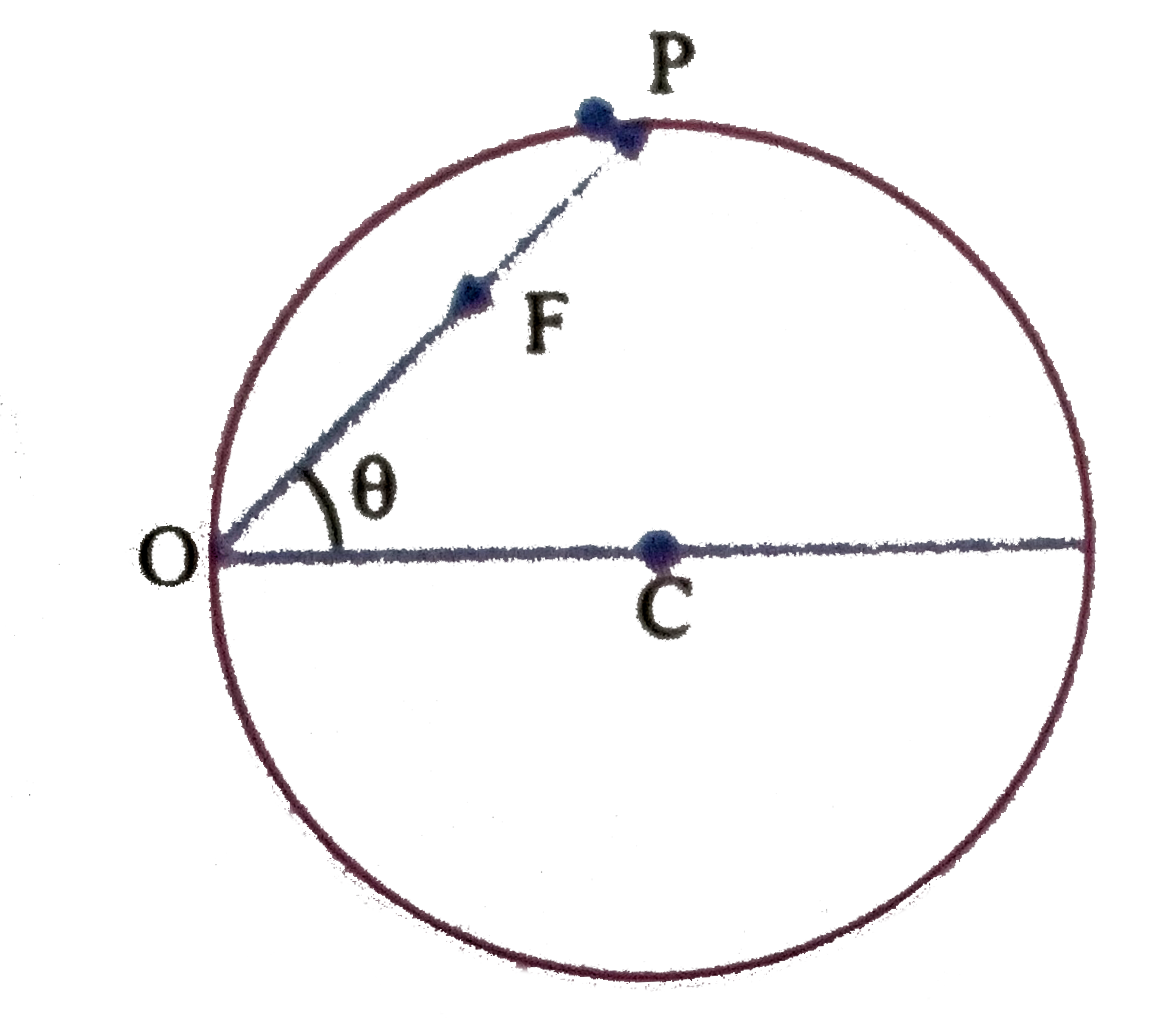
A particle `'P'` is moving on a circular under the action of only one force action always toward the fixed point `'O'` on the circumference. Find the ratio of `(d^(2)theta)/(dt^(2))` & `(("d"theta)/(dt))^(2)`

A

`2 tan theta`

B

`tan theta`

C

`(tan theta)/2`

D

`(tan theta)/3`

Text Solution

Verified by Experts

The correct Answer is:
A

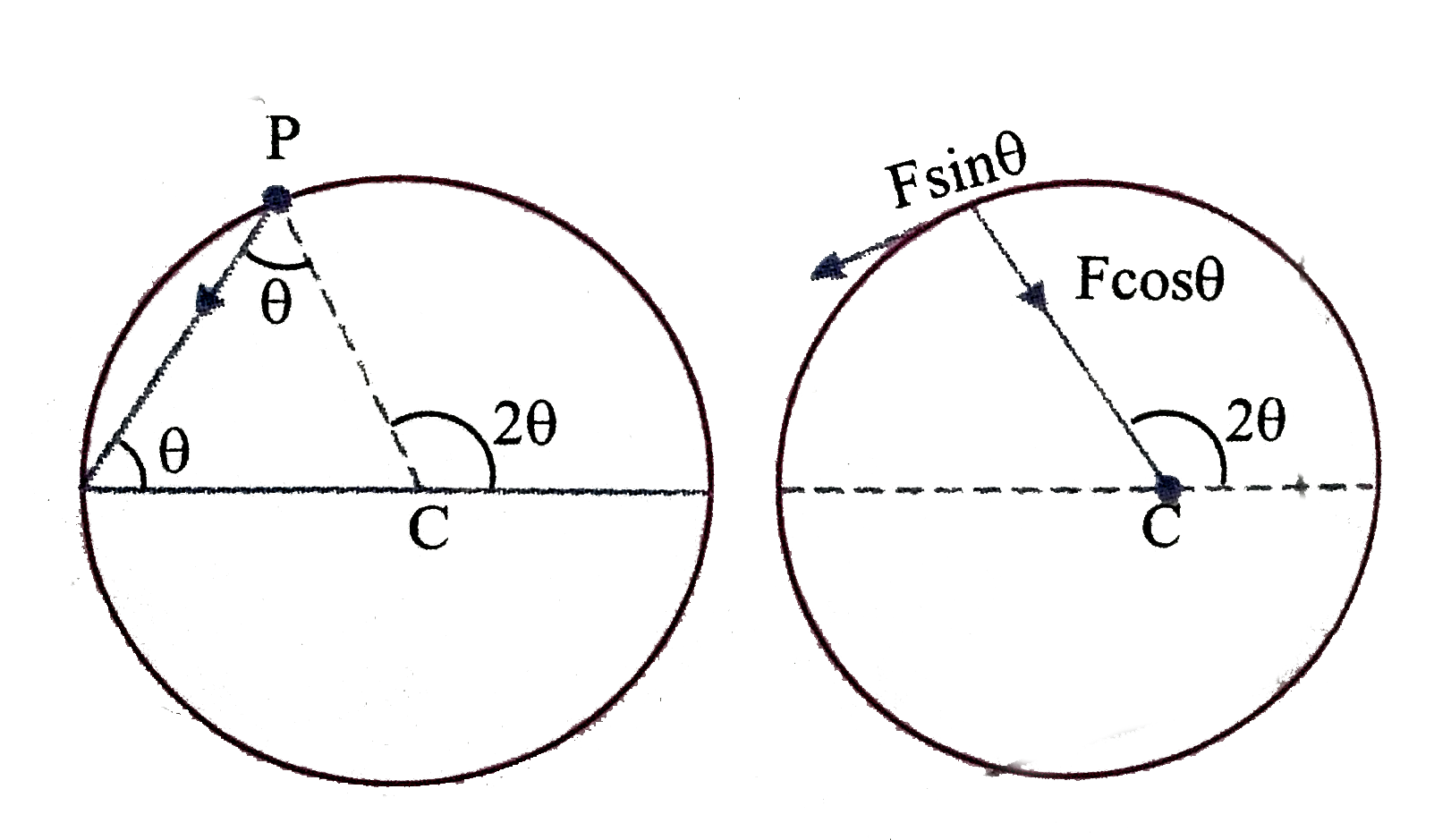
`F cos theta=mRomega^(2) , F sin theta=ma_(t)`
Angular velocity `'omega'` of line joining `'P'` and `'C'` is
`omega =d/(dt)(2theta)=2(d theta)/(dt),:.(d theta)/(dt)=omega/2`
Tangential acceleration of particle about `'d'`
`a_(t)=(F sin theta)/m=Ralpha rArralpha=(F sin theta)/(mR)`
But `alpha=(domega)/(dt)=d/(dt)(2(d theta)/(dt))=2(d^(2) theta)/(dt^(2))`
`rArr (d^(2)theta)/(dt^(2))=alpha/2`, Hence `(d^(2)theta)/(dt^(2))=(F sin theta)/(2mR)`
`((d theta)/(dt^(2)))^(2)=1/4omega^(2)=1/4xx(Fos theta)/(mR)`
On solving `(d^(2)theta//dt^(2))/(((d theta)/(dt))^(2))`
Promotional Banner

Topper's Solved these Questions

  • CIRCULAR MOTION

    NARAYNA|Exercise LEVEL I(H.W)|43 Videos
  • CIRCULAR MOTION

    NARAYNA|Exercise LEVEL II(H.W)|51 Videos
  • CIRCULAR MOTION

    NARAYNA|Exercise LEVEL-VI Integer|7 Videos
  • CALORIMETRY

    NARAYNA|Exercise Level- II (H.W)|11 Videos
  • COLLISION

    NARAYNA|Exercise Level-II (H.W)|54 Videos

Similar Questions

Explore conceptually related problems

A particle is moving in a circular path of radius a under the action of an attractive potential U=-(k)/(2r^(2)) . Its total energy is :

A particle is moving in a circular path of radius 1 m. under the action of a centripetal force, the speed sqrt2pi ms^(-1) of the particle is constant. Find the average of the velocity ("in" ms^(-1)) between A and B.

A particle is moving with a constant speed in a circular path. Find the ratio of average velocity to its instantaneous velocity when the particle rotates an angle theta =((pi)/(2)) .

A particle moves from point P(1,2,3) to (2,1,4) under the action of a constant force F=(2hati+hatj+hatk)N . Work done by the force is

If x^2=t^2+! then find (d^2x)/(dt^2)

A particle of mass m moves from A to C under the action of force vecF = 2xyhati + y^2 hatj , along different paths as shown in figure.

Find (d (sin ^ (2) theta * cos theta)) / (d theta)

It x=sin^(2)theta , then find (dx)/(dt) where (d theta)/dt)=omega

