Home
Class 11
PHYSICS
Two blocks A and B, each of mass m, are ...

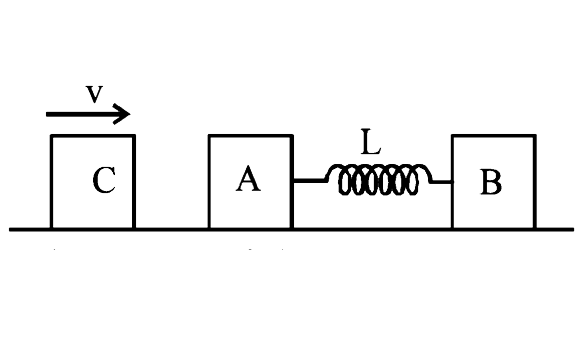
Two blocks A and B, each of mass m, are connected by a masslesss spring of natural length L and spring constant K. The blocks are initially resting on a smooth horizontal floor with the spring at its natural length, as shown in fig. A third identical block C, also of mass m, moves on the floor with a speed v along the line joining A and B, and collides elastically with A. Then

A

the kinetic energy of the `A-B` system, at maximum compression of the spring, is zero

B

the kinetic energy of the `A-B` system, at maximum compression of the spring, is `(m v^(2))/(4)`

C

the maximum compression of the spring is `v sqrt(((m)/(K)))`

D

the maximum compression of the spring is `vsqrt((m)/(2K))`

Text Solution

Verified by Experts

The correct Answer is:

B, D

After collision between `C` and `A, C` stops while `A` moves with speed of `C` i.e., `v` [in head on elastic collision, two equal masses exchange their velocities]. At maximum compression, `A` and `B` will move with same speed `(v)/(2)` (From conservation of linear momentum).

Let `x` be the maximum compression in this position.
`KE` of `A-B` system at maximum compression
`= (1)/(2) (2m) ((v)/(2))^(2)` or `K_("max") = (m v^(2))/(4)`
From conservation of mechanical energy in two position shown in figure.
or `(1)/(2)m v^(2) = (1)/(4) m v^(2) + (1)/(2) Kx^(2)`
`(1)/(2)Kx^(2) = (1)/(4)m v^(2), x = v sqrt((m)/(2K))`
Promotional Banner

Topper's Solved these Questions

  • COLLISION

    NARAYNA|Exercise Comprehension type|35 Videos
  • COLLISION

    NARAYNA|Exercise Subjective type Questions|9 Videos
  • COLLISION

    NARAYNA|Exercise INTEGER TYPE QUESTIONS|8 Videos
  • CIRCULAR MOTION

    NARAYNA|Exercise LEVEL II(H.W)|51 Videos
  • FRICTION

    NARAYNA|Exercise Passage type of questions I|6 Videos

Similar Questions

Explore conceptually related problems

Two blocks A and H . each of mass m , are connected by a massless spring of natural length I . and spring constant K . The blocks are initially resting in a smooth horizontal floor with the spring at its natural length, as shown in Fig. A third identical block C , also of mass m , moves on the floor with a speed v along the line joining A and B . and collides elastically with A . Then

Two blocks A and B of masses m and 2m are connected by a massless spring of natural length L and spring constant k . The blocks are intially resting on a smooth horizontal floor with the spring at its natural length , as shown . A third identical block C of mass m moves on the floor with a speed v_(0) along the line joining A and B and collides elastically with A . FInd (a) the velocity of c.m. of system (block A + B + spri ng) and (b) the minimum compression of spring.

Two blocks A and B each of mass m are connected by a light spring of natural length L and spring constant k. The blocks are initially resting on a smooth horizontal floor with the spring at its natural length, as shown. A third identical block C, also of mass m, moves on the floor with a speed v along the line joining A to B and collides with A. Collision is elastic and head on. Then -

Two blocks A and B each of mass m are connected by a massless spring of natural length L and spring constant k. The blocks are initially resting on a smooth horizontal floor with the spring at its natural length. A third identical block C also of mass m moves on the floor with a speed v along the line joining A and B and collides with A. Then The kinetic energy of the A-B system at maximum compression of the spring is mv^(2)//4 The maximum compression of the spring vsqrt(m//3k) The kinetic energy of the A-B system at maximum compression The maximum coppression of the spring is vsqrt(m//k)

Two identical blocks A and B , each of mass m resting on smooth floor are connected by a light spring of natural length L and spring constant k , with the spring at its natural length. A third identical block C (mass m ) moving with a speed v along the line joining A and B collides with A . The maximum compression in the spring is

Two identical blocks A and B each of mass m resting on the smooth horizontal floor are connected by a light spring of natural length L and spring constant K. A third block Cof mass m moving with a speed v along the line joining A and B collides with A. The maximum compression in the spring is

A block of mass m is connected to another block of mass M by a massless spring of spring constant k . the blocks are kept of a smooth horizontal plane and are at rest. The spring is unstretched when a constant force F starts acting on the block of mass M of pull it. Find the maximum extension of the spring

Two blocks of mass m_(1) and m_(2) are connected with a spring of natural length l and spring constant k. The system is lying on a smooth horizontal surface. Initially spring is compressed by x_(0) as shown in figure. Show that the two blocks will perform SHM about their equilibrium position. Also (a) find the time period, (b) find amplitude of each block and (c) length of spring as a function of time.

