Home
Class 11
PHYSICS
A particle (A) of mass m(1) elastically ...

A particle `(A)` of mass `m_(1)` elastically collides with another stationary particle `(B)` of mass `m_(2)`. Then :

A

`(m_(1))/(m_(2)) = (1)/(2)` and the particles fly a part in the opposite direction with equal velocities.

B

`(m_(1))/(m_(2)) = (1)/(3)` and the particles fly apart in the opposite direction with equal velocities.

C

`(m_(1))/(m_(2)) = (2)/(1)` and the collision angle between the particles is `60^(@)` symmetrically.

D

`(m_(1))/(m_(2)) = (2)/(1)` and the particles fly apart symmetrically at an angle `90^(@)`

Text Solution

Verified by Experts

The correct Answer is:
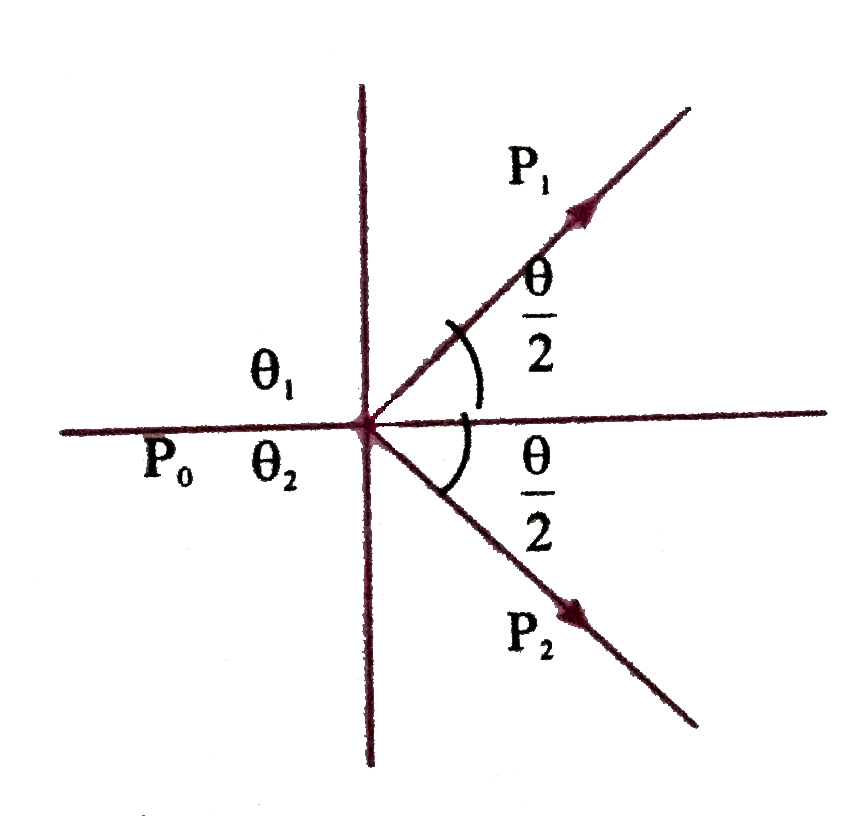
B, C

`m_(1)u + 0 = -m_(1)v+m_(2)v` ……….(1)
From kinetic energy conservation
`(1)/(2)m_(1)u^(2) = (1)/(2)m_(1)v^(2) + (1)/(2)m_(2)v^(2)` ………..(2)

From eq. (1) and and eq. (2) we get , `(m_(1))/(m_(2)) = (1)/(3)`
So, choice (b) is correct.
`P^(2) = P_(1)^(2) + P_(2)^(2) +2P_(1)P_(2) cos theta` .........(1)
Also from conservation of kinetic energy
`(P^(2))/(2m_(1)) = (P_(1)^(2))/(2m_(1)) + (P_(2)^(2))/(2m_(2))` ............(2)
Since particles fly symmetrically
`P_(1) sin "(theta)/(2) = P_(2) sin "(theta)/(2)` ..........(3)
Solving eq. (1), (2) and (3) we get
`(m_(1))/(m_(2)) = (2)/(1)`
Promotional Banner

Topper's Solved these Questions

  • COLLISION

    NARAYNA|Exercise Comprehension type|35 Videos
  • COLLISION

    NARAYNA|Exercise Subjective type Questions|9 Videos
  • COLLISION

    NARAYNA|Exercise INTEGER TYPE QUESTIONS|8 Videos
  • CIRCULAR MOTION

    NARAYNA|Exercise LEVEL II(H.W)|51 Videos
  • FRICTION

    NARAYNA|Exercise Passage type of questions I|6 Videos

Similar Questions

Explore conceptually related problems

A particle of mass m_(1) makes an elastic, one-dimensional collision with a stationary particle of mass m_(2) .What fraction of the kinetic energy of m_(1) is carried away by m_(2) ?

A particle of mass m_(1) makes an elastic one dimensional collision with a stationary particle of mass m_(2) .What fraction of the kinetic energy of m_(1) is carried away by m_(2) ?

A particle of mass m_(1) experiences a perfectlly elastic collision with a stationary particle of mass m_(2) . Match the entires in column I to all the entires in column II .

A ball of mass m_(1) makes an elastic , one-dimensional collision with a stationary particle of mass m_(2) . The fraction of the kinetic energy of m_(1) transferred to m_(2) is

A particle of mass m_1 collides elastically with a stationary particle of mass m_2(m_1gtm_2) . Find the maximum angle through which the striking particle may deviate as a result of the collision.

A particle of mass m_1 experienced a perfectly elastic collision with a stationary particle of mass m_2 . What fraction of the kinetic energy does the striking particle lose, if (a) it recoils at right angles to its original motion direction, (b) the collision is a head-on one?

A particle of mass m_(1) collides head on with a stationary particles of mass m_(2) . If (m_(1))/(m_(2)) gte, where e is the coefficient of restitution, then :

A particle of mass m_1 makes a head on elastic collision with another stationary body of mass m_2 , If m_1 rebounds with half of its original speed then (m_1 /m_2) is

A particle of mass m, collides with another stationary particle of mass M. If the particle m stops just after collision, then the coefficient of restitution for collision is equal to

A particle of mass m collides with another stationary particle of mass M such that the second particle starts moving and the first particle stops just after the collision. Then which of the following conditions must always be valid ?

