Home
Class 11
PHYSICS
A body of mass m moving with a velocity ...

A body of mass `m` moving with a velocity `v` in the `x` direction collides with another body of mass `M` moving in `y` direction with a velocity `V`. They coalesce into one body during collision.

A

The magnitude of momentum of the composition body `[(m v)^(2) + (MV)^(2)]^(1//2)`

B

The fraction of initial `K.E.` transformed into heat is `= ((mM)/(m+M))((v^(2)+V^(2))/(mv^(2)+MV^(2)))`

C

Decrease in kinetic energy is `(mM)/(2(m+M))(v^(2)+V^(2))`

D

None of these

Text Solution

Verified by Experts

The correct Answer is:
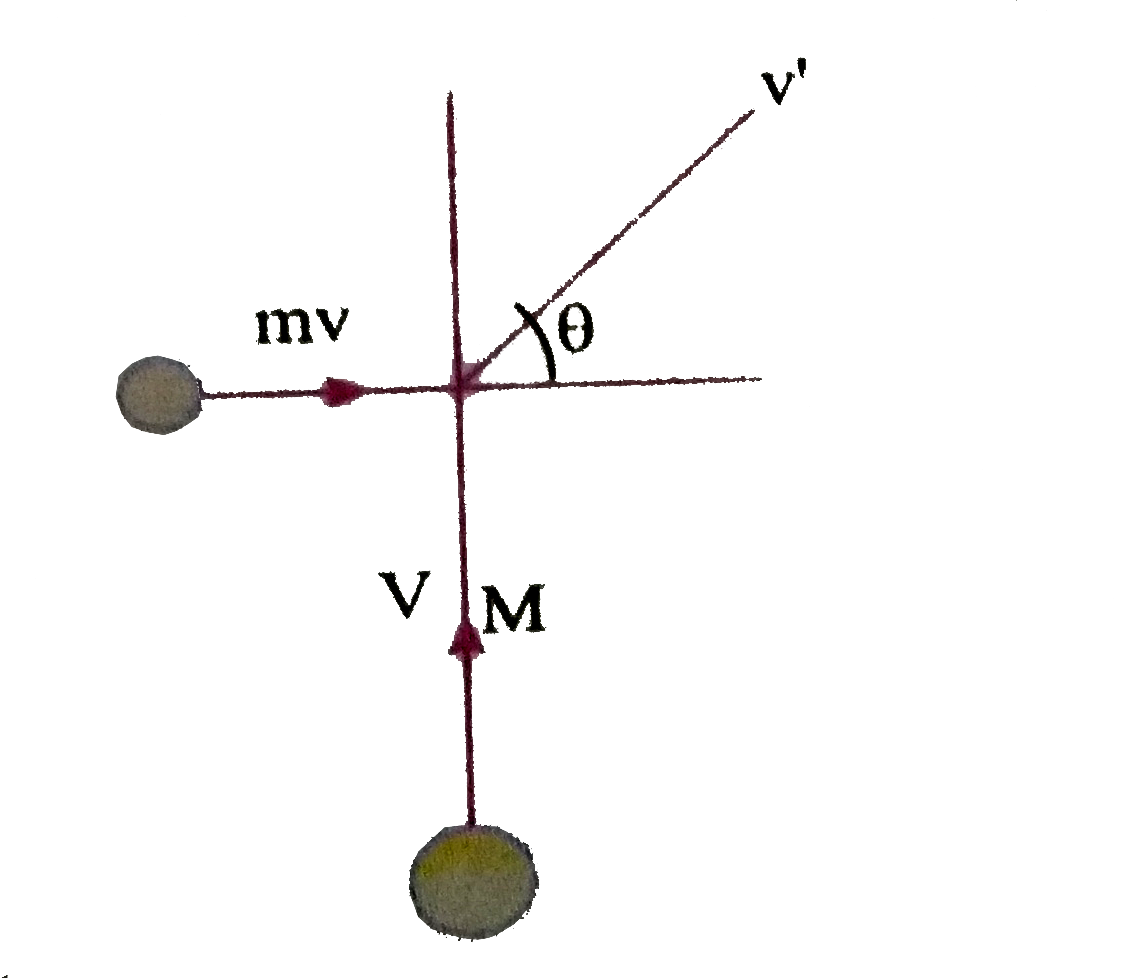
A, B, C


(a) `mv = (M+m)V' cos theta`
(b) `Mv = (m+M)V' sin theta`
`(m + M)V' = sqrt((mv)^(2) + (MV)^(2))`
(b) Initial kinetic is , `k_(l) = 1/2 mv^(2) + 1/2 MV^(2)`
Final K.E. is `k_(f) = 1/2 (m + M) v'^(2)`
Decrease in K.E. `= k_(1) - k_(f) , Deltak = (mM)/(2(m+M)) (v^(2) + V^(2))`
Fraction of initial kinetic transformed into heat is
`(Deltak)/(k_(l)) = (mM)/(m+M) ((v^(2) + V^(2))/(mv^(2) + MV^(2)))`
Promotional Banner

Topper's Solved these Questions

  • COLLISION

    NARAYNA|Exercise Comprehension type|35 Videos
  • COLLISION

    NARAYNA|Exercise Subjective type Questions|9 Videos
  • COLLISION

    NARAYNA|Exercise INTEGER TYPE QUESTIONS|8 Videos
  • CIRCULAR MOTION

    NARAYNA|Exercise LEVEL II(H.W)|51 Videos
  • FRICTION

    NARAYNA|Exercise Passage type of questions I|6 Videos

Similar Questions

Explore conceptually related problems

A body of mass m moving with velocity V in the X-direction collides with another body of mass M moving in Y-direction with velocity v. They coalesce into one body during collision. Calculate : (i) the direction and magnitude of the momentum of the final body. (ii) the fraction of initial kinetic energy transformed into heat during the collision in terms of the two masses.

A body of mass 2kg moving with a velocity of 3m/sec towards left collides head-on with a body of mass 3kg moving in opposite direction with a velocity 2m/sec. After collision the two bodies stick together and move with a common velocity which is :

A body of mass 2 kg moving with a velocity of 3 m/sec collides head on with a body of mass 1 kg moving in opposite direction with a velocity of 4 m/sec. After collision, two bodies stick together and move with a common velocity which in m/sec is equal to

A body of mass 3 kg moving with a velocity of 4 m//s towards left collides head on with a body of mass 4 kg moving in opposite direction with a velocity of 3 m//s . After collision the two bodies stick together and move with a common velocity which is

A body of mass M moves with velocity v and collides elasticity with another body of mass m(M gt gt m) at rest , then the velocity of the body of mass m is

A body of mass 0.1 kg travelling with a velocity of 5 m/s, collides head-on with another body of mass 0.2 kg travelling in the same direction with a velocity of 1.2 m/s. If the two bodies stick together after collision, their common velocity is

A ball of mass M moving with a velocity v collides perfectly inelastically with another ball of same mass but moving with a velocity v in the opposite direction. After collision

