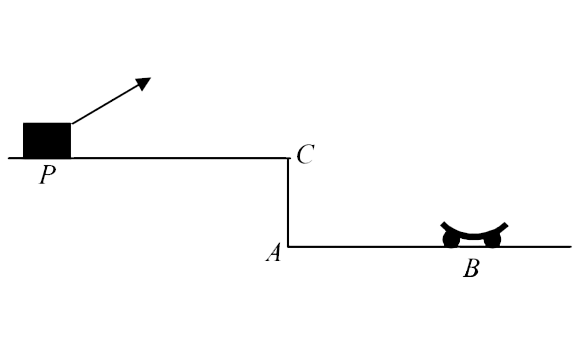
(i) `100 m//s` velocity of the ball is relative to ground. [Unless and untill it is mentioned in the question, the velocity is always relative to ground.

`a_(x) = 0` and `a_(y) = -g = -10 m//s^(2)`
Horizontal component of its velocity,
`u_(x) = u cos 30^(@)` , or `u_(x) = (100)(sqrt(3))/(2)m//s = 50sqrt(3)m//s` and vertical component of its velocity,
`u = u sin 30^(@) , u_(y) = 100(1)/(2)m//s = 50m//s`
vertical displacement of the ball when it strikes the carriage is `-120 m` or `S_(y) = u_(y)t + (1)/(2)a_(y)t^(2)`
`rArr -120 = (50t) + ((1)/(2))(-10)t^(2)`
`rArr t^(2)-10t -24 = 0 rArr t = 12s` or `-2s`
Ignoring the negative time, we have `t_(0) = 12s`
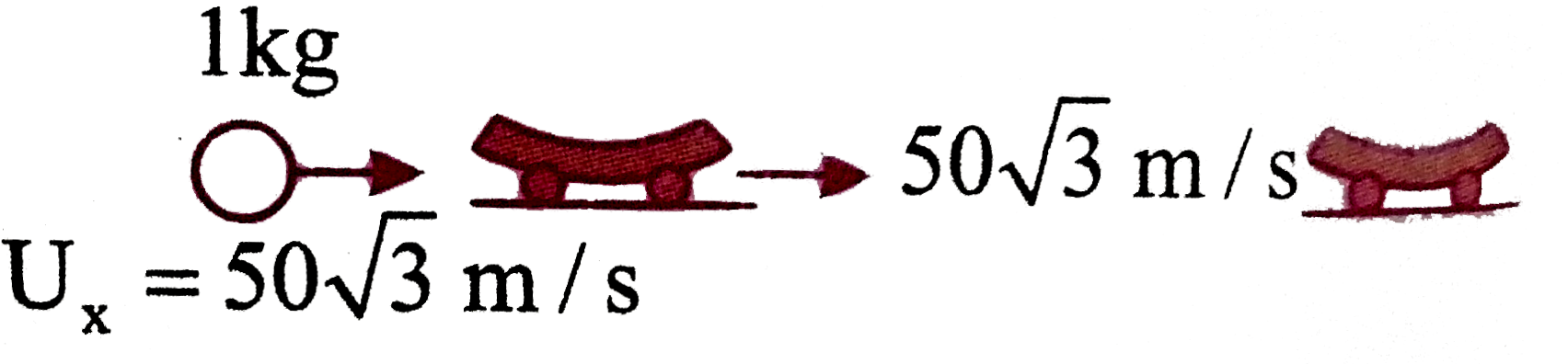
(ii) When it strikes the carriage, its horizontal component of velocity is still `50sqrt(3) m//s`. It strikes to the carriage. Let `V_(2)` be the velocity of (carriage `+` ball) system after collision.
Then, applying conservation of linear momentum in horizontal direction.
(mass of ball) (horizontal component of its velocity before collision)`=` (mass of ball`+`carriage)`(V_(2))`
`therefore (1 kg) (50 sqrt(3) m//s) = (10 kg)(V_(2)) :. V_(2) = 5sqrt(3)m//s`
The second ball is fired when the first ball strikes the carriage i.e., after `12s`. In these `12s` the car will move forward a distance of `12V`, or `60sqrt(3) m`.
The second ball also takes `12s` to travel a vertical displacement of `-120m`. This ball will strike the carriage only when the carriage also covers the same distance of `60sqrt(3) m` in these `12s`. This is possible only when resistive force are zero because velocity of car `(V_(1)) =` Velocity of carriage after first collision `(V_(2)) = 5sqrt(2)m//s`. Hence, at the time of second collision : Horizontal component of velocity of ball `= 50 sqrt(3) m//s`. and horizontal velocity of carriage `+` first ball `= 5sqrt(3) m//s` Let `V` be the desired velocity of carriage after second collision. Then conservation of linear momentum in horizontal direction gives

`U_(x) = 50sqrt(3)m//s`
Before collision
`11V = (1)(50sqrt(3))+(10)(5sqrt(3)) = 100sqrt(3)`
`therefore V = (100sqrt(3))/(11)m//s` to `V = 15.75 m//s`