Home
Class 12
PHYSICS
Assume that the nuclear binding energy p...

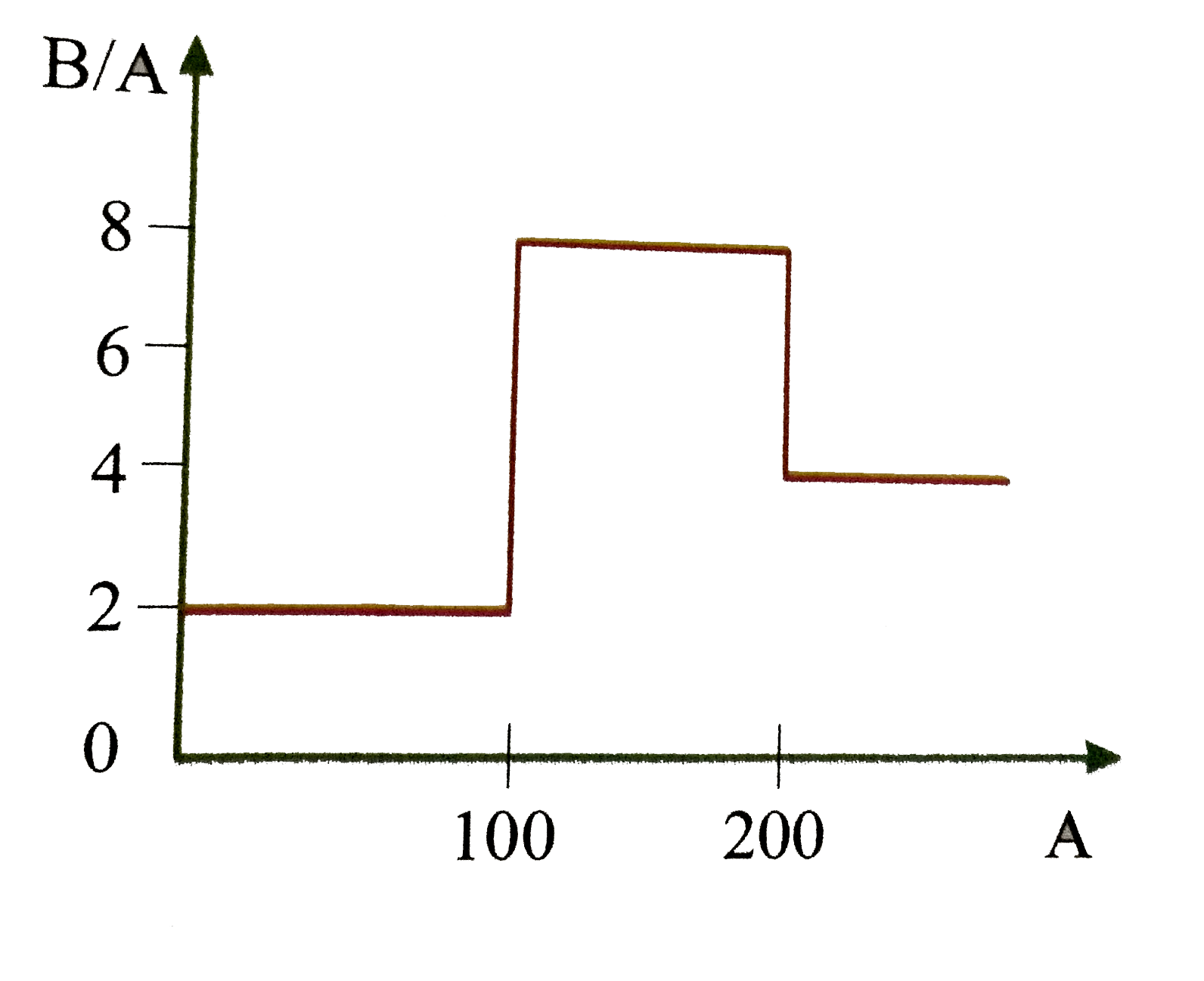
Assume that the nuclear binding energy per uncleon `(B//A)` versus mass number `(A)` is as shwon in Fig. Use this plot to choose the correct choice `(s)` given below:

A

Fusion of two nuclei with mass number lying is the range of `1 lt A lt 50` will release energy

B

Fusion of two nuclei with mass number lying in the range of `51 lt A lt 100` will release energy

C

Fission of a nucleus lying in the mass range of `100 lt A lt 200` will release energy when broken into equal fragments.

D

Fission of a nucleus lying in the mass range of `200 lt A lt 260` will release energy when broken into equal fragments.

Text Solution

Verified by Experts

The correct Answer is:

B, D

In fussion two or more lighter nuclei combined to make a comparatively heavier nucleus. In fission a heavy nucleus breaks into two or more lighter nuclei. Further energy will be released in nucleus process if total binding energy increases. Hence B,D are correct
Promotional Banner

Topper's Solved these Questions

  • NUCLEAR PHYSICS

    NARAYNA|Exercise NCERT Based question|72 Videos
  • NUCLEAR PHYSICS

    NARAYNA|Exercise Previous JEE questions|21 Videos
  • NUCLEAR PHYSICS

    NARAYNA|Exercise Level-V questions(Single answer type questions)|12 Videos
  • MOVING CHARGES AND MAGNETISM

    NARAYNA|Exercise EXERCISE - 4|20 Videos
  • NUCLEI

    NARAYNA|Exercise ASSERTION & REASON|5 Videos

Similar Questions

Explore conceptually related problems

Assume that the nuclear binding energy per nucleon (B//A) versus mass number (A) is as shown in figure. Use this plot to choose the correct choice(s) given below. (a) Fusion of two nuclei with mass numbers, lying in the range of 1ltAlt50 will release energy. Fusion of two nuclei with mass numbers lying in the range of 51ltAlt100 will release energy. (c) Fission of a nucleus lying in the mass range of 100ltAlt200 will release energy when broken into two equal fragements. (d) Fission of a nucleus lying in the mass range of 200ltAlt260 will release energy when broken into two equal fragments.

Assume that the nuclear binding energy per nucleon (B/A) versus mass number (A) is as shown in the figure. Use this plot to choose the correct choice(s) given below. Figure

Assume that the nucles binding energy per nucleus (B//A) versus mass number (A) is as shown in the figure Use this plate to choose the energy the correct (s) given below

The dependence of binding energy per nucleon, B_(N) on the mass number, A, is represented by

Binding energy per nucleon plot against the mass number for stable nuclei is show in the figure. Which curve is correct ?

The dependence of binding energy per nucleon, B_N on the mass number, A is represented by. (a) , (b) , ( c) , (d) .

(a) Explain the processes of nuclear fission and nuclear fusion by using the plot of binding energy per nucleon (BE/A) versus the mass number A. (b) A radioactive isotope has a hald -life of 10 years. How long will it take for the activity to reduce to 3.125%.

NARAYNA-NUCLEAR PHYSICS-Level-V Multiple answer questions
  1. Choose the correct options

    Text Solution

    |

  2. A nuclide A undergoes alpha-decay and another nuclides B undergoes bet...

    Text Solution

    |

  3. Assume that the nuclear binding energy per uncleon (B//A) versus mass ...

    Text Solution

    |

  4. From the following equation pick out the possible nuclear fusion react...

    Text Solution

    |

  5. Many unstable nuclie can decay spontaneously to a nucleus of lower mas...

    Text Solution

    |

  6. Many unstable nuclie can decay spontaneously to a nucleus of lower mas...

    Text Solution

    |

  7. Many unstable nuclie can decay spontaneously to a nucleus of lower mas...

    Text Solution

    |

  8. We have two radioactive nuclei A and B. Both convert into a stable nuc...

    Text Solution

    |

  9. We have two radioactive nuclei A and B. Both convert into a stable nuc...

    Text Solution

    |

  10. We have two radioactive nuclei A and B. Both convert into a stable nuc...

    Text Solution

    |

  11. The mass of nucleus .(z)X^(A) is less than the sum of the masses of (A...

    Text Solution

    |

  12. The mass of nucleus .(z)X^(A) is less than the sum of the masses of (A...

    Text Solution

    |

  13. 4xx10^23tritium atoms are contained in a vessel. The half-life of deca...

    Text Solution

    |

  14. 4xx10^23tritium atoms are contained in a vessel. The half-life of deca...

    Text Solution

    |

  15. 4xx10^23tritium atoms are contained in a vessel. The half-life of deca...

    Text Solution

    |

  16. Consider radioactive decay of A to B with which further decays either ...

    Text Solution

    |

  17. Consider radioactive decay of A to B with which further decays either ...

    Text Solution

    |

  18. Consider radioactive decay of A to B with which further decays either ...

    Text Solution

    |

  19. Nuclei of a radioactive element X are being produced at a constant rat...

    Text Solution

    |

  20. Nuclei of a radioactive element X are being produced at a constant rat...

    Text Solution

    |
