Home
Class 12
PHYSICS
The measurement of an unknown resistance...

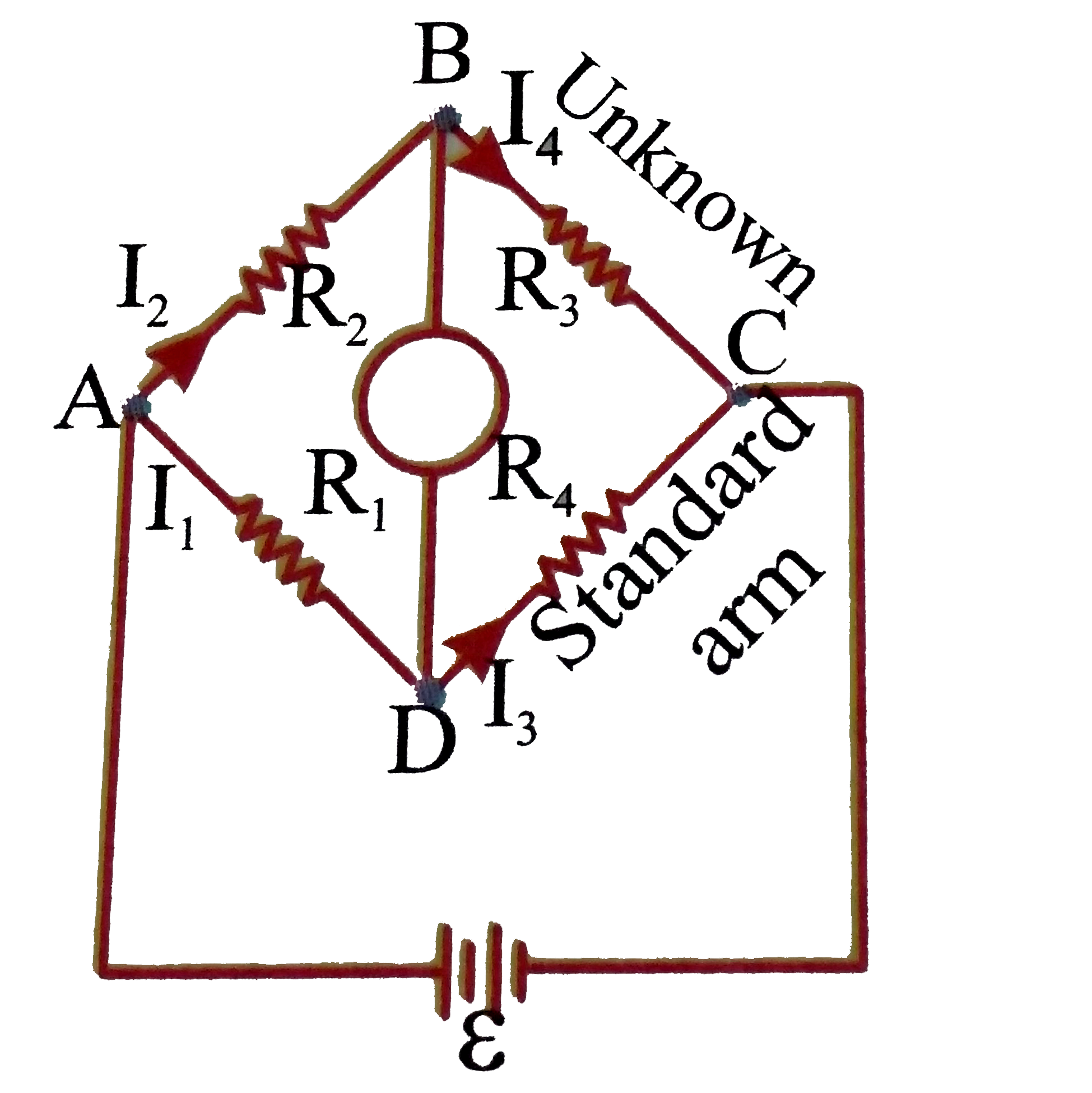
The measurement of an unknown resistance R is to be carried out using Wheatstone bridge (see Fig. 2(EP).3). Two students perform an experiment in two way. The first student takes `R_(2)=10 Omega` and `R_(1)=5Omega`. The other student takes `R_(2)=1000Omega` and `R_(1)=500Omega`. In the standard arm, both take `R_(3)=5Omega`. Both find `R=(R_(2))/(R_(1))R_(3)=10Omega` within errors.

A

The errors of measurement of the two students are the same

B

Errors of measurement do depend on the accuracy with which `R_(2)` and `R_(1)` can be measured

C

if the student uses large values of `R_(2)` and `R_(1)` the currents through the arms will be feeble. This will make determination of null point accurately more difficult

D

Wheatstone bridge is a very accurate instrument and has no errors of measurement

Text Solution

Verified by Experts


Given for first student
`R_(2)=10Omega,R_(1)=5Omega,R_(3)=5Omega`
for second student `R_(1)=500Omega,R_(3)=5Omega`
Now, according to wheatstone bridge rule,
`(R_(2))/(R)=(R_(1))/(R_(3))impliesR=R_(3)xx(R_(2))/(R_(1))`
Now putting all the values inn Eq. (i) we get `R=10Omega` for both student. thus, we can analyse that the wheatstone bridge is most sensitive and accurate if resistance are of same value. thus, the errors of measurement of the two studets depend on te accuracy and sensitivity of the bridge which inturn depends on the accuracy with which `R_(2)` and `R_(1)` can be measured.
When `R_(2)` and `R_(1)` are larger,t he currents though the arms of bridge is very weak. This can make the determination of null point accurately more difficult.
Promotional Banner

Topper's Solved these Questions

  • CURRENT ELECTRICITY

    NARAYNA|Exercise Level 5|42 Videos
  • CURRENT ELECTRICITY

    NARAYNA|Exercise Level 6|43 Videos
  • CURRENT ELECTRICITY

    NARAYNA|Exercise Level 3|46 Videos
  • COMMUNICATION SYSTEM

    NARAYNA|Exercise Level-II(H.W)|25 Videos
  • DUAL NATURE OF RADIATION AND MATTER

    NARAYNA|Exercise ASSERTION AND REASON|15 Videos

Similar Questions

Explore conceptually related problems

Find the current through the resistance R in Fig if R =10 Omega and R=20Omega .

In the given circuit, R_(1) = 10Omega R_(2) = 6Omega and E = 10V, then correct statement is

In the circuit shown in figure Current through R_(2) is zero if R_(4) = 2 Omega and R_(3) = 4 Omega In this case

In Fig. 27-43, the current in resistance 6 is i_(6)= 2.80 A the resistances are R_(1)=R_(2)=R_(3)=2.00 Omega, R_(4)=16.0 Omega, R_(5)=8.00 Omega and R_(6)=4.00 Omega . Wat is the emf of the ideal battery?

In the circuit shown below E_(1) = 4.0 V, R_(1) = 2 Omega, E_(2) = 6.0 V, R_(2) = 4 Omega and R_(3) = 2 Omega . The current I_(1) is

In the given circuit values are as follows epsi=2V,epsi_(2)=4V,R_(1)=1Omega and R_(2)=R_(3)=1Omega . Calculate the current through R_(1),R_(2) and R_(3)

The potential difference in volt across the resistance R_(3) in the circuit shown in figure, is (R_(1)=15Omega,R_(2)=15Omega, R_(3)=30Omega, R_(4)=35Omega)

Find the currents in the Y connection of 3 resistances R_(1) = 10Omega , R_(2)=20Omega and R_(3)= 30 Omega . When the terminals of R_(1) , R_(3) and R_(3) are maintained at potentials V_(1) = 10V, V_(2) =6V and V_(3) = 15V.

In the circuit shown in Fig. the emf of the sources is equal to xi = 5.0 V and the resistances are equal to R_(1) = 4.0 Omega and R_(2) = 6.0 Omega . The internal resistance of the source equals R = 1.10 Omega . Find the currents flowing through the resistances R_(1) and R_(2) .

In the given figure, E=12V, R_(1)=3Omega, R_(2)=2Omega" and "r=1Omega . The choose the correct option/s